Wind Load Calculator: Gable Roof Envelope Procedure

Click For Summary

Discussion Overview

The discussion centers around the development of a wind load calculator specifically for gable roofs, focusing on the Envelope Procedure. Participants explore various aspects of wind load calculations, including the impact of roof overhangs, shear wall reactions, and pressure distributions for different roof types. The conversation includes technical details and considerations for future enhancements to the calculator.

Discussion Character

  • Technical explanation
  • Exploratory
  • Debate/contested

Main Points Raised

  • One participant notes the complexity introduced by roof overhangs in wind load calculations and outlines a to-do list for the calculator's development.
  • Another participant discusses the contribution of wind forces on walls to lateral forces on the roof diaphragm, suggesting that forces on overhang edges may be insignificant.
  • A participant mentions the completion of shear wall reactions, questioning the utility of the assumption that only exterior walls act as shear walls and proposing the addition of options for internal shear wall specifications.
  • There is a mention of the ability to calculate truss/rafter uplift and horizontal load, with one participant reflecting on the accuracy of their calculations compared to a truss manufacturer's output.
  • One participant shares their estimates for pressure distributions for various roof types using the Envelope Procedure, indicating a need for more complex calculations for hip roofs compared to gable roofs.

Areas of Agreement / Disagreement

Participants express differing views on the significance of wind forces on overhangs and the assumptions regarding shear walls. The discussion remains unresolved regarding the best approach to incorporate internal shear walls and the complexity of calculations for different roof types.

Contextual Notes

Participants acknowledge limitations in their assumptions, particularly regarding the role of internal shear walls and the complexity of pressure calculations for various roof configurations.

medeek
Messages
46
Reaction score
6
I've recently started working on a wind load calculator.

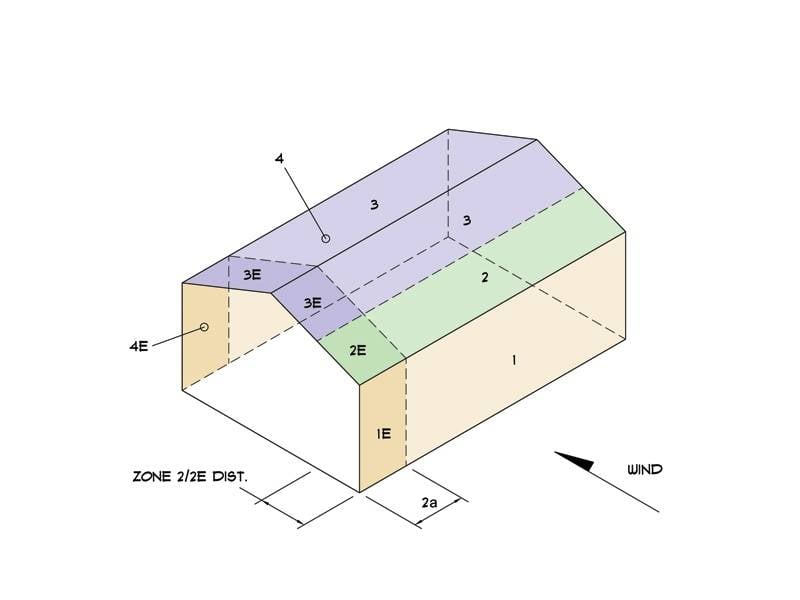
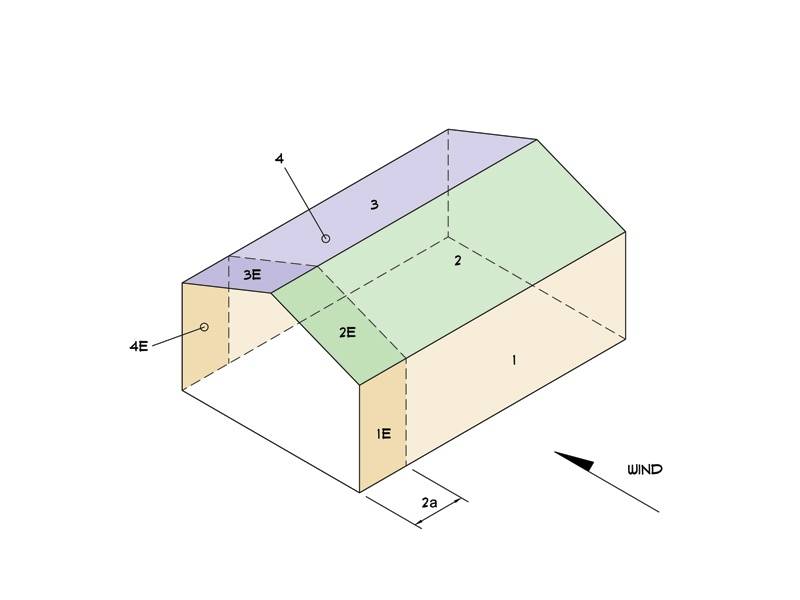
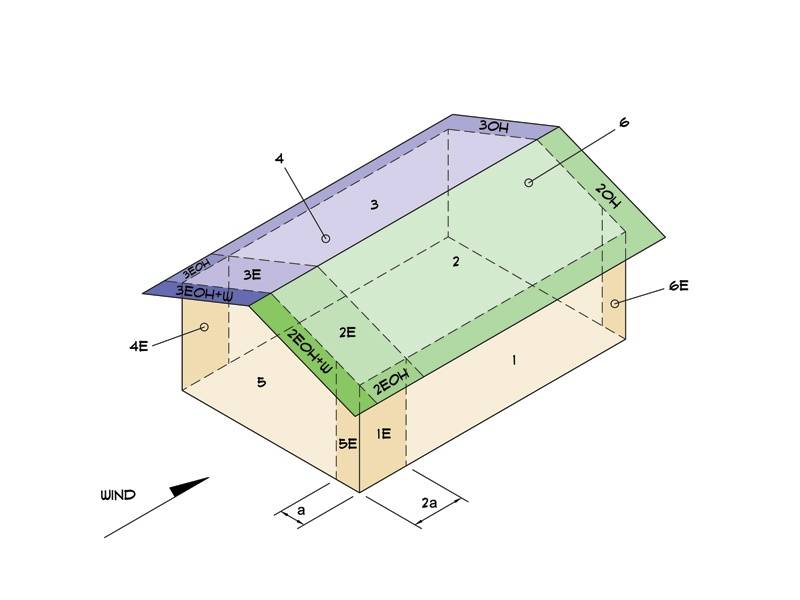
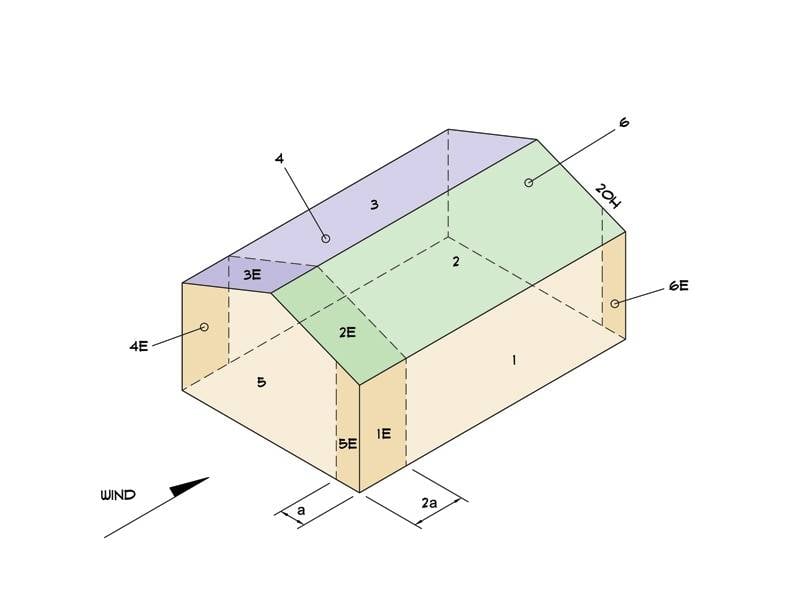
Notice the complexity when overhangs are added to the roof. These load diagrams show the Envelope Procedure for a Gable Roof:

Load Case A:
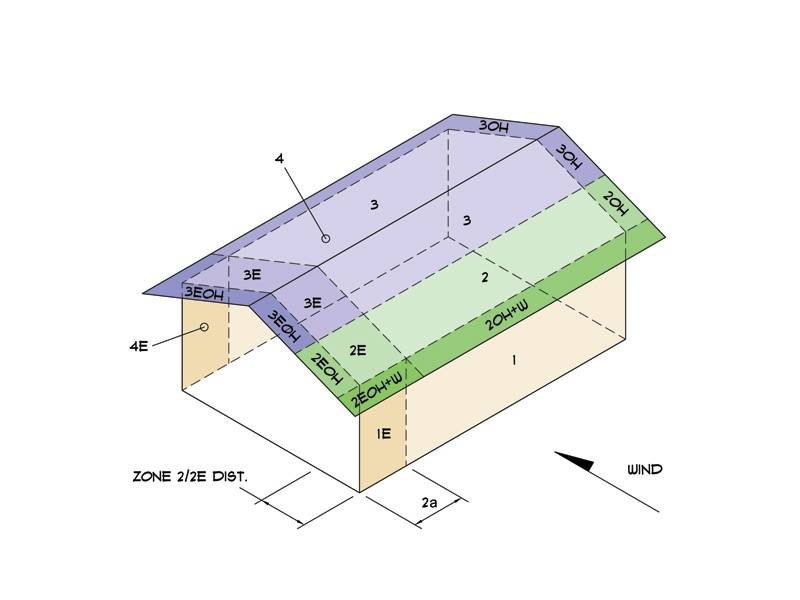
GB_A1A_800.jpg


GB_A1B_800.jpg


GB_A2A_800.jpg


GB_A2B_800.jpg


Load Case B:

GB_B1_800.jpg


GB_B2_800.jpg


If torsional load cases are required then another Load Case A and B are required for the torsional load case.

Give the gable roof option a whirl, all of the other options are not programmed yet and I may never add them pending further research as to how well I can extrapolate the Envelope Procedure to these configurations.

If there are no overhangs set the overhang values to zero, I will need to add in a footnote about that later just to clarify.

Not a finished product yet, not by a long shot. The current Todo list includes the following:

To Do List:

1) Calculate min. lateral load with roof forces neglected and min. pressures of 8 psf and 16 psf on roof and walls respectively. (psf)
2) Calculate max. uplift and max. horizontal reactions of trusses or rafters assuming 24" o/c and 16" o/c for design of hurricane ties (lbs).
3) Calculate base wind shear in transverse and longitudinal direction (lbs).
4) Calculate shear wall reactions (lbs) and unit shear (plf) assuming only external shear walls (4 walls).
5) Calculate roof diaphragm distributed load (plf) assuming one story building with external shear walls only.
6) Include C & C wind loads for component design.
7) Include Directional Procedure as a comparison to Envelope Procedure or setup separate calculator for this method.
8 ) Complete PDF report output.

http://design.medeek.com/resources/wind/wind_calculator.pl
 
Engineering news on Phys.org
Interesting to note that for a gable roof only the wind forces on the walls contribute any lateral forces to the roof diaphragm and then to the shear walls for the longitudinal direction (wind parallel to ridge).

The breakdown of the forces would then be:

Transverse:

GB_LOADS_A1A_1024.jpg


Longitudinal:

GB_LOADS_B1_1024.jpg


One could argue that there is a certain amount of wind force on the edge of overhangs but I'm thinking its insignificant.
 
Shearwall reactions are now complete, assuming of course that only the exterior walls are acting as shear walls. This assumption is pretty useless for building with dimensions exceeding a certain limit since they will probably involve steel moment frames or multiple internal shear walls. I'm wondering if it might be useful to add some sort of advanced option which let's one specify an internal shearwall spacing or even a internal shearwall layout. The programming would get pretty complex.

I also added the ability to calculate truss/rafter uplift and horizontal load. Not entirely sure how useful this is either but I've personally ran into it enough times so I thought it might be of some benefit. The funny thing is after writing the code and creating the image for this section (3) I happened to look at a truss manufacturer's output for a garage I was designing a while back. I quickly noticed that the horizontal reactions and uplift were listed on the document, so if you've already taken your design to get the trusses quoted you probably don't need this information calculated. Just out of curiosity I used the same parameters as the truss manufacturer used for their wind loads and after adjusting for the TC and BC dead loads both my horizontal reactions and uplift were within 0.5 lbs of their values. Nothing like a third party check nailing it so perfectly, that is why I love this stuff.

GB_TRUSS_A1A_1024.jpg
 
This is my best guess at the pressure distributions for Dutch Gable, Half Hip and Flat Roof types using the Envelope Procedure:

DG_A1A_800.jpg


HH_A1A_800.jpg


FL_A1A_800.jpg
 
Compare the pressure profiles for a hip with the gable roof(Load Case A):

HP_A1A_800.jpg


GB_A1A_800.jpg


The calculations to resolve the pressures on the roof surfaces into lateral forces for the hip roof is going to get a little more involved.
 

Attachments

  • HP_A1A_800.jpg
    HP_A1A_800.jpg
    27.8 KB · Views: 1,273

Similar threads

  • · Replies 8 ·
Replies
8
Views
4K
  • · Replies 10 ·
Replies
10
Views
4K
Replies
2
Views
3K
  • · Replies 2 ·
Replies
2
Views
3K
Replies
1
Views
8K
Replies
4
Views
3K
  • · Replies 2 ·
Replies
2
Views
3K
  • · Replies 11 ·
Replies
11
Views
5K
  • · Replies 1 ·
Replies
1
Views
2K
  • · Replies 5 ·
Replies
5
Views
7K