SUMMARY
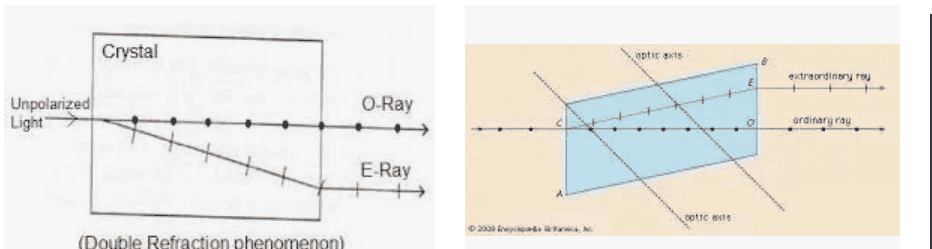
The discussion centers on the behavior of e-ray and o-ray in uniaxial materials, specifically addressing the conditions under which the e-ray is positioned above or below the o-ray. According to Snell's law, the refractive indices of the ordinary ray (no) and extraordinary ray (ne) can vary without restriction in uniaxial materials. This variability leads to different orientations of the rays depending on the material's properties and the angle of incidence.
PREREQUISITES
- Understanding of Snell's law and its application in optics
- Familiarity with the concepts of birefringence and uniaxial materials
- Knowledge of refractive indices (no and ne) in optical physics
- Basic principles of light propagation and ray optics
NEXT STEPS
- Research the principles of birefringence in different materials
- Study the mathematical formulation of Snell's law in detail
- Explore the implications of refractive index variations in optical devices
- Investigate practical applications of uniaxial crystals in optics
USEFUL FOR
Students and professionals in optics, physicists studying light behavior in materials, and engineers designing optical systems utilizing birefringent materials.