Work problem - Rope, pulley and brick (applied integration)

Join the discussion
Ask a follow-up here, or get your own question answered by working scientists, mathematicians and engineers — people, not an autocomplete.
Real named experts · corrections over time · the nuance an AI answer skips
22 replies · 4K views
themli
Messages
21
Reaction score
3
Member warned that the homework template is required
If a brick is pulled across the floor by a rope thruogh a pulley, 1 meter above the ground - and work = W, where [itex]W = 10N[/itex], (in Newton).Show that the horizontal component of W, which is pulling the brick has the size
[tex]\frac{10x}{\sqrt{1+x^2}} (*)[/tex]
Use this to calculate the amount of work needed to move the brick from x = 10 to x = 2.

This is what I have so far:
In terms of the expression (*), I'm thinking the 10x has to do with W being equal to 10N, and the W-side (call it Z) being the hypotenuse: [itex]\sqrt{1+x^2}[/itex]
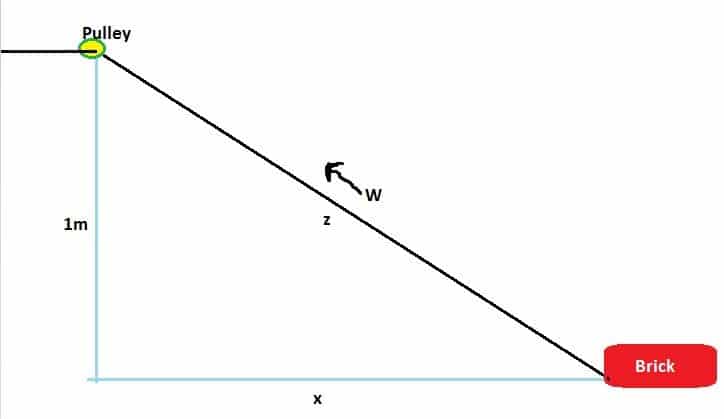
ex5d.jpg

Let the angle by the brick be θ:
[tex]\cos θ=\frac{x}{\sqrt{1+x^2}}[/tex]

So is the formula found by taking cosθ×10?

In terms of calculating work, I'm not sure. I first thought taking the definite integral of (*) from 2 to 10?
 
Last edited by a moderator:
Physics news on Phys.org
Can I integrate it as 10*cosine? Or should I use the original expression using integration by parts (and other methods)?
 
Write down the integral you want to calculate (##\ \int F \, dx\ ##). The integrand can be written as ##\ 10 \cos\theta\ ## but then you still need to do something ...
 
BvU said:
Write down the integral you want to calculate (##\ \int F \, dx\ ##). The integrand can be written as ##\ 10 \cos\theta\ ## but then you still need to do something ...
Clearly, since [itex]10\int_2^{10}cosθ[/itex] gives a negative number... I have no clue about physics, so I might be missing something about the work?

In the text, the brick is moving from 10 to 2, so maybe i should do:

[itex]10\int_{10}^{2}cosθ \approx 14.53[/itex]

How's that?

Alternatively, I know that [itex]W = F \times s[/itex] or [itex]W = F(s)[/itex], so I need to find some value for displacement
 
Last edited:
BvU said:
Once you have the right expression for the integral, there isn't much physics going on anymore: it's pure math.

What do you make of ##dx## ?
Ah right - above I just used [itex]dθ[/itex] , but It depends on the integrand, so [itex]dx[/itex] means I need the integrand to be in terms of [itex]x[/itex]. So I should use the expression [itex]\frac{x}{\sqrt{1+x^2}}[/itex], thus [tex]10\int_{10}^2 \frac{x}{\sqrt{1+x^2}} dx[/tex]
 
What I meant is that if you want to use theta as integration variable, you should not forget to express ##dx## in terms of ##\theta##. Perhaps keeping ##x## as integration variable is easier...?
 
Yes, that was just a typo on my part - I did integrate using dθ with cos (I did get a number above, which I assume is wrong?) and dx using the x-expression, which I haven't calculated yet, looks like a tricky integral, trig substitution maybe?

Btw about the limits of integration, from the illustration I made, it looks like we are moving in the negative direction, from 10 to 2 (this is the way it was stated in the problem as well). I know under the fundamental theorem you change the sign when flipping the limits of integration.
 
Turns ot both ways are pretty straightforward (goes to show that I'm also not that comfortable with integrals). Good exercise to actually do it both ways ! That also gives you an extra checking opportunity.

And you know you have the wrong sign if the work comes out negative :smile:
 
[tex]10\int_{2}^10 \frac{x}{\sqrt{1+x^2}} dx[/tex] Let [itex]u=1+x^2, du=2x dx[/itex] so we have

[tex]5\int_{x=2}^{x=10} \frac{1}{\sqrt{u}} du[/tex]

[tex]10\sqrt{u} = 10\sqrt{1+x^2}[/tex]

From [itex]x = 2[/itex] to 10

[tex]\approx 78.14[/tex]
 
Looks good. Now perhaps ##\ \displaystyle \int 10\cos\theta\, dx \ ## with ##\ \theta = \cot x\ ## :rolleyes: ?

[edit] Sorry, wrong way around o:) : should of course be ##\ \cot\theta = x \ ##
 
Last edited:
Let [itex]θ= cotx , dθ=-csc^2xdx[/itex] so we have

[tex]-10\int_{2}^{10} cos(cotx)csc^2x dx[/tex]

Let u = cotx, [itex]du=-csc^2x dx[/itex]

[tex]-10\int_{x=2}^{x=10} cos(u) dx = -10(sin(cotx))[/tex] from 2 to 10

Is that negative? No idea how I would calculate [itex]\sin(\cot x)[/itex], it's a composite function but..
 
No, so something's wrong. The answer I got was [tex]1.441\times (-10) = -14.41[/tex]
 
BvU said:
Step from ##\ d\theta\ ## to ##\ dx\ ## :$$
d\theta = -csc^2 x \, dx \Rightarrow \ dx = ... d\theta $$
 
BvU said:
Step from ##\ d\theta\ ## to ##\ dx\ ## :$$
d\theta = -csc^2 x \, dx \Rightarrow \ dx = ... d\theta $$
[tex]dθ = -csc^2x dx[/tex]
[tex]dx = \frac{dθ}{-csc^2x}[/tex]
 
Last edited:
I miscalculated something in the post above, the integral of [tex]\sin u du[/tex] Is equal to
[tex]14.4[/tex] not negative. I missed a negative sign from the csc^2. But it's still not 78.14.
 
BvU said:
You need to express ##\ \csc^2 x \ ## in terms of ##\theta##
Not sure how to do that. At the point θ to dθ, I take dθ/dx and get [itex]-\csc^2x dx[/itex]. Isn't it equivalent to when I use u-substitution, and I express the term I differentiate still using x, with the point of cancelling the already existing x-terms? So same here, I replaced θ with x-terms.

And also, is 78.14 the wrong answer?
 
themli said:
Not sure how to do that. At the point θ to dθ, I take dθ/dx and get [itex]-\csc^2x dx[/itex]. Isn't it equivalent to when I use u-substitution, and I express the term I differentiate still using x, with the point of cancelling the already existing x-terms? So same here, I replaced θ with x-terms.
You have ##\displaystyle \int \cos\theta\, dx\ ## with $$
x = {\cos \theta\over\sin \theta}\ \Rightarrow \ dx = -{1\over \sin^2 \theta} \;d\theta $$ and you integrate from ##\operatorname{arccot}10## to ##\operatorname{arccot}2##

And also, is 78.14 the wrong answer?
Well compare the two answers ... :wink:

(the value seems quite reasonable: about 10 N times 8 m would be a first guess when you completely ignore the angle)
 
BvU said:
You have ##\displaystyle \int \cos\theta\, dx\ ## with $$
x = {\cos \theta\over\sin \theta}\ \Rightarrow \ dx = -{1\over \sin^2 \theta} \;d\theta $$ and you integrate from ##\operatorname{arccot}10## to ##\operatorname{arccot}2##

Well compare the two answers ... :wink:

(the value seems quite reasonable: about 10 N times 8 m would be a first guess when you completely ignore the angle)
Got it! Got the same answer, [itex]78.138[/itex]. That was a strange integral lol. I can't thank you enough!:smile:

However, when the brick is dragged up, the angle could be calculated, because we now the length of the sides ([itex]1, 8, 10.1[/itex]) by pythagorean theorem. Should I take that into account? Since [itex]10N \times 10.1 = 101[/itex]. That is the z side is 10.1 long.

Edit: Nvm, I was only trying to find the horizontal work.
 
Last edited: