Construction Workbench Top Pulling Force With Sloping Leg

Click For Summary
SUMMARY

This discussion focuses on calculating the pulling force (Q) exerted on a workbench with sloping front legs at 78 degrees, fixed to a wall at the rear. The force Q is influenced by the load's position on the worktop, necessitating a free body diagram to evaluate the sum of forces and moments. The conversation highlights that dynamic loads, such as those from a bench vise, can significantly increase the force Q, especially with diagonal front legs. Additionally, the structural integrity of the back support is crucial, as improper load distribution can lead to unexpected failures.

PREREQUISITES
  • Understanding of basic physics principles, particularly forces and moments
  • Familiarity with free body diagrams for structural analysis
  • Knowledge of load distribution and its effects on structural integrity
  • Basic engineering concepts related to triangular support structures
NEXT STEPS
  • Research how to create and analyze free body diagrams in structural engineering
  • Study the effects of dynamic loads on workbench stability and design
  • Explore the use of triangular supports in engineering for enhanced stability
  • Learn about different leg configurations and their impact on load distribution
USEFUL FOR

This discussion is beneficial for DIY enthusiasts, furniture builders, structural engineers, and anyone involved in designing stable workbench systems.

Ian K
Messages
2
Reaction score
2
TL;DR
How to calculate outward force of workbench top with slopping leg
Hello,
I am making a workbench for my mancave, the front edge of the bench is supported by legs that slopes inwards at 78 degrees and the back/rear edge of the bench top is fixed to the wall. How do I calculate the force Q pulling the bench top away from the wall please?

Also is the force Q affected by the position of a load on the worktop? eg L1 is quarter distance from front, L2 is in the middle and L3 is three quarters distance from the front. See attached photos of sketches.

Many thanks in advance Ian K
PS I assume L/2 is correct for the shared vertical load supports (Leg and Wall)
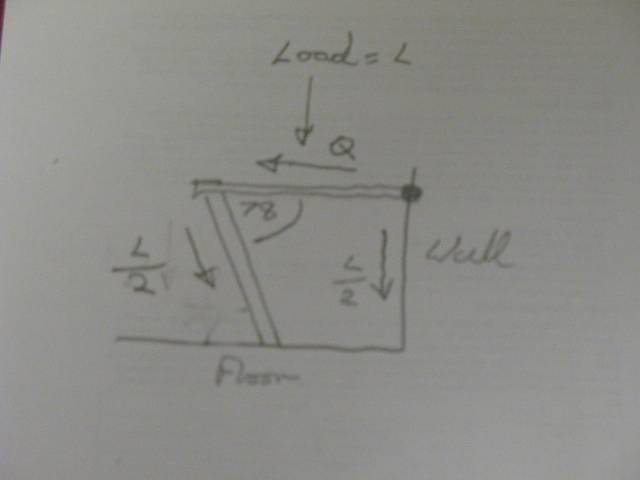
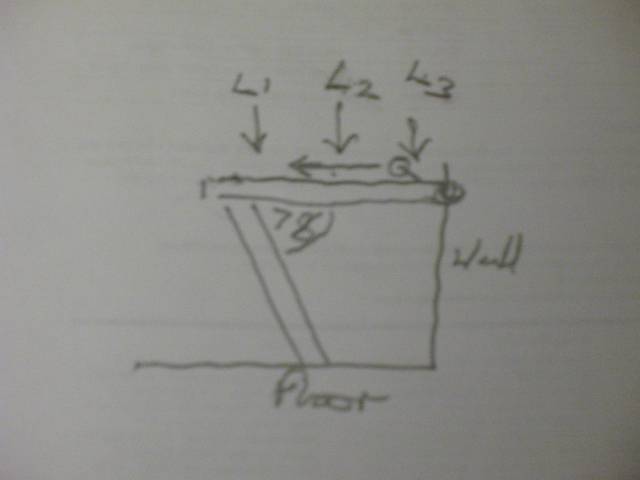
IMG_6198.JPG


IMG_6199.JPG
 
Last edited by a moderator:
Physics news on Phys.org
Ian K said:
How do I calculate the force Q pulling the bench top away from the wall please?
##Q## will oppose the horizontal reaction force between the floor and the legs.

Ian K said:
Also is the force Q affected by the position of a load on the worktop?
Yes. You have to do a proper free body diagram and evaluate the sum of forces and the sum of moments for the assembly. Don't assume half of the reaction force will be on the wall and half on the legs.
 
@Ian K The load L will probably be highest when it is a dynamic load - as you whack an object on the (can you do without one?) bench vise. With vertical front legs, the force Q will be a lot less, of course. Is there a good reason for having diagonal front legs? You could be opening a can of worms here; the stresses on the back wall can usually be relieved by props at the back but here the back support becomes a serious issue.

Wrestling with a big object on a vise can pull a bench from a wall and give a nasty surprise. But, of course, your application may not call for that. :smile:

A diagonal member from lower front to just below the rear fixing could help, of course. Triangles are fabulous things in engineering.
 
Hey folks! So I’m kinda losing my mind over my hedgie’s setup lately. No matter what I do, the enclosure keeps getting super humid and it’s starting to smell funky. I clean it, switch bedding, crack the window, the whole nine yards… but it still ends up damp and I’m worried it’s gonna mess with my little dude’s health. I’m starting to feel like I’m doing something wrong even though I’m trying so hard. Has anyone dealt with this before? Any tips, hacks, gear recs… literally anything would...

Similar threads

  • · Replies 5 ·
Replies
5
Views
12K
  • · Replies 10 ·
Replies
10
Views
3K
  • · Replies 52 ·
2
Replies
52
Views
7K
  • · Replies 5 ·
Replies
5
Views
4K
  • · Replies 1 ·
Replies
1
Views
4K
  • · Replies 1 ·
Replies
1
Views
10K