How Do You Calculate Cam Dimensions for Optimal Rod Travel?

  • Context: Undergrad 
  • Thread starter Thread starter Chantry09
  • Start date Start date
  • Tags Tags
    Cam Dimensions
Click For Summary
SUMMARY

The calculation of cam dimensions for optimal rod travel involves determining the length of dimension "a" based on the travel of rod "c" and the length of connecting rod "b." The formula for dimension "a" is established as half the travel of rod "c," specifically 3/8 units when the cylinder travel is 3/4 units. The Pythagorean theorem is applicable when the axle is not aligned with the cylinder, affecting the height of rod "c." The relationship between the pivoting of rod "b" and the positioning of the axle is crucial for accurate calculations.

PREREQUISITES
  • Understanding of camshaft mechanics
  • Knowledge of Pythagorean theorem applications
  • Familiarity with connecting rod dynamics
  • Basic principles of rotational motion
NEXT STEPS
  • Research camshaft design principles
  • Study the effects of pivot points on connecting rods
  • Learn about advanced applications of the Pythagorean theorem in mechanical systems
  • Explore simulation tools for cam and rod dynamics analysis
USEFUL FOR

Mechanical engineers, automotive designers, and hobbyists involved in engine design and optimization of cam mechanisms.

Chantry09
Messages
59
Reaction score
0
Hi,

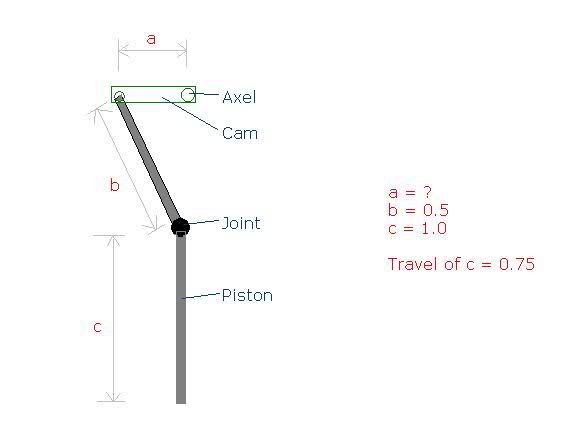
Im trying to work out the dimensions of the offset on a cam for a project. I know the travel of rod c, as well as the length of the connecting rod b, but I am not sure what the lenth of dimension a should be. I know this is probably simple maths (just pythagoras?) but I need to make sure I get the full travel out of rod c with full 360 degree rotation on the axel.

It would normally be very simple (a = 0.5 x travel of rod c), but it is the fact that rod b is allowed to pivot around the joint to rod c makes it a bit more confusing.
n4zk7p.jpg
 

Attachments

  • untitled67.JPG
    untitled67.JPG
    9.7 KB · Views: 414
Mathematics news on Phys.org
c will be highest when a is pointing directly upward. At that position, the distance from the Axle to the tip of c is b+ c- a= 1.5- a. c will be lowest when a is pointing directly downward. At that position, the distance from the Axle to the tip of c is a+ b+ c= a+ 1.5. The distance between those, the "travel" is a+1.5- (1.5- a)= 2a. You want a equal to 1/2 the travel just as you said. The fact that b pivots changes the speed with which c travels but not the distance.
 
As long as the axel is in line with the piston, the cam "a" needs to be half the length of the travel desired at the piston. Therefore, since the cylinder travel is 3/4 units, the cam should be 3/8 units.

The Pythagorean theorem comes into play when the axel is NOT in line with the cylinder.
 
HallsofIvy said:
c will be highest when a is pointing directly upward.\

... unless the axle is not in line with the cylinder. In that case (in fact, in all cases), cylinder "C" will be highest when the pivot point connecting cam "A" and rod "B" is in a position such that the axle is directly between that pivot point and the joint between rod "B" and cylinder "C"
 

Similar threads

  • · Replies 18 ·
Replies
18
Views
3K
  • · Replies 4 ·
Replies
4
Views
2K
  • · Replies 9 ·
Replies
9
Views
2K
  • · Replies 9 ·
Replies
9
Views
30K
  • · Replies 6 ·
Replies
6
Views
3K
  • · Replies 25 ·
Replies
25
Views
2K
  • · Replies 31 ·
2
Replies
31
Views
3K
  • · Replies 3 ·
Replies
3
Views
2K
  • · Replies 4 ·
Replies
4
Views
3K
  • · Replies 55 ·
2
Replies
55
Views
5K