Working out tension of string holding a ball underwater

Click For Summary
SUMMARY

The discussion focuses on calculating the tension in two strings holding a submerged ball with a volume of 5000 cm³ in a swimming pool. Participants emphasize the importance of applying the principles of buoyancy and force balance, noting that the gravitational force, buoyancy force, and tension forces must be equal for the ball to remain stationary. The density of water is a critical factor in determining the buoyant force acting on the ball. The conversation also highlights the need for proper forum etiquette when posting homework questions.

PREREQUISITES
  • Understanding of buoyancy principles
  • Knowledge of gravitational force calculations
  • Familiarity with tension force equations
  • Basic physics concepts related to force balance
NEXT STEPS
  • Research the formula for calculating buoyant force using Archimedes' principle
  • Learn how to apply force balance equations in static equilibrium scenarios
  • Study the relationship between density and buoyancy in fluids
  • Explore the concept of tension in multiple string systems
USEFUL FOR

This discussion is beneficial for physics students, educators, and anyone interested in understanding the dynamics of submerged objects and the forces acting upon them.

Alice Martin
Messages
2
Reaction score
0
I have a physics homework question that i need help with;
A submerged ball of negligible mass is attached to the bottom of a swimming pool by two strings as shown. The volume of the ball is 5000cm^3. Calculate the tension in each string. (hint you need to look up the density of water)

How do i do this? Do i use the buoyancy of the ball or the tension formula?

The
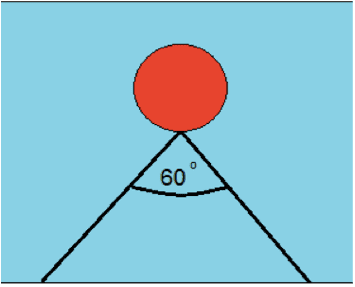
Screen Shot 2016-04-25 at 4.13.49 pm.png
triangle with the base being the bottom of the pool and the ball being attached to the top vertex with a 60 degree angle
 
Physics news on Phys.org
What you need to do is a force balance on the ball. :wink:

So there is a gravitational force, a buoyancy force and tension forces all acting on the ball, which is not moving. What does that tell you?
 
  • Like
Likes Alice Martin
mfig said:
What you need to do is a force balance on the ball. :wink:

So there is a gravitational force, a buoyancy force and tension forces all acting on the ball, which is not moving. What does that tell you?
Thank you! That is a really simple way of putting it. I did not even think about the fact that the forces must be equal!:wink:
 
Hi Alice! Welcome to PF!

I've gone ahead moved your thread to the homework forums, but in the future please make sure you place your question here (or in whichever homework forum is appropriate) and that you fill in the template provided when you create a thread in the homework forums.

@mfig, please use the report feature to report homework posts outside of the homework forums instead of replying to them. Thank you!
 

Similar threads

  • · Replies 3 ·
Replies
3
Views
1K
Replies
1
Views
3K
  • · Replies 7 ·
Replies
7
Views
9K
  • · Replies 5 ·
Replies
5
Views
2K
  • · Replies 15 ·
Replies
15
Views
6K
  • · Replies 11 ·
Replies
11
Views
2K
  • · Replies 4 ·
Replies
4
Views
4K
  • · Replies 18 ·
Replies
18
Views
2K
  • · Replies 9 ·
Replies
9
Views
4K
Replies
10
Views
2K