Working out the current flow in a wire

Click For Summary
SUMMARY

The discussion focuses on constructing a closed-loop circuit with resistances of 4Ω, 10Ω, and 8Ω, and applying Kirchhoff's laws to solve for current flow. Participants emphasized the importance of splitting the 4Ω and 10Ω wires into two 2Ω resistors each to accurately represent the circuit. The user successfully derived three equations from Kirchhoff's second law, leading to the determination of currents I = -0.5 A, I1 = -1.5 A, and I2 = 1 A, with negative signs indicating the opposite direction of assumed current flow.

PREREQUISITES
  • Understanding of Kirchhoff's laws, specifically Kirchhoff's voltage law.
  • Familiarity with circuit components, including resistors and their configurations.
  • Basic knowledge of Ohm's law and current flow in electrical circuits.
  • Ability to solve simultaneous equations in the context of electrical circuits.
NEXT STEPS
  • Study the application of Kirchhoff's laws in complex circuits.
  • Learn about series and parallel resistor combinations and their impact on total resistance.
  • Explore methods for solving simultaneous equations, including substitution and elimination techniques.
  • Investigate the implications of negative current values in circuit analysis.
USEFUL FOR

Electrical engineering students, circuit designers, and anyone interested in understanding current flow and circuit analysis using Kirchhoff's laws.

Bolter
Messages
262
Reaction score
31
Homework Statement
Finding the current that flows in the third wire and 20 V battery
Relevant Equations
Ohm's law
Kirchhoff's 1st & 2nd law
Hi there!

I have recently been given this question by my teacher as shown below

Screenshot 2020-01-30 at 17.18.09.png

I'm struggling to see the set up arrangement for this circuit

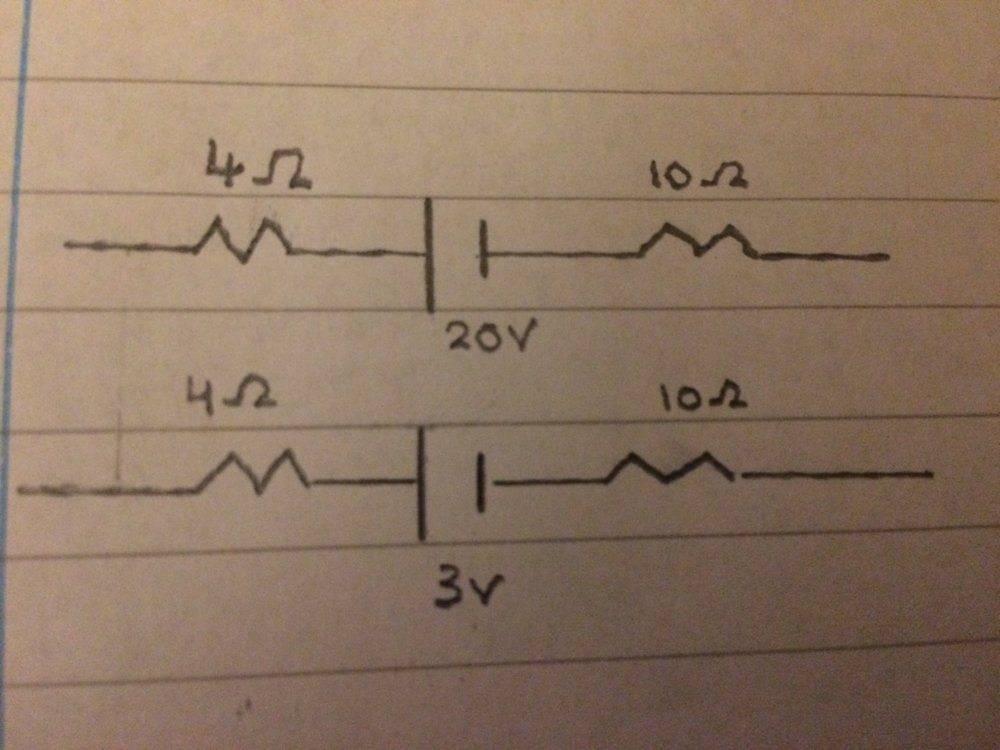
This is what I have drawn so far
IMG_3768.JPG


How would I fit in the third wire here and ensure I have closed loop circuit so that current can begin to flow?

Any help would be great! Thanks
 
Physics news on Phys.org
You have included the resistances of the connecting wires twice; first draw the cells with one above the other, and then add on the internal resistances. You are then connecting the poles with wires of ##4\Omega## and ##10\Omega##, but you are subsequently also connecting the midpoint of these wires with an ##8\Omega## wire.

If the resistance of the wires increases linearly with length, try splitting the resistances of each of the wires connecting the poles into equal halves. Does this help you to draw the diagram?
 
etotheipi said:
You have included the resistances of the connecting wires twice; first draw the cells with one above the other, and then add on the internal resistances. You are then connecting the poles with wires of ##4\Omega## and ##10\Omega##, but you are subsequently also connecting the midpoint of these wires with an ##8\Omega## wire.

If the resistance of the wires increases linearly with length, try splitting the resistances of each of the wires connecting the poles into equal halves. Does this help you to draw the diagram?

Thanks I have tried to follow through with what you have said and get my new set up looking like this?

IMG_3769.JPG
 
Bolter said:
Thanks I have tried to follow through with what you have said and get my new set up looking like this?

This looks good to me, however to solve the problem you need so separate the ##4\Omega## wire into two ##2\Omega## resistors on either side of the node, and the same goes for the ##10\Omega## wire. If you want justification, it comes from the fact that each of the connecting wires can be thought of as two half wires joined together, and since both have the same length they both have the same resistance.

Then you need to solve for the currents! If you label up the currents in each branch, what equations can you write down from Kirchhoff's two laws?
 
etotheipi said:
This looks good to me, however to solve the problem you need so separate the ##4\Omega## wire into two ##2\Omega## resistors on either side of the node, and the same goes for the ##10\Omega## wire. If you want justification, it comes from the fact that each of the connecting wires can be thought of as two half wires joined together, and since both have the same length they both have the same resistance.

Then you need to solve for the currents! If you label up the currents in each branch, what equations can you write down from Kirchhoff's two laws?

Ok so I have tried to construct some equations from Kirchhoff's 2nd law, where I know that sum the voltages around a closed circuit is zero

IMG_3770.JPG


Do these 2 equations that I have obtained from Kirchhoff's 2nd law look right?
 
Bolter said:
Ok so I have tried to construct some equations from Kirchhoff's 2nd law, where I know that sum the voltages around a closed circuit is zero

Do these 2 equations that I have obtained from Kirchhoff's 2nd law look right?

They seem fine to me; notice that now you have 3 equations and 3 unknowns:

##I = I_{1} + I_{2}##, ##3 = 10I + 8I_{2}## and ##-17 = 10I + 8I_{1}##

This is now just a case of solving the simultaneous equations.
 
etotheipi said:
They seem fine to me; notice that now you have 3 equations and 3 unknowns:

##I = I_{1} + I_{2}##, ##3 = 10I + 8I_{2}## and ##-17 = 10I + 8I_{1}##

This is now just a case of solving the simultaneous equations.

I have now solved these simultaneously using a bit of substitution and elimination and the results I obtained were

I = –0.5 A
I2 = 1 A
I1 = –1.5 A

IMG_3771.JPG


IMG_3772.JPG


This doesn't seem right to me since the answer gives these?

Screenshot 2020-01-30 at 19.31.42.png
 
Bolter said:
This doesn't seem right to me since the answer gives these?

The ##1.0\text{A}## and ##1.5\text{A}## currents are the same as you determined for parts a) and b). Perhaps you are concerned about the negative signs of the currents? This just means that your original guess of the direction of the currents happened to be incorrect (this is fine, Kirchhoff's laws are self correcting!), and the currents should in fact be in the opposite direction.

Note also that a faster way to solve the system would be to add the two equations ##3 = 10I + 8I_{2}## and ##-17 = 10I + 8I_{1}##. Then you can turn ##8I_{1} + 8I_{2}## into ##8I##!
 
Last edited by a moderator:
  • Like
Likes   Reactions: Bolter
etotheipi said:
The ##1.0\text{A}## and ##1.5\text{A}## currents are the same as you determined for parts a) and b). Perhaps you are concerned about the negative signs of the currents? This just means that your original guess of the direction of the currents happened to be incorrect (this is fine, Kirchhoff's laws are self correcting!), and the currents should in fact be in the opposite direction.

Note also that a faster way to solve the system would be to add the two equations ##3 = 10I + 8I_{2}## and ##-17 = 10I + 8I_{1}##. Then you can turn ##8I_{1} + 8I_{2}## into ##8I##!

Ah so these negative signs just indicate that the current is actually flowing in the opposite direction as opposed to the direction that I chose. I see how these current directions fix themselves if I stay consistent throughout with the direction that I initially chose first

Thanks this was quite useful to take in note of!
 
  • Like
Likes   Reactions: etotheipi

Similar threads

  • · Replies 10 ·
Replies
10
Views
915
  • · Replies 7 ·
Replies
7
Views
961
  • · Replies 9 ·
Replies
9
Views
2K
  • · Replies 31 ·
2
Replies
31
Views
2K
  • · Replies 5 ·
Replies
5
Views
2K
  • · Replies 10 ·
Replies
10
Views
2K
Replies
4
Views
2K
  • · Replies 36 ·
2
Replies
36
Views
4K
Replies
4
Views
2K
  • · Replies 13 ·
Replies
13
Views
2K