Would anyone explain the solution a little bit to me?

Click For Summary
SUMMARY

The discussion focuses on calculating the expected value E(X^3µσ) and understanding the variance σ² in the context of probability theory. Key formulas discussed include E[aX+c]=aE[X]+c for expected values and the definition of variance as σ²=E[(X-µ)²]. The alternative formula for variance, Var(X) = E(X²) - µ², is also highlighted, leading to the conclusion that E(X²) = σ² + µ². These foundational concepts are essential for solving probability problems in a mathematics context.

PREREQUISITES
  • Understanding of expected value and variance in probability theory
  • Familiarity with continuous probability distributions
  • Knowledge of mathematical notation and integrals
  • Basic algebra skills for manipulating equations
NEXT STEPS
  • Study the properties of expected values in probability distributions
  • Learn about continuous probability distributions and their applications
  • Explore advanced variance concepts and their derivations
  • Practice solving problems involving E[X^n] and variance calculations
USEFUL FOR

Students preparing for mathematics courses, particularly those focusing on probability and statistics, as well as educators seeking to clarify these concepts for their students.

Kior
Messages
11
Reaction score
0
Member warned about posting without the template and with no effort
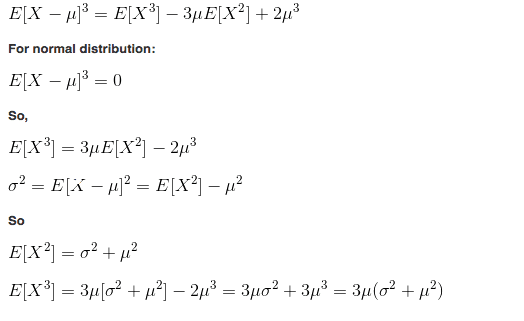
I am preparing for my math probability class next semester. There is question: Calculate E(x3µσ) Would anyone explain the solution in the picture a little bit to me?

1.Why is the step hold? Is there a formula or something that i can calculate E[X-µ]n?
2.Why is the fourth step hold? Where is the σ from and why variance σ2= E[X-µ]2?
media%2Ff8e%2Ff8e1f936-5fdb-445c-8fef-dd01be6d4e86%2Fphp7cYPNz.png
 
Physics news on Phys.org
If the distribution is continuous, then we have ## E[X^n]=\int X^n \rho(X) dX ##.
Then it can be proved that ## E[aX+c]=aE[X]+c ## which can be used to prove the first formula.
And variance is defined to be the expected value of the squared deviation from the mean, which means ## \sigma^2=E[(X-\mu)^2] ##.
 
Shyan said:
If the distribution is continuous, then we have ## E[X^n]=\int X^n \rho(X) dX ##.
Then it can be proved that ## E[aX+c]=aE[X]+c ## which can be used to prove the first formula.
And variance is defined to be the expected value of the squared deviation from the mean, which means ## \sigma^2=E[(X-\mu)^2] ##.

Note that ##\sigma^2 \equiv \text{Var}(X)## is given by
[tex]\begin{array}{cll} \text{Var}(X)& = E(X - \mu)^2 &\text{definition}\\<br /> & = E(X^2) - \mu^2 & \text{alternative formula}<br /> \end{array}[/tex]
Therefore, we have ##E(X^2) = \sigma^2 + \mu^2##.

To get the "alternative formula", just expand out ##(X - \mu)^2## and then take expectations.
 

Similar threads

Replies
6
Views
2K
  • · Replies 5 ·
Replies
5
Views
2K
  • · Replies 8 ·
Replies
8
Views
3K
  • · Replies 2 ·
Replies
2
Views
1K
  • · Replies 14 ·
Replies
14
Views
3K
Replies
7
Views
3K
  • · Replies 11 ·
Replies
11
Views
2K
  • · Replies 7 ·
Replies
7
Views
4K
  • · Replies 5 ·
Replies
5
Views
5K
  • · Replies 15 ·
Replies
15
Views
2K