W3bbo
- 31
- 0
(Apologies for the lack of LaTeX formatting - I usually do my typesetting with MathType, but I only have Microsoft Equation Editor on this computer which doesn't have LaTeX export).
This isn't a homework question, but is problem I've discovered I'm facing after diving into another problem, but I digress:
Consider this set, A:
A = { T, T, R }
It has six proper permutations, but only three distinct permutations:
TTR, TRT, RTT
The expression for the number of unique permutations (in this case) is:
|A|! / ( |'T' elements| ! * |'R' elements| ! )
So: 3! / 2! * 1! which is 6/2 == 3
Due to certain requirements, I need to express this function recursively. Because the factorial function is used, I figured I could take it from there.
The expressions below take the permutation-count formula and assumes that every set A is comprised of N 'T' elements, and M 'R' elements and is called "routes".
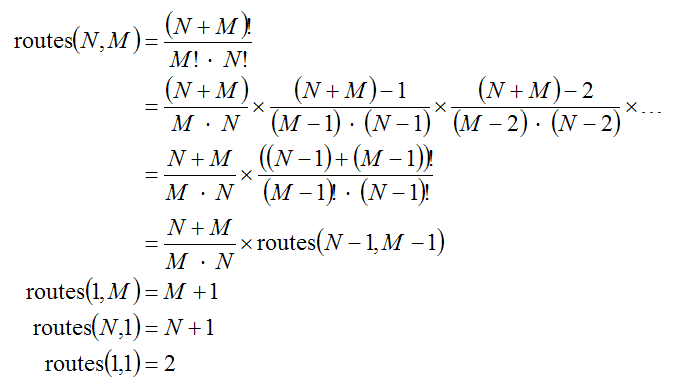
...but I can't figure out how to make it recursive. Note the huge error on the third line down, it does not follow from the line above.
Is a recursive definition even possible?
Thanks!
This isn't a homework question, but is problem I've discovered I'm facing after diving into another problem, but I digress:
Consider this set, A:
A = { T, T, R }
It has six proper permutations, but only three distinct permutations:
TTR, TRT, RTT
The expression for the number of unique permutations (in this case) is:
|A|! / ( |'T' elements| ! * |'R' elements| ! )
So: 3! / 2! * 1! which is 6/2 == 3
Due to certain requirements, I need to express this function recursively. Because the factorial function is used, I figured I could take it from there.
The expressions below take the permutation-count formula and assumes that every set A is comprised of N 'T' elements, and M 'R' elements and is called "routes".
...but I can't figure out how to make it recursive. Note the huge error on the third line down, it does not follow from the line above.
Is a recursive definition even possible?
Thanks!