Y" -y' -2y = 4(t^2) , y(0) = 1 , y'(0) =4?

  • Thread starter Thread starter foo9008
  • Start date Start date
Join the discussion
Registration is free. Ask a follow-up in this thread, or start your own.
6 replies · 3K views
foo9008
Messages
676
Reaction score
4

Homework Statement


the answer that i found id 2(e^t) -1 , why it is wrong ? the answer given is cosht
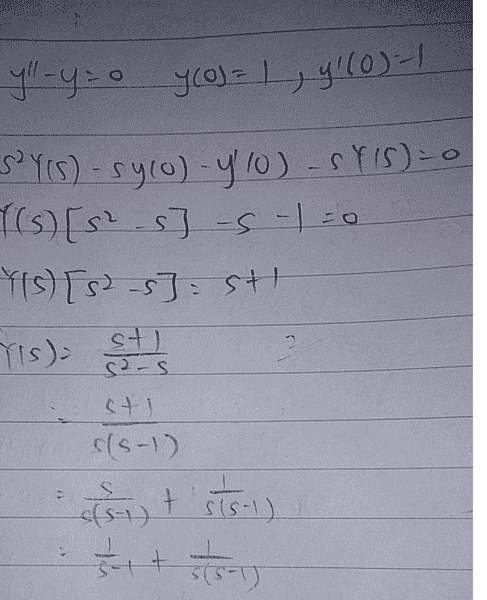
XiICijK.png


Homework Equations

The Attempt at a Solution

 
Physics news on Phys.org
Did you substitute your answer back into the original differential equation? Did it satisfy this equation and all of the initial conditions?

If the answer is no, it didn't, then that's why.

BTW: You should not put one equation in the thread title when the problem covers a completely different equation.
 
SteamKing said:
BTW: You should not put one equation in the thread title when the problem covers a completely different equation.
Furthermore, the equation should be in the problem statement section, not in the thread title.
 
  • Like
Likes   Reactions: SammyS
foo9008 said:

Homework Statement


the answer that i found id 2(e^t) -1 , why it is wrong ? the answer given is cosht
XiICijK.png


Homework Equations

The Attempt at a Solution


If you try your answer and the book's answer in the original equation, you will see both are incorrect. Either that, or you copied the problem incorrectly. In your work, ##\mathcal L(y) \ne s Y(s)##. Also, there is no reason to post this problem as an image instead of just typing it.
 
  • Like
Likes   Reactions: foo9008
Are you required to use the Laplace transform? This is a simple second order, linear equation with constant coefficients. It has characteristic equation [itex]r^2- r- 2= (r- 2)(r+ 1)[/itex] and a "specific solution" to the entire equation must be of the form [itex]Ax^2+ Bx+ C[/itex].
 
HallsofIvy said:
Are you required to use the Laplace transform? This is a simple second order, linear equation with constant coefficients. It has characteristic equation [itex]r^2- r- 2= (r- 2)(r+ 1)[/itex] and a "specific solution" to the entire equation must be of the form [itex]Ax^2+ Bx+ C[/itex].
No. The DE in the title is different from the one in the image that the OP posted. The initial value problem in the posted image is y'' - y = 0, y(0) = 1, y'(0) = 1.
 
Which is even easier without using the Laplace transform! The characteristic equation is r^2- 1= (r- 1)(r+ 1)= 0.