Magnetic flux and current directions of transformer

Click For Summary
The discussion focuses on the principles of transformer operation, particularly Faraday's law of induction and the relationship between magnetic flux and current directions. Participants clarify that the magnetic flux is not simply a sum of induced magnetic fields but is better understood in terms of magnetomotive forces (MMFs) and core reluctance. It is emphasized that the primary magnetic flux induces voltage rather than current, and the reflected load current in the primary winding balances the secondary current to maintain constant flux. Additionally, there is debate about the correctness of current directions in the provided diagram, with some asserting that they should be out of phase to comply with Lenz's law. Overall, the conversation highlights the complexities of transformer theory and the importance of accurate terminology and concepts.
goodphy
Messages
212
Reaction score
8
Hello.

Let's take a transformer picture first.
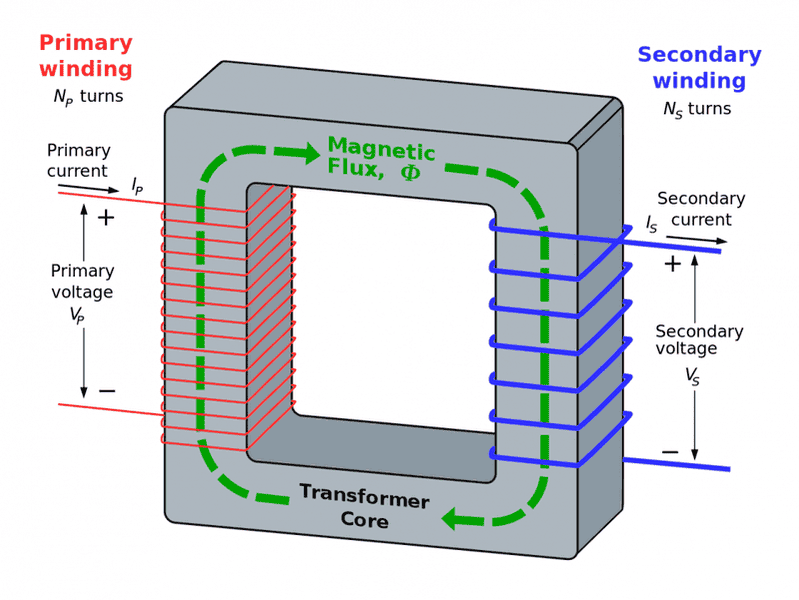
Transformer3d_col3.svg.png


The basic equation explaining how the transformer work is the equation of Faraday's law of induction.
\begin{array}{*{20}{c}}<br /> {{V_P} = - {N_P}\frac{{d{{\rm{\Phi }}_B}}}{{dt}}\;\;\;\;\left( 1 \right).}\\<br /> {{V_S} = - {N_S}\frac{{d{{\rm{\Phi }}_B}}}{{dt}}\;\;\;\;\left( 2 \right).}<br /> \end{array} A current in the primary winding IP1 generates B-field (magnetic field) B1 which induces a current in the secondary winding IS1 . IS1 induces another B-field B2 which induces a new current in the primary IP2. IP2 also induces another B-field B3 which induces a new current in the secondary IS2 and so on.

So...I think that the magnetic flux Φ in above equations is a sum of all induced magnetic field B1 + B2 + B3 ... multiplied by a cross-section of the magnetic core. Could you tell me whether or not I'm right on this?

And when I think about Lenz's law, current directions in the attached picture is wrong. The currents must be out of phase or opposite in directions in this picture. In order for currents to be in phase, one of the winding direction must be inverted. For example, in the primary winding, the winding should be done from back side to front side of the core (front side is the side facing reader) to achieve in-phase currents. Could you also confirm my opinion?

Thanks for reading my post and I'm waiting for any replies.
 
Engineering news on Phys.org
goodphy said:
A current in the primary winding IP1 generates B-field (magnetic field) B1 which induces a current in the secondary winding IS1
Read Faradays law again:

n/dt does not induce a current, but a voltage.
Say that the secondary winding is unloaded, no current at all will pass the secondary winding.
 
  • Like
Likes goodphy
Current makes magnetomotive force MMF, amp turns .
Flux B that flows around the core is MMF/Reluctance of the core.
Flux induces voltage not current, as Hesch points out.

Currents in both Primary and Secondary windings make MMF's. Flux is ΣMMF's / Reluctance of core.

Some authors pretend there is more than one flux flowing and use sum of those fluxes instead, and that is their choice but they should define their method and terms up front.
I prefer to think in terms of summed MMF's because it's easier to account for nonlinear reluctance of the core(and other magnetic effects) in your thinking..

old jim
 
Last edited:
  • Like
Likes goodphy and cnh1995
goodphy said:
So...I think that the magnetic flux Φ in above equations is a sum of all induced magnetic field B1 + B2 + B3 ... multiplied by a cross-section of the magnetic core.
No.
goodphy said:
A current in the primary winding IP1 generates B-field (magnetic field) B1 which induces a current in the secondary winding IS1 .
As Hesch said earlier, primary magnetic flux induces voltage and not current.
goodphy said:
IS1 induces another B-field B2 which induces a new current in the primary IP2.
Right and it is called the 'reflected load current'. This reflected current Ip2flows such that Np*Ip2=Ns*Is.i.e. mmf due to Ip2 exactly cancels out the mmf due to secondary current and this keeps the flux in the core constant. There is no B3, B4 and so on.

goodphy said:
A current in the primary winding IP1 generates B-field (magnetic field) B1
This current is called as 'magnetizing current'. As long as primary voltage (rms) and frequency are constant, this magnetizing current is constant irrespective of the load on the secondary.

Edit: The great old Jim got there before me!
 
  • Like
Likes goodphy
goodphy said:
And when I think about Lenz's law, current directions in the attached picture is wrong. The currents must be out of phase or opposite in directions in this picture.

Are you sure about that ?
Looks to me like currents flowing in directions shown create opposing primary and secondary MMF's, both up by right hand rule,
which is how transformers work.

Current is pushed into primary by source
current is pushed out of secondary into load.
 
  • Like
Likes goodphy
Sorry cnh, had i known you were on it i'd have held back.
 
jim hardy said:
Sorry cnh, had i known you were on it i'd have held back.
Please don't say that!
Your explanations are way better than mine (and full of interesting anecdotes). It is a great experience to learn from an expert like you!
 
  • Like
Likes dlgoff
There's a time for old guys to step aside and let youth run ahead.
It makes us happy . Like maybe we helped a little.

Keep up your good work !
 
  • Like
Likes dlgoff and cnh1995

Similar threads

  • · Replies 3 ·
Replies
3
Views
2K
  • · Replies 2 ·
Replies
2
Views
1K
  • · Replies 5 ·
Replies
5
Views
5K
  • · Replies 4 ·
Replies
4
Views
3K
  • · Replies 6 ·
Replies
6
Views
900
Replies
5
Views
4K
  • · Replies 8 ·
Replies
8
Views
3K
Replies
8
Views
2K
Replies
12
Views
3K
  • · Replies 3 ·
Replies
3
Views
3K