Formula for Electromotive force?

  • Thread starter Thread starter per persson
  • Start date Start date
  • Tags Tags
    elecromagnetism
Click For Summary
SUMMARY

The discussion centers on the formula for electromotive force (emf) in circuits, specifically addressing the contributions of electric fields and magnetic fields. The key formula presented is derived from Faraday's law in integral form: $$\oint_C\mathbf E\cdot d\mathbf l=-\frac{\partial}{\partial t}\int_S\mathbf B\cdot \mathbf{\hat n}~dA$$. It clarifies that the non-conservative electric field arises when magnetic flux changes over time, impacting the emf. The conversation contrasts two examples: one where the electric field is conservative and another where it is non-conservative due to variations in magnetic flux.

PREREQUISITES
  • Understanding of Faraday's law of electromagnetic induction
  • Familiarity with concepts of conservative and non-conservative electric fields
  • Knowledge of vector calculus, particularly line and surface integrals
  • Basic principles of electromagnetism, including the behavior of magnetic fields
NEXT STEPS
  • Study the implications of Faraday's law in different circuit configurations
  • Explore the relationship between electric fields and magnetic fields in dynamic systems
  • Learn about conservative and non-conservative fields in electromagnetism
  • Investigate the effects of angular motion on magnetic flux and induced emf
USEFUL FOR

Students of physics, electrical engineers, and anyone interested in understanding the principles of electromotive force and electromagnetic induction in circuits.

per persson
Messages
27
Reaction score
1
Homework Statement
difficulty understanding the formula for emk.
Relevant Equations
formulas for emk.
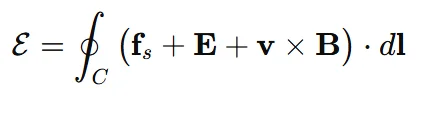
So the formula for emk for a circuit is
1760708819114.webp
where f_s is caused by non emf forces like a battery. E is the electricalfield inside the circuit? v is the velocity of the circuit and B is the external magnetic field. I have difficulty understanding E. There are two "types" of electrical field one caused by charges and one by variation in a external magnetic field. The first one is a conservative field so it does not contribute to emk but the second does.

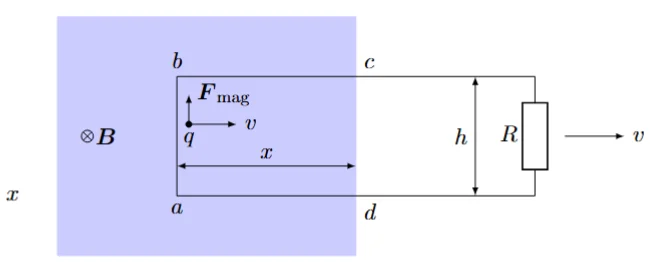
I don't understand the following example
1760709178196.webp
1760709202535.webp
and
1760709215653.webp
.

Why is the only contribution to emk by v x B? Isn't there a variation in the magnetic field because the whole circuit is not in it so the flux through the circuit decreases. Shouldn't that cause an non-conservative E which contributes to the emk?

Another example
1760709692292.webp
. Here a metal ring spins with angular frequency w. The total velocity is 0 and although the magnetic field is constant the spinning of the metal ring causes a variation of the flux through the ring which causes a non conservative E that contributes to emk.

So what is the difference between the first and second example why is E conservative in the first but there is a non conservative E in the second case?


I
 
Physics news on Phys.org
The electric field that you are asking about comes from Faraday's law in integral form when you have no batteries and no moving parts, $$\oint_C\mathbf E\cdot d\mathbf l=-\frac{\partial}{\partial t}\int_S\mathbf B\cdot \mathbf{\hat n}~dA.$$ It is the non-conservative emf that you think is missing.
 
kuruman said:
The electric field that you are asking about comes from Faraday's law in integral form when you have no batteries and no moving parts, $$\oint_C\mathbf E\cdot d\mathbf l=-\frac{\partial}{\partial t}\int_S\mathbf B\cdot \mathbf{\hat n}~dA.$$ It is the non-conservative emf that you think is missing.
Sorry I'm completely lost are you talking about example 1 or 2?
 
I am talking about the ##\mathbf E## in the expression

Screen Shot 2025-10-17 at 10.50.30 AM.webp

that you provided. I assume it is the non-conservative electric field when the magnetic flux is changing with respect to time. How is it defined in the source you got it from? If my assumption is correct, this field is present in both examples.
 
I'm a bit rusty so forgive me -- but in both of those examples, the magnetic field ##\mathbf{B}## is a constant* (in the lab frame), so ##\partial \mathbf{B} / \partial t = 0##.

And this means that ##\mathbf{E}## is a conservative vector field in both of those examples, i.e. ##\int_C \mathbf{E} \cdot d\mathbf{l} = \int_S (\nabla \times \mathbf{E}) \cdot d\mathbf{S} = 0##.

As you pointed out, the EMF is defined by ##\mathcal{E} = \int_C (\mathbf{E} + \mathbf{v} \times \mathbf{B}) \cdot d\mathbf{l} = \int_C \mathbf{E} \cdot d\mathbf{l} + \int_C (\mathbf{v} \times \mathbf{B}) \cdot d\mathbf{l}##. The first term is zero, so you are just left with the integral of ##\mathbf{v} \times \mathbf{B}##.

*[N.B. this assumes the back-reaction due to the currents in the circuit are negligible. I believe this is an explicit assumption in these examples -- i.e. we are told to treat ##\mathbf{B}## is constant and ignore second order corrections. At least, this is the case with the majority of introductory electrodynamics problems].
 
  • Like
Likes   Reactions: TSny

Similar threads

  • · Replies 1 ·
Replies
1
Views
1K
Replies
1
Views
2K
Replies
1
Views
1K
  • · Replies 2 ·
Replies
2
Views
2K
  • · Replies 3 ·
Replies
3
Views
2K
Replies
11
Views
3K
  • · Replies 6 ·
Replies
6
Views
1K
Replies
12
Views
2K
  • · Replies 5 ·
Replies
5
Views
1K
  • · Replies 9 ·
Replies
9
Views
1K