How is x-vt a rightward moving wave?

  • Thread starter Thread starter Jaccobtw
  • Start date Start date
Click For Summary

Homework Help Overview

The discussion revolves around the concept of wave motion, specifically examining the expression x - vt and its implications for the direction of wave propagation. Participants explore how this expression relates to the position of a wave at different times, questioning the interpretation of rightward movement in the context of wave functions.

Discussion Character

  • Exploratory, Conceptual clarification, Mathematical reasoning, Assumption checking

Approaches and Questions Raised

  • Participants discuss the relationship between the wave function and its graphical representation over time, questioning how changes in time affect the position of the wave. Some suggest visualizing the wave's movement through graphs, while others explore the implications of the mathematical form of the wave function.

Discussion Status

The discussion is active, with various interpretations being explored regarding the movement of the wave. Participants have provided insights into how the wave function translates over time and the significance of the parameters involved. There is a recognition of the complexity of visualizing wave motion in a static context.

Contextual Notes

Some participants note the need for additional dimensions or representations to fully grasp the dynamics of wave motion, indicating that the current approach may be limited in capturing the full behavior of the wave as time progresses.
Jaccobtw
Messages
167
Reaction score
32
Homework Statement
How is x-vt a rightward moving wave?
Relevant Equations
f(x-vt) = disturbance
The only way I can see x-vt being a rightward moving wave is if x-vt = some position the wave had initially. As t increases, x-vt gets smaller, despite the fact that it is a rightward moving wave. For example, if x = 10 m and v = 1 m/s, as t increases, x-vt describes a position the wave had in the past. Is this correct intuition?
 
Physics news on Phys.org
It's a rightward moving wave for ##v > 0##. At ##t =0##, the wave takes the form of ##y = f(x)##. Choose a function ##f##. Something simple. For example ##f(x) = x##. Draw that initial state of the wave on a graph.

Then, for ##t = 1##, say, the wave takes the form ##y = f(x -v) = x -v##. Draw that state of the wave on a graph. Take ##v = 1## as well, so that ##y = x - 1##.

Has the wave moved left or right?
 
Another way of looking at this is from the standpoint of the wave.

For positive ##x## at a particular instant in time ##t## and at position ##x##, the function ##f(x-vt)## return a specific value, say ##3## units. Time always increases. At a later time ##t'>t## must ##x## increase, decrease or stay the same for the function to return the same value of ##3## units?
 
PeroK said:
It's a rightward moving wave for ##v > 0##. At ##t =0##, the wave takes the form of ##y = f(x)##. Choose a function ##f##. Something simple. For example ##f(x) = x##. Draw that initial state of the wave on a graph.

Then, for ##t = 1##, say, the wave takes the form ##y = f(x -v) = x -v##. Draw that state of the wave on a graph. Take ##v = 1## as well, so that ##y = x - 1##.

Has the wave moved left or right?
f(x) = 10 for t = 0

For t = 1, and v = 1

10-(1)(1) =9

We began at 10 and now we’re at 9, so hasn’t the wave moved to the left?
 
Jaccobtw said:
f(x) = 10 for t = 0

For t = 1, and v = 1

10-(1)(1) =9

We began at 10 and now we’re at 9, so hasn’t the wave moved to the left?
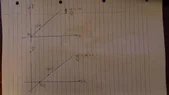
That's not two graphs! This is what the graphs of ##y = x## and ##y = x-1## look like.
 

Attachments

  • Graphs.webp
    Graphs.webp
    18.3 KB · Views: 2
  • Like
Likes   Reactions: Jaccobtw
PS I've shown two points on the wave (P and Q) at times 0 and 1.
 
Another example: consider the function ##f(x)=x^2##, whose graph is a parabola opening upwards, with its vertex at ##(x,y)=(0,0)##.

For ##v=+1##, ##f(x-vt)=(x-t)^2##.

At ##t=0## we have the original function.

At ##t=1##, ##f(x-vt)=(x-1)^2##. It's still a parabola. Where is the vertex?

At ##t=2##, ##f(x-vt)=(x-2)^2##. It's still a parabola. Where is the vertex?
 
  • Like
Likes   Reactions: PeroK
Note that, in general, if ##a > 0## and ##g(x) = f(x-a)##, then ##g(x)## is ##f(x)## translated to the right. One way to see this is to consider a point ##x_0## where ##f(x_0) = 0##. The corresponding zero for the function ##g(x)## is at ##x_1 = x_0 + a##. As ##g(x_1) = f(x_1 - a) = f(x_0 + a - a) = f(x_0) = 0##.

From this, we can see that the zeroes of the function ##g(x)## are the zeroes of the function ##f(x)## translated to the right by ##a##. And, everything else is translated to the right as well,
 
PeroK said:
PS I've shown two points on the wave (P and Q) at times 0 and 1.
PeroK said:
That's not two graphs! This is what the graphs of ##y = x## and ##y = x-1## look like.
Thank you, I think I’ve got it down. (x, f(x)) is where we want to find the disturbance. x-vt is the coordinate in the moving reference frame. It says, what is the disturbance at (x, f(x)) when the wave has moved a distance vt.
 
  • #10
Jaccobtw said:
Thank you, I think I’ve got it down. (x, f(x)) is where we want to find the disturbance. x-vt is the coordinate in the moving reference frame. It says, what is the disturbance at (x, f(x)) when the wave has moved a distance vt.
Perhaps, but ##y = f(x - vt)## is a function of two variables. You need either an animation, or to have an additional ##t## axis. Perhaps with ##t## going into the page. It's not enough, IMO, to try to think of a wave as a static function in 2D.
 
  • #11
I’ll try to offer yet another perspective. The function ##f## describes the shape of the wave. We can consider a point on the wave with a particular constant value of ##f##, call it ##f_0##. Now consider how the point (or more generally, points) with this value are moving with time. We have ##f(x-vt) = f_0## so - assuming ##f## is locally invertible - we must have ##x-vt = c_0## for some constant ##c_0## such that ##f(c_0) = f_0##. Solving for ##x## we find $$x= vt + c_0.$$
Therefore, the ##x## value for which the wave takes the value ##f_0## increases (assuming ##v > 0##) with time. The wave moves to the right.
 
  • Informative
Likes   Reactions: PeroK
  • #12
This somewhat repeats what has already been said, but there is an important underlying point that's maybe worth making explicitly...

Suppose you have any function ##y=f(x)## and some (say positive) constant ##a##.

The graphs of ##y=f(x)## and ##y = f(x-a)## are the same shape - but the graph of ##y=f(x-a)## is shifted in the +ve x direction by an amount ##a##.

(Correspondingly, the graphs of ##y=f(x)## and ##y = f(x+a)## are the same shape - but the graph of ##y=f(x+a)## is shifted in the -ve x direction by an amount ##a##.)

For example:
1769864250610.webp

If the ‘constant’ ##a## increases uniformly over time, this means the graph steadily shifts in the +ve x direction.
 
  • Like
Likes   Reactions: PeroK
  • #13
PeroK said:
Perhaps, but ##y = f(x - vt)## is a function of two variables. You need either an animation, or to have an additional ##t## axis. Perhaps with ##t## going into the page. It's not enough, IMO, to try to think of a wave as a static function in 2D.
What if I phrase it like this: We want to find the disturbance at ##(x, f(x))## at time ##t## when the wave travels at velocity ##v##. Subtraction shifts the graph to the right. ##x - vt## is smaller than ##x## because it gives the coordinate where we want to find the disturbance in the moving reference frame.
 
  • #14
Jaccobtw said:
What if I phrase it like this: We want to find the disturbance at ##(x, f(x))## at time ##t## when the wave travels at velocity ##v##. Subtraction shifts the graph to the right. ##x - vt## is smaller than ##x## because it gives the coordinate where we want to find the disturbance in the moving reference frame.
Or, let the mathematics speak for itself. See post #12 by Steve.
 
  • Like
Likes   Reactions: SammyS

Similar threads

  • · Replies 4 ·
Replies
4
Views
2K
Replies
4
Views
2K
  • · Replies 13 ·
Replies
13
Views
2K
  • · Replies 30 ·
2
Replies
30
Views
3K
  • · Replies 13 ·
Replies
13
Views
2K
  • · Replies 1 ·
Replies
1
Views
2K
  • · Replies 2 ·
Replies
2
Views
1K
  • · Replies 1 ·
Replies
1
Views
3K
  • · Replies 30 ·
2
Replies
30
Views
3K
  • · Replies 9 ·
Replies
9
Views
3K