LucKy
- 4
- 1
Hello all
I summarised my question on the attached picture
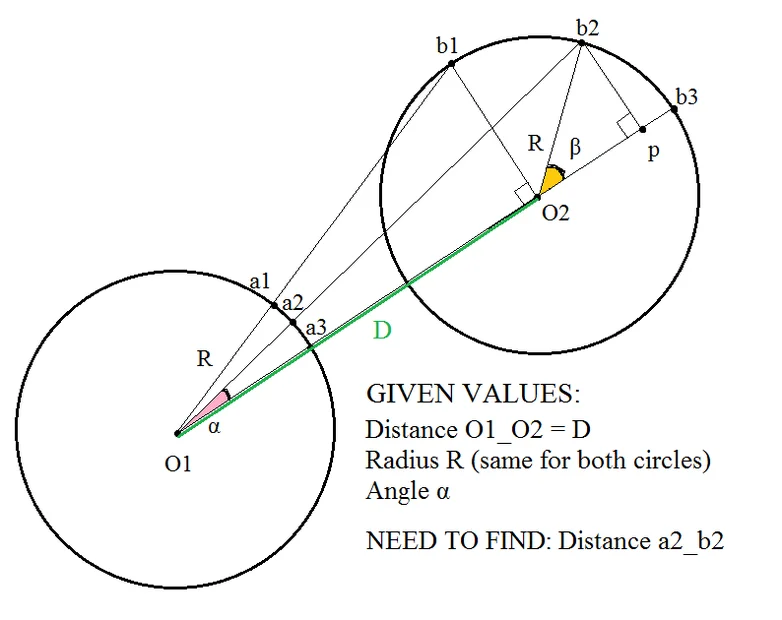
I will wery appreciate if somebody can confirm:
Does my attempt to find distance a2_b2 correct? Is there simplier method?
It is not a homework, It is for my hobby project.
(I want to simulate my robot's sensor readings in some situations)
My attempt:
Step 1. Calculate ## {\angle \beta} ##:
Assume ##{\angle \beta}## is directly proportional to ##{\angle \alpha}## (NOT SURE!)
$$ \frac {\angle \beta} {\angle \alpha} = \frac {\angle b1\_O2\_b3 } {\angle a1\_O1\_a3} $$
$$ {\angle b1\_O2\_b3 }= \frac \pi 2 \text{ , } {\angle a1\_O1\_a3} = \tan^{-1}(\frac R D) $$
$$ {\angle \beta} = \frac {\angle \alpha * \frac \pi 2} {\tan^{-1}(\frac R D)} $$
Step2. Calculate distance O2_p:
$$ {O2\_p} = {R*\cos(\beta)}$$
Step3. Calculate distance O1_p
$$ {O1\_p} = {D + O2\_p} = {D + R*\cos(\beta)}$$
Step4. Calculate distance O1_b2
$$ {O1\_b2} = \frac {O1\_p} {\cos(\alpha)} = \frac {D + R*\cos(\beta)} {\cos(\alpha)}$$
Step5. (Final) Calculate distance a2_b2
$$ {a2\_b2} = {O1\_b2 - R} = \frac {D + R*\cos(\beta)} {\cos(\alpha)} - R \text{, where } {\angle \beta} = \frac {\angle \alpha * \frac \pi 2} {\tan^{-1}(\frac R D)} $$
I summarised my question on the attached picture
I will wery appreciate if somebody can confirm:
Does my attempt to find distance a2_b2 correct? Is there simplier method?
It is not a homework, It is for my hobby project.
(I want to simulate my robot's sensor readings in some situations)
My attempt:
Step 1. Calculate ## {\angle \beta} ##:
Assume ##{\angle \beta}## is directly proportional to ##{\angle \alpha}## (NOT SURE!)
$$ \frac {\angle \beta} {\angle \alpha} = \frac {\angle b1\_O2\_b3 } {\angle a1\_O1\_a3} $$
$$ {\angle b1\_O2\_b3 }= \frac \pi 2 \text{ , } {\angle a1\_O1\_a3} = \tan^{-1}(\frac R D) $$
$$ {\angle \beta} = \frac {\angle \alpha * \frac \pi 2} {\tan^{-1}(\frac R D)} $$
Step2. Calculate distance O2_p:
$$ {O2\_p} = {R*\cos(\beta)}$$
Step3. Calculate distance O1_p
$$ {O1\_p} = {D + O2\_p} = {D + R*\cos(\beta)}$$
Step4. Calculate distance O1_b2
$$ {O1\_b2} = \frac {O1\_p} {\cos(\alpha)} = \frac {D + R*\cos(\beta)} {\cos(\alpha)}$$
Step5. (Final) Calculate distance a2_b2
$$ {a2\_b2} = {O1\_b2 - R} = \frac {D + R*\cos(\beta)} {\cos(\alpha)} - R \text{, where } {\angle \beta} = \frac {\angle \alpha * \frac \pi 2} {\tan^{-1}(\frac R D)} $$
Last edited: