-6dB loss phemonena in differential pair signaling

  • Thread starter Thread starter yefj
  • Start date Start date
yefj
Messages
111
Reaction score
2
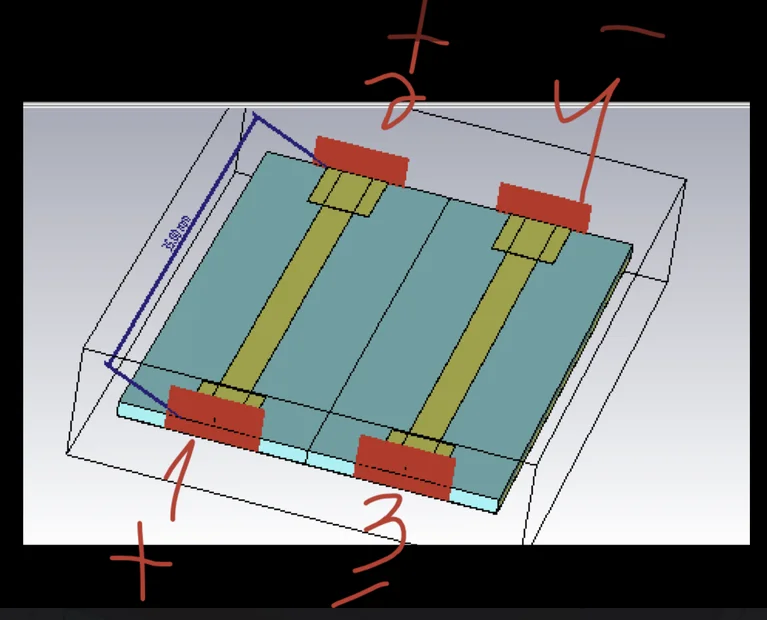
In differential port 1 we have same power going threw 1 SE and 3 SE. we get the ouput at 2 SE and 4 SE.

suppose 2SE is faulty.What whould be the value of SDD21?how SDD21 in that case? What is the mathematical logic we get -6dB in SDD21? Thanks.
1780110344773.webp
 
Engineering news on Phys.org
could you clear something p for me please? Is that diagram of what I would have called a 3dB coupler or Hybrid?)- with two quarter wave 3db coupled lines? (1-2 and 3-4 ). Of so, I would expect the inputs for1 and 4 to combine in phase and the output from 1 to be +6dB and the output from 3 to be zero (many negative dB to nearly zero power) when the inputs to 1 and 4 are equal and co-phase. In practice, unbalanced power would emerge from 3.

From what you have said, you seem to be connecting 1 and 3. The device I used to be familiar with should have its inputs at 1 and 4.

Perhaps you could try that and see if the result is more what you want.
It's at least 30 years since I made and used one of these and it was all UHF (below GHz) with clunky micro strip but the theory should still be the same.
 
yefj said:
In differential port 1 we have same power going threw 1 SE and 3 SE. we get the ouput at 2 SE and 4 SE.

suppose 2SE is faulty.
Based on so little solid information, you really cannot expect us to guess, but you don't answer questions, so here goes ...

I assume there is a ground plane below the tracks. You have a balanced line between 1 and 3, with an unbalanced line between 2 and 4. Since 2 is faulty, I assume it is shorted to the ground plane. The impedance of the output is half that of the input, so you may have built a balun transmission line transformer with a 100:50 impedance ratio.
I have no idea how you are instrumenting or terminating the lines. If you expect an output voltage that is 1/2 of the input, then that will be 1/4 of the power = -6dB.

If your VNA has balanced 100Ω transmitter inputs, 1 and 3, each of which is a 50Ω coaxial connector, then the VNA may be doing something with the computation since the receiver inputs 2 and 4 are not balanced.
 
Baluncore said:
Based on so little solid information, you really cannot expect us to guess, but you don't answer questions, so here goes ...
Little information; yes. I was thinking that the layout is like the well known directional coupler design of which there are millions on micro strip and smaller:
1780919599100.webp

the signal paths are shown to be 'diagonal'., which agrees with my last post Does this fit in with the OP's description? I notice the OP's diagram is a CAD version; what's actually in the real test device and how is it actually being connected? It could affect the result, without anything being actually wrong with the device.
 
sophiecentaur said:
Does this fit in with the OP's description?
With much closer tracks, above a ground plane, it would form a backward wave coupler, but the tracks are not close coupled, they are widely separated, and remain parallel.

I suspect the OP is testing a 100Ω parallel differential transmission line, formed from two parallel 50Ω tracks, each above a ground plane, with each side of the differential fed through a 50Ω coaxial connector.

The track fault hypothesised could be a coaxial connector series-open, or parallel-short, both of which would have λ dependent reflections.

We will probably never find out if this was an EM simulation, or a prototype under test.
 
A simulation with a built in error? You what?
 
Baluncore said:
I suspect the OP is testing a 100Ω parallel differential transmission line, formed from two parallel 50Ω tracks, each above a ground plane, with each side of the differential fed through a 50Ω coaxial connector.
You have used two alternative terms for essentially the same thing.
It all depends on the ratio of the balanced and unbalanced impedances and we can't see the ground plane so we can't know. The coupler is very basic so it's going to have a limited bandwidth but, whatever its purpose, it's either a splitter or combiner and the logic of the connections will be the same. I can't see how the OP can be using it correctly because his two inputs aren't connected right (unless he knows something about the unseen parts of the picture).
 
Maybe the OP has gone away??
 
sophiecentaur said:
A simulation with a built in error? You what?
There is history, but no pictures available in previous threads. Some posts are like quicksand, the more you struggle, the sooner you drown in the delusion of engineering.
sophiecentaur said:
Maybe the OP has gone away??
Yes, but they will usually return with another question, probably in another thread, in a couple of days. I have found the important thing is not to take it too seriously. If it was serious, then pictures would be available, and sufficient data would have been provided.
 
  • Like
Likes   Reactions: sophiecentaur

Similar threads

  • · Replies 58 ·
2
Replies
58
Views
6K
  • · Replies 7 ·
Replies
7
Views
2K
Replies
7
Views
2K
  • · Replies 3 ·
Replies
3
Views
2K
Replies
37
Views
8K
  • · Replies 1 ·
Replies
1
Views
2K
  • · Replies 3 ·
Replies
3
Views
3K
  • · Replies 4 ·
Replies
4
Views
3K
  • · Replies 17 ·
Replies
17
Views
4K
  • · Replies 11 ·
Replies
11
Views
8K