BJT differential amplifier, small signal analysis

Click For Summary

Discussion Overview

The discussion revolves around the small-signal analysis of BJT differential amplifiers, focusing on the input and output impedance of the differential pair and the implications of grounding the emitter in the small-signal equivalent circuit.

Discussion Character

  • Technical explanation
  • Mathematical reasoning
  • Debate/contested

Main Points Raised

  • One participant describes the grounding of the emitter in the small-signal circuit and its implications for analyzing the circuits of Q1 and Q2 separately.
  • Another participant provides links to resources that may assist in understanding the differential pair.
  • Several participants inquire about the input and output impedance of the differential amplifier, with one suggesting it is 2βr_e under certain conditions.
  • Another participant argues that the input impedance is not low and becomes high only with negative feedback, providing an example with specific values.
  • One participant suggests that the input impedance can be calculated as 2*r_pi based on circuit inspection, while the output impedance is proposed to be 2*Rc if ro is very high.
  • Disagreement arises regarding the output impedance of a single CE amplifier, with one participant asserting it is not equal to ro/(β+1) and providing an alternative formula for the differential output impedance.
  • A participant describes their method for calculating input impedance using a test generator and seeks confirmation on their approach.
  • Another participant confirms the method for finding input and output impedance and provides a formula for output impedance under the assumption of symmetry.

Areas of Agreement / Disagreement

There is no consensus on the output impedance of a single CE amplifier, with conflicting views presented. Participants express differing opinions on the calculations and implications of input and output impedance in the context of the differential amplifier.

Contextual Notes

Some calculations and assumptions depend on specific circuit conditions, such as the presence of negative feedback or the values of resistances involved, which remain unresolved in the discussion.

eliotsbowe
Messages
34
Reaction score
0
Hello, I'm having some issues with small-signal analysis of BJT differential amplifiers.

Let's say I have this BJT differential pair and suppose that Q1 and Q2 perfectly match: http://i50.tinypic.com/14ahdgn.jpg

Suppose a small differential input is applied and consider the small–signal equivalent circuit:
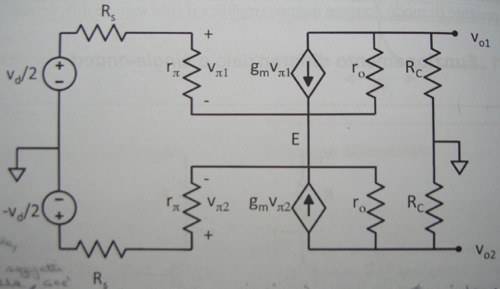
2eajod3.jpg


Having two opposite-phase inputs with the same amplitude (\frac{v_d}{2} , - \frac{v_d}{2}) makes the potential of the emitter E stuck at its initial value.

My book says that:
- If the potential of E is stuck at its value, then E can be considered as a ground point for the small-signal circuit;
- If E is grounded, then every point the two circuits have in common is grounded; this means that the two circuits become totally independent one from each other and I can solve the small-signal circuit of Q1 and Q2 separately;

Can anyone please explain me the reason for these two statements?

One last question: both small-signal circuits of Q1 and Q2 have an input impedance r_\pi and an output impedance Rc || r_o.
What's the input/output impedance of the whole differential pair?

Thanks in advance for your time.
 
Engineering news on Phys.org
Thanks. I managed to solve the first two questions and I found something I was looking for in the pdf you've linked.

Now there's one pending question: what's the input/output impedance of the differential couple?

I mean: if I connect some circuit component to the two inputs of the differential amplifier, what impedance is the component going to "see"?
 
Don't quote me on this as it's been a long time. I believe is 2βr_e=2\frac β {g_m}\;. The emitter of one transistor only see the r_e\; of the other, assuming the tail resistor is much higher resistance.
 
Well, thanks for trying, but I'm interested in the procedure to find the two impedances!
 
I am pretty sure it is correct, input impedance of diff pair is not low. It become high impedance only when you add negative feedback and move the other side to follow the input.

Think about a normal diff pair in an opamp, the tail current say is 10uA. So it is 5uA each.

r_e=1/gm= \frac {V_T}{I_c}≈\frac {25mV}{5\mu A}=5000,\;\; β=100\;\Rightarrow 2β r_e= 1MΩ

That is in the ball part of the input impedance of some opamp when it is open loop. The impedance only get higher due to negative feedback.
 
Last edited:
eliotsbowe,

Now there's one pending question: what's the input/output impedance of the differential couple?

I mean: if I connect some circuit component to the two inputs of the differential amplifier, what impedance is the component going to "see"?

You can tell just from inspection of the schemat what the impedances will be. Assuming ro is very high, the input circuit goes through the two r_pi resistors, so the impedance will be 2*r_pi. The output impedance is 2*Rc by inspection if ro is very large. Otherwise I would think it would be 2*Rc||ro/(β+1), because the output impedance of a single CE transistor diminishes by ro/(β+1)

Ratch
 
I disagree with output impedance of a single CE amplifier is not equal ro/(β+1).
As for differential output impedance Rout = (2Rc*ro)/(Rc + ro)
 
Okay, I think I got it.
Just one thing: to compute the input impedance of a circuit, I usually disconnect the signal generator and its own resistance and replace it with a test generator, let's say a voltage generator Vx. The input impedance is defined as Vx / Ix , where Ix is the current flowing through the generator.

If I want to apply this method to the differential pair, I guess I should disconnect both \frac{v_d}{2} and -\frac{v_d}{2} (and the two R_s resistors) and replace them with a test generator connected between the positive terminals of the two r_\pi resistors.
Is this right?
 
  • #10
Yes, you use this circuit to find Rin
attachment.php?attachmentid=50889&stc=1&d=1347795670.jpg


And this one to find Rout
attachment.php?attachmentid=50890&stc=1&d=1347795705.jpg

And from this diagram when we assume full symmetry. From the inspection we can see that
Rout = Vt/It = 2Rc||2ro
 

Attachments

  • 2ea.JPG
    2ea.JPG
    13.5 KB · Views: 1,071
  • 2eaj.JPG
    2eaj.JPG
    14.7 KB · Views: 1,055
Last edited:
  • #11
Ok, thanks!
 
  • #12
Jony130,

Sorry I did not get back sooner.

I disagree with output impedance of a single CE amplifier is not equal ro/(β+1).
As for differential output impedance Rout = (2Rc*ro)/(Rc + ro)

Yes, you are correct. The output impedance of a CE is ro/(β+1) only if it is driven by a current source. Otherwise, in this voltage driven case, it is ro as you pointed out.

Ratch
 

Similar threads

  • · Replies 20 ·
Replies
20
Views
4K
  • · Replies 1 ·
Replies
1
Views
2K
Replies
2
Views
2K
  • · Replies 10 ·
Replies
10
Views
2K
  • · Replies 21 ·
Replies
21
Views
3K
  • · Replies 3 ·
Replies
3
Views
3K
  • · Replies 47 ·
2
Replies
47
Views
5K
  • · Replies 29 ·
Replies
29
Views
5K
  • · Replies 8 ·
Replies
8
Views
2K
  • · Replies 22 ·
Replies
22
Views
10K