Just another postscript...
The OP recently posted a question about the reciprocal spacetime interval (##a=1##) at
Hello!
I have a problem with understanding homogeneity of the space.
In the book Landau&Lifshitz it was written that two spacetime intervals differ by constant ##a##: ##ds'^2=ads^2##
The coefficient ##a## can't depend on coordinates or time of interval because this violated homogeneity of the space.
My questions are:
1. Could anyone explain on the examples what does "violated homogeneity of the space" mean in this case?
2. How does dependence of coordinates and time of the interval violate homogeneity of the space?
As hard as I tried I couldn't understand it many times.
Thanks.
I thought a spacetime interval argument may help
@Mike_bb.
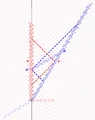
I define some events as above:
- E0: clocks A and B are reset to ##0s##
- E2: clock B shows ##80s##
- E4: clock A shows ##80s##
For convenience, I define, that all events have their y- and z-coordinates ##=0## and I omit these coordinates.
In observer B's frame (x', t') the time interval between E0 and E2 is
##\Delta t'_{20} = t'_2 - t'_0 = 80s \ \ \ \ \ (1)##
In observer B' frame (x', t') the distance between E0 and E2 is (the clock is at rest in this frame)
##\Delta x'_{20} = x'_2 - x'_0 = 0m \ \ \ \ \ (2)##
The invariant spacetime interval is
##s^2=c^2\Delta t^2 - \Delta x^2= c^2\Delta t'^2 - \Delta x'^2##
Inserting values from equations (1) and (2):
##c^2\Delta t_{20}^2 - \Delta x_{20}^2= c^2(80s)^2 - (0m)^2##
##c^2\Delta t_{20}^2 - v^2\Delta t_{20}^2= c^2(80s)^2##
##c^2\Delta t_{20}^2(1 - v^2/c^2)= c^2(80s)^2##
In observer A's frame (x, t), clock B shows ##80s## at the coordinate-time:
##\Delta t_{20}= \gamma (80s) = 100s##
----------------------------
Reciprocal calculation:
In observer A's frame (x, t) the time interval between E0 and E4 is
##\Delta t_{40} = t_4 - t_0 = 80s \ \ \ \ \ (3)##
In observer A's frame (x, t) the time interval between E0 and E4 is (the clock is at rest in this frame)
##\Delta x_{40} = x_4 - x_0 = 0m \ \ \ \ \ (4)##
Again, the invariant spacetime interval is
##s^2=c^2\Delta t^2 - \Delta x^2= c^2\Delta t'^2 - \Delta x'^2##
Inserting values from equations (3) and (4):
##c^2\Delta {t'_{40}}^2 - \Delta {x'_{40}}^2= c^2(80s)^2 - (0m)^2##
##c^2\Delta {t'_{40}}^2 - v^2\Delta {t'_{40}}^2= c^2(80s)^2##
##c^2\Delta {t'_{40}}^2(1 - v^2/c^2)= c^2(80s)^2##
In observer B's frame (x', t'), clock A shows ##80s## at the coordinate-time:
##\Delta t'_{40}= \gamma (80s) = 100s##