How does reciprocal time dilation work?

  • Context: Undergrad 
  • Thread starter Thread starter Mike_bb
  • Start date Start date
Join the discussion
Registration is free. Ask a follow-up in this thread, or start your own.
85 replies · 3K views
Mike_bb said:
Time doesn't depend on frames. Only time interval depends on the frames. (as in example above)
This statement suggest you still do not grasp the relativity of simultaneity. Consider for space like separated events ##A,B##, I can always find 2 inertial reference frames, one in which ##A## has a coordinate time before ##B## and another one in which ##B## has a coordinate time before ##A##.
 
  • Like
  • Informative
Likes   Reactions: Mike_bb, Sagittarius A-Star, PeterDonis and 1 other person
Physics news on Phys.org
Mike_bb said:
[clock A = 80s] and [clock B = 100s]
In which frame? (And please use complete sentences)


Mike_bb said:
[clock A = 100s] and [clock B = 80s].
In what frame? (And please use complete sentences)


Mike_bb said:
clock a=80s -> clock a=100s - it's correct.
What is correct? Please use complete sentences.


Mike_bb said:
But how is it possible that clock b = 100s -> clock=80s ?
So close to a complete sentence. What is the second clock here and what does the arrow mean?

Mike_bb said:
The clock is running backwards.
Yay for a complete sentence. The sentence is false, but at least it is complete.

What makes you believe that any clock is running backwards? If you draw a spacetime diagram you will be able to see that neither clock ever runs backwards.

Even if you choose not to do the diagram, I am going to have to insist that you start writing in complete sentences.
 
  • Agree
Likes   Reactions: Mike_bb and Bystander
A simple explanation of the relativity of simultaneity is given in Morin's book "Special Relativity: For the Enthusiastic Beginner", chapter 1.3.1

Event 1 is “light hitting the left receiver”
Event 2 is “light hitting the right receiver”

In A's reference frame, E1 and E2 happen simultaneously.
In B's reference frame, E1 happened before E2 happens.

rel-sych.webp

source:
https://davidmorin.physics.fas.harv...nuum12331/files/2025-10/relativity_chap_1.pdf
via:
https://davidmorin.physics.fas.harvard.edu/books/special-relativity
 
  • Like
Likes   Reactions: Mike_bb
Mike_bb said:
Case 1) Reference frame: A
E1: clock A shows 100s
E2: clock B shows 80s

Case 2) Reference frame: B
E3: clock B shows 100s
E4: clock A shows 80s

I think you need to write out...
  • I'm going to use "reads" to avoid possible misinterpretations
    when using anything suggesting what it "visually looks like".

According to observer A, E1 (clock A reads 100) and E2 (clock B reads 80) are simultaneous.

According to observer B, E3 (clock B reads 100) and E4 (clock A reads 80) are simultaneous.
 
  • Like
  • Agree
Likes   Reactions: Mike_bb and Dale
Mike_bb said:
Time doesn't depend on frames. Only time interval depends on the frames.
You have it exactly backwards:
- Time coordinates assigned to events depend on reference frames, because they assign them.
- Time intervals measured by clocks between events local to that clock are frame invariant.
 
  • Like
Likes   Reactions: Mike_bb
Sagittarius A-Star said:
A simple explanation of the relativity of simultaneity is given in Morin's book "Special Relativity: For the Enthusiastic Beginner", chapter 1.3.1

Event 1 is “light hitting the left receiver”
Event 2 is “light hitting the right receiver”

In A's reference frame, E1 and E2 happen simultaneously.
In B's reference frame, E1 happened before E2 happens.


source:
https://davidmorin.physics.fas.harv...nuum12331/files/2025-10/relativity_chap_1.pdf
via:
https://davidmorin.physics.fas.harvard.edu/books/special-relativity
This is nice example. Thanks! But for our example you wrote that:

With reference to Observer B's rest-frame:
Clock B first shows 80s (E2) and 20s later clock B shows 100s (E3). Clock A shows then 80s.

From frame B: clock B shows 100s(E3), clock A shows 80s. Then clock A shows 100s, clock B shows 125s. But E1 (clock A shows 100s), E2(clock B shows 80s). 125s isn't equal to 80s.

Where did I go wrong? THx.
 
Mike_bb said:
From frame B: clock B shows 100s(E3), clock A shows 80s. Then clock A shows 100s, clock B shows 125s. But E1 (clock A shows 100s), E2(clock B shows 80s). 125s isn't equal to 80s.

Where did I go wrong? THx.
The same place you've been going wrong for the whole thread. You swap frames mid sentence and don't understand the difference between events and coordinate time. You don't grasp what the relativity of simultaneity means.

At some point, you will just have to sit down and work it out yourself. Everything to answer your misconceptions already exist within this thread, posted from multiple different angles by multiple posters.

Asking the same question over and over again will just hit a wall.
 
Matterwave said:
The same place you've been going wrong for the whole thread. You swap frames mid sentence and don't understand the difference between events and coordinate time. You don't grasp what the relativity of simultaneity means.

At some point, you will just have to sit down and work it out yourself. Everything to answer your misconceptions already exist within this thread, posted from multiple different angles by multiple posters.

Asking the same question over and over again will just hit a wall.
If from frame B clock A shows 100s then in frame A clock A shows 100s. What's wrong?
 
  • Sad
Likes   Reactions: Matterwave
Matterwave said:
The same place you've been going wrong for the whole thread. You swap frames mid sentence and don't understand the difference between events and coordinate time. You don't grasp what the relativity of simultaneity means.

At some point, you will just have to sit down and work it out yourself. Everything to answer your misconceptions already exist within this thread, posted from multiple different angles by multiple posters.

Asking the same question over and over again will just hit a wall.
Well, see post #50:

With reference to Observer B's rest-frame:
Clock B first shows 80s (E2) and ##20s## later clock B shows 100s (E3). Clock A shows then ##100s/\gamma=80s##.

With reference to Observer A's rest-frame:
Clock B first shows 80s (E2) and ##\gamma20s## later clock B shows 100s (E3). Clock A shows then ##\gamma100s=125s##.
 
Mike_bb said:
If from frame B clock A shows 100s then in frame A clock A shows 100s. What's wrong?
Two straight roads cross each other, making an angle ##\theta##. Two cars driving on the two roads at the same speed pass through the intersection at the same time. A time ##t## later, the driver of one car notes that he has proceeded a distance ##vt## along his road and the other car is falling behind because it is only doing ##v\cos\theta## in his forward direction. The other driver also notes that she has driven a distance ##vt## and the first car has fallen behind because it is only doing ##v\cos\theta## in her forward direction.

So both cars are behind and both are ahead. Is this a paradox?
 
Ibix said:
Two straight roads cross each other, making an angle ##\theta##. Two cars driving on the two roads at the same speed pass through the intersection at the same time. A time ##t## later, the driver of one car notes that he has proceeded a distance ##vt## along his road and the other car is falling behind because it is only doing ##v\cos\theta## in his forward direction. The other driver also notes that she has driven a distance ##vt## and the first car has fallen behind because it is only doing ##v\cos\theta## in her forward direction.

So both cars are behind and both are ahead. Is this a paradox?
I provided example in post#69.
 
Mike_bb said:
Time doesn't depend on frames.
The time-coordinate of an inertial frame is defined by a grid of synchronized clocks, which are all at rest with reference to this frame.

The Einstein-synchronization is based on the definition, that the one-way-speed of light is isotropic.
But regardless which definition you use for synchronizing the clock-grid, simultaneity between events will always be frame-dependent.

Mike_bb said:
This is nice example. Thanks! But for our example you wrote that:
From frame B: clock B shows 100s(E3), clock A shows 80s. Then clock A shows 100s, clock B shows 125s. But E1 (clock A shows 100s), E2(clock B shows 80s). 125s isn't equal to 80s.

Where did I go wrong? THx.
You missed the relativity (=frame-dependency) of simultaneity. See posting #50.

With reference to frame B the events [clock B = 100s] and [clock A = 80s] happen simultaneous to each other.
With reference to frame A the events [clock B = 100s] and [clock A = 125s] happen simultaneous to each other.
 
Last edited:
  • Like
Likes   Reactions: Mike_bb
Sagittarius A-Star said:
With reference to frame B the events [clock B = 100s] and [clock A = 80s] happen simultaneous to each other.
With reference to frame A the events [clock B = 100s] and [clock A = 125s] happen simultaneous to each other.
Yes, I agree with this, there is no contradiction. But why did you write about these events? I asked about that from frame B clock A shows 80s (as you mentioned in post#50) then clock A shows 100s. Which time does clock B show?
 
  • Sad
Likes   Reactions: Matterwave and weirdoguy
Mike_bb said:
Yes, I agree with this, there is no contradiction. But why did you write about these events? I asked about that from frame B clock A shows 80s (as you mentioned in post#50) then clock A shows 100s. Which time does clock B show?
With reference to frame A the events [clock A = 100s] and [clock B = 80s] happen simultaneous to each other.
With reference to frame B the events [clock B = 100s] and [clock A = 80s] happen simultaneous to each other.
 
  • Like
Likes   Reactions: Mike_bb
Mike_bb said:
I provided example in post#69.
We are 70+ posts into this thread and you are still banging your head on the same confusion.

Can you resolve the paradox of the cars being both ahead and behind? Because it is closely analogous to the issue you can't resolve in relativity.
 
Sagittarius A-Star said:
With reference to frame A the events [clock A = 100s] and [clock B = 80s] happen simultaneous to each other.
With reference to frame B the events [clock B = 100s] and [clock A = 80s] happen simultaneous to each other.
That's the point, [clock A = 100s] and [clock B = 80s]. I suggest following simultaneously events:
With reference to frame B the events [clock B = 125s] and [clock A = 100s]. Such way we have a contradiction because [clock A=100s] and [clock B=80s] are simultaneously events but [clock B = 125s] and [clock A = 100s] are also simultaneously events. How to be in this case?
 
  • Sad
Likes   Reactions: Matterwave and weirdoguy
Mike_bb said:
I suggest following simultaneously events:
With reference to frame B the events [clock B = 125s] and [clock A = 100s]. Such way we have a contradiction because [clock A=100s] and [clock B=80s] are simultaneously events but [clock B = 125s] and [clock A = 100s] are also simultaneously events. How to be in this case?
With reference to which frame is the highlighted statement valid?
 
  • Like
Likes   Reactions: Mike_bb
Sagittarius A-Star said:
With reference to which frame is the highlighted statement valid?
frame A
 
  • Agree
Likes   Reactions: Sagittarius A-Star
Mike_bb said:
frame A
That means there is no contradiction, analog to what you wrote in posting #73:

Mike_bb said:
Yes, I agree with this, there is no contradiction.
 
  • Agree
Likes   Reactions: Mike_bb
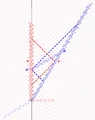
Here's my graphical attempt to help you @Mike_bb .

After a summary-and-diagram,
there is a second diagram with an exercise for you to do.


First, here's a simplified summary of radar measurements by Alice (in red) and by Bob (in blue).
  • Let P' be the event "[on Bob's worldline] Bob's wristwatch reads 8".
    So, ##t_{P',{\rm says\ Bob}}=8##.

    Alice assigns coordinates to distant-event P'
    by sending the appropriate light-signal (when her watch reads ##t_s=4##) to reach P'
    and waiting to receive its echo (when ##t_r=16##).
    She assigns the time ##t_{P',{\rm says\ Alice}}=(16+4)/2=10##.
    Alice says the midpoint-event P ("[on Alice's worldline] Alice's wristwatch reads 10")
    is simultaneous with distant-event P' ("[on Bob's worldline] Bob's wristwatch reads 8").
  • Similarly (swapping Alice and Bob, and Ps and Qs),
    Let Q' be the event "[on Alice's worldline] Alice's wristwatch reads 8".
    So, ##t_{Q',{\rm says\ Alice}}=8##.

    Bob assigns coordinates to distant-event Q'
    by sending the appropriate light-signal (when his watch reads ##t_s=4##) to reach Q'
    and waiting to receive its echo (when ##t_r=16##).
    He assigns the time ##t_{Q',{\rm says\ Bob}}=(16+4)/2=10##.
    Bob says the midpoint-event Q ("[on Bob's worldline] Bob's wristwatch reads 10")
    is simultaneous with distant-event Q' ("[on Alice's worldline] Alice's wristwatch reads 8").
1786349315594.webp


Important exercise

Consider the event E "[on Alice's worldline] Alice's watch reads 10".
Use the radar construction on the diagram below to answer
  1. What event on Bob's worldline does Alice regard as simultaneous with E?
  2. What event on Bob's worldline does Bob regard as simultaneous with E?

    1786351384021.webp

View the next line after finishing the construction.


For the event E "[on Alice's worldline] Alice's watch reads 10",
Alice regards the event "[on Bob's worldline] Bob's watch reads 8" as simultaneous with E,
whereas
Bob regards the event "[on Bob's worldline] Bob's watch reads 12.5" as simultaneous with E.


Alice would choose the event on Bob's worldline such that
"its associated send-and-receive-pair-of-events has midpoint-event as E (which is on her worldline)".
- One could search: does the reflection-event associated with (say) 9-and-11 meet Bob's worldline? If not, try 8-and-12, etc...
- Alternatively, one could pick an arbitrary event on Bob's worldline, then note the associated send-and-receive-pair-of-events on Alice's worldline. If its midpoint-event isn't E, try another event on Bob's worldline. (Think "similar triangles".)

Bob would choose the event on Bob's worldline such that
it is the midpoint-event of the "send-and-receive-pair-of-events associated with E (which is not on his worldline)".
- Draw the lightcone-of-E (just the light-signals from E) and note the intersection-events with Bob's worldline.
 

Attachments

  • 1786348425611.webp
    1786348425611.webp
    113.7 KB · Views: 1
  • 1786351192158.webp
    1786351192158.webp
    104.9 KB · Views: 1
Last edited:
  • Like
Likes   Reactions: Mike_bb
Mike_bb said:
That's the point, [clock A = 100s] and [clock B = 80s].
This is an incomplete sentence. You have named two events, so you have the subject of the sentence, but not the verb. Please use complete sentences.

Mike_bb said:
I suggest following simultaneously events:
With reference to frame B the events [clock B = 125s] and [clock A = 100s].
Good. This is a complete sentence, you identified the reference frame, and made a correct statement.

Mike_bb said:
Such way we have a contradiction because [clock A=100s] and [clock B=80s] are simultaneously events
This statement is incomplete, which makes it appear false. You have (again) made a statement about simultaneity without specifying the reference frame. In your previous statement you explicitly established that you are talking about simultaneity in frame B. So, without an explicit statement about the reference frame, the implicit frame is still frame B. In frame B the events [clock A = 100 s] and [clock B = 80 s] are not simultaneous. So, as written, this statement is false.

Mike_bb said:
but [clock B = 125s] and [clock A = 100s] are also simultaneously events
Again, this is incomplete. In which frame are they simultaneous? You have not stated explicitly. Without an explicit statement the implicit frame would still be B. So this statement would be true, but unclear because of the lack of an explicit statement about which frame to use.

Mike_bb said:
How to be in this case?
It cannot be. Your second statement is false due to your continued use of incomplete sentences.

You are not going to learn this material without drawing (preferably by hand) the diagram, either the one I suggested or the one @robphy suggested. But whether you choose to do that or not, you must start using complete sentences. Every single statement about simultaneity must include the reference frame to which it refers.
 
  • Like
Likes   Reactions: Mike_bb, robphy and Sagittarius A-Star
Sagittarius A-Star said:
The time-coordinate of an inertial frame is defined by a grid of synchronized clocks, which are all at rest with reference to this frame.

Let me visualize this.

Reference frame A:
Code:
Clock B:             [0s] -->
Frame A clock grid:  [0s]   [0s]   [0s]   [0s]   [0s]   [0s]   [0s]
                    --------> x

Clock B:                             --> [ 40s]
Frame A clock grid: [ 50s] [ 50s] [ 50s] [ 50s] [ 50s] [ 50s] [ 50s]
                    --------> x

Clock B:                                                  --> [ 80s]
Frame A clock grid: [100s] [100s] [100s] [100s] [100s] [100s] [100s]
                    --------> x

Reference frame B:
Code:
Clock A:                                                   <-- [0s]
Frame B clock grid:  [0s]   [0s]   [0s]   [0s]   [0s]   [0s]   [0s]
                                                                  --------> x'

Clock A:                             <-- [ 40s]
Frame B clock grid: [ 50s] [ 50s] [ 50s] [ 50s] [ 50s] [ 50s] [ 50s]
                                                                  --------> x'

Clock A:            [ 80s] <-- 
Frame B clock grid: [100s] [100s] [100s] [100s] [100s] [100s] [100s]
                                                                  --------> x'

When you define one frame as the "stationary frame", then the moving clock will always be directly compared to that clock of the stationary clock grid, which is next to it.
 
Last edited:
  • Informative
Likes   Reactions: Mike_bb
Mike_bb said:
How to be in this case?
More precise.
 
  • Agree
Likes   Reactions: Mike_bb
Thanks to all! I solved my problems! Please don't ban me.
 
  • Like
Likes   Reactions: Sagittarius A-Star
Mike_bb said:
Thanks to all! I solved my problems! Please don't ban me.
Why would you be banned?
 
  • Agree
Likes   Reactions: Mike_bb
robphy said:
Why would you be banned?
Let's don't go there.

Mike_bb said:
Thanks to all! I solved my problems! Please don't ban me.
Great. Thread closed temporarily for moderation.