Detecting if resistances are parallel or series in complex circuits

Click For Summary
SUMMARY

This discussion focuses on identifying whether resistors in complex circuits are arranged in series or parallel and finding their equivalent resistance. Resistors are classified as parallel if they connect to the same two nodes, while they are in series if they are connected end-to-end without any other connections. The key to solving complex resistor arrangements lies in redrawing the circuit to maintain electrical connections, disregarding the physical layout. Advanced configurations may require Kirchhoff's laws for analysis when simple series and parallel rules do not apply.

PREREQUISITES
  • Understanding of basic electrical circuit concepts
  • Familiarity with series and parallel resistor configurations
  • Knowledge of Kirchhoff's laws for circuit analysis
  • Ability to redraw circuit diagrams for clarity
NEXT STEPS
  • Learn techniques for redrawing complex circuits for easier analysis
  • Study Kirchhoff's laws for analyzing non-series and non-parallel resistor networks
  • Explore advanced circuit analysis methods such as mesh and nodal analysis
  • Investigate software tools for circuit simulation and analysis
USEFUL FOR

Electrical engineering students, circuit designers, and anyone involved in analyzing complex resistor networks will benefit from this discussion.

agoogler
Messages
81
Reaction score
0
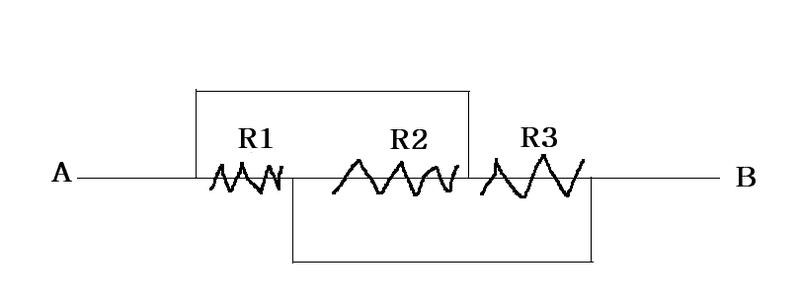
I know how to detect when resistors are arranged in parallel or series arrangement and I can also find their equivalent resistance in simple circuits or when resistances are connected in form of triangle but what happens when the arrangement is complex like this :
5EMUd.png


Which resistors are parallel and which are in series ? How can I find the equivalent resistance in such cases ? Is there rule or method for figuring this out ?
 
Physics news on Phys.org
ZapperZ said:
Well, well, well. Isn't this interesting.

Check out Post #5 from our last PF Physics Trivia:

https://www.physicsforums.com/showthread.php?t=680864

Zz.
Actually this is from a book so I know that these resistors are in parallel but I'm more interested to know why i.e. the explanation.
 
They are parallel if they all terminate on the same two busses ... a common wire for one end of each resistor, and another common end for the other end.

Serial means that they are all spliced into a single wire, end to end, with nothing else connected in the middle.

If you can topologically rearrange a set of resistors so that they could all be soldered together at one end, and also at the other, then they form a parallel resistance.
 
You can always change the connecting wires ... make them longer or shorter, rearrange them to your convenience ... at least you can for this kind of problem. Just don't make or break any connections.

If you end up with resistors strung along a single line with each node connecting only the next resistor, then this branch is serial.

If instead you end up with two wires such that you could shorten each of the wires into a "solder knot", and end up with one end of each resistor in one of the solder knots, and the other end of each one in the second solder knot ... then your resistors are in parallel.

This latter statement is equivalent to saying that all of the resistors provide paths connecting a voltage A to a voltage B: parallel resistors connect two independent busses.
 
If two devices are connected to each other at both ends, they are in parallel. If they are connect at one end and nothing else connects there, they are in series.
 
Redraw, keeping the connections as they are. This is the first step of any complicated resistor arrangement. It is the key to solving this sort of problem. All that matters is the electrical connections not how it looks on paper.
 
Sometimes, colors can help:

attachment.php?attachmentid=62360&stc=1&d=1380653372.jpg


All resistors are between yellow and red.
 

Attachments

  • resistors.jpg
    resistors.jpg
    9.4 KB · Views: 984
Another way in this case is to give the same letter to points which are connected together by a wire; you'll find that the only letters needed are A and B, so it's very easy to see that all three resistors are connected in parallel.

Note that you can have resistor networks which can't be analysed into series and parallel groupings. An example would be four resistors connected in a ring ABCDA, in which these letters stand for the connections between the resistors. A fifth resistor is connected as a 'bridge' between A and C. The resistance is measured across B and D. This resistance can't be calculated by using series and parallel rules, but Kirchhoff's laws, or some more advanced technique has to be used.
 
  • #10
Thanks everyone for answers.
Integral said:
Redraw, keeping the connections as they are. This is the first step of any complicated resistor arrangement. It is the key to solving this sort of problem. All that matters is the electrical connections not how it looks on paper.
Do you have any tips for redrawing? When I get a complex circuit like this , how should I approach redrawing it? Is there any method ? Thank you
 
  • #11

Similar threads

  • · Replies 5 ·
Replies
5
Views
2K
  • · Replies 6 ·
Replies
6
Views
2K
Replies
4
Views
2K
  • · Replies 38 ·
2
Replies
38
Views
5K
Replies
152
Views
7K
  • · Replies 6 ·
Replies
6
Views
2K
  • · Replies 10 ·
Replies
10
Views
2K
  • · Replies 2 ·
Replies
2
Views
1K
  • · Replies 1 ·
Replies
1
Views
1K
  • · Replies 18 ·
Replies
18
Views
5K