A problem in Coupling Transformers

Click For Summary

Discussion Overview

The discussion revolves around a problem related to coupling transformers, specifically focusing on the output voltage and behavior of a diode in the circuit. Participants explore the calculations involved and the implications of diode orientation on the output voltage across a load resistor.

Discussion Character

  • Technical explanation, Debate/contested, Mathematical reasoning

Main Points Raised

  • One participant calculates the output voltage as V(out) = nV(in) and arrives at 624 V, questioning the correctness of their solution.
  • Another participant agrees with the output voltage calculation but points out potential issues with the diode's peak inverse voltage (PIV) rating and the forward voltage drop across the diode.
  • A later reply challenges the initial claim about the diode being reversed biased, suggesting that the diode will conduct during the opposite half-cycles, affecting the load resistor's voltage.
  • One participant proposes that the potential across the load resistor will remain the same but with an opposite sign when the diode is reversed, seeking confirmation of this interpretation.

Areas of Agreement / Disagreement

Participants express differing views on the behavior of the diode when reversed and its impact on the output voltage across the load resistor. There is no consensus on the implications of the diode orientation or the correctness of the initial calculations.

Contextual Notes

Participants note limitations regarding the diode's specifications and the assumptions made in the calculations, particularly concerning the PIV rating and forward voltage drop.

Who May Find This Useful

This discussion may be useful for individuals interested in electrical engineering, specifically those studying transformer circuits and diode behavior.

bibo_dvd
Messages
37
Reaction score
0
Hello Guys !

While Studing coupling transformers i found this problem
i tried to solve it
but i don't know if my solving is right or no !
so tell me :)

The problem :
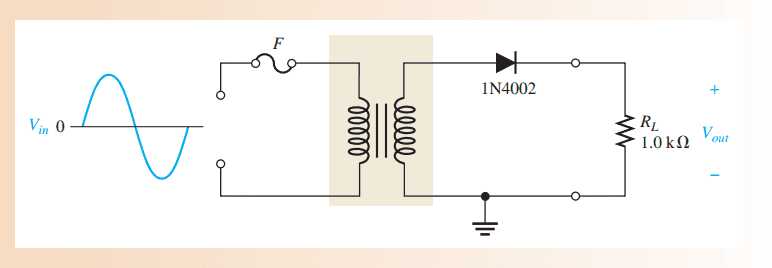
27phVRt.png

eJPQdSJ.png


My solve is :
V(out)=nV(in)
V(out)= 2 * 312 = 624 v
PIV = V(out) = 624 v
and if the diode is turned around it will be reversed biased so no current will pass across RL and
Output voltage will equal to zero ..

am i right guys or what ??

Thank you !
 
Physics news on Phys.org
bibo_dvd said:
My solve is :
V(out)=nV(in)
V(out)= 2 * 312 = 624 v
PIV = V(out) = 624 v
Looks okay. Although whoever set the problem doesn't know his components very well. A 1N4002 diode as a PIV rating of about 100 V if I recall correctly. Expect the magic smoke to escape from the diode very shortly after switching on!

Also, you have ignored the ~0.7 V forward drop across the diode. Probably okay considering what a small percentage this is of the total voltage.

and if the diode is turned around it will be reversed biased so no current will pass across RL and
Output voltage will equal to zero ..
Nope. The secondary will present a full AC voltage signal, so if you turn the diode around it will simply conduct when the diode is forward biased on the opposite half-cycles (opposite that is to the half-cycles when it conducted in the original diode orientation). What does that tell you about the resulting potential across the load resistor?
 
gneill said:
What does that tell you about the resulting potential across the load resistor?

I think the potential across the load resistor will be the same but with an opposite sign
i mean that the voltage will take this shape ..am i right ??

SlNR6jY.png
 
bibo_dvd said:
I think the potential across the load resistor will be the same but with an opposite sign
i mean that the voltage will take this shape ..am i right ??

SlNR6jY.png

Looks good!
 
  • Like
Likes   Reactions: 1 person

Similar threads

Replies
7
Views
2K
Replies
15
Views
3K
  • · Replies 12 ·
Replies
12
Views
2K
  • · Replies 20 ·
Replies
20
Views
5K
  • · Replies 2 ·
Replies
2
Views
3K
Replies
6
Views
2K
  • · Replies 1 ·
Replies
1
Views
2K
  • · Replies 2 ·
Replies
2
Views
2K
  • · Replies 2 ·
Replies
2
Views
3K
  • · Replies 7 ·
Replies
7
Views
2K
