2 bodies spining and cut in the middle

  • Thread starter Thread starter york
  • Start date Start date
  • Tags Tags
    bodies Cut
Click For Summary
SUMMARY

The discussion centers on determining the minimum separation speed (Vsep = V1 - V2) required for two rigid bodies, M1 and M2, to avoid collision after being severed from their connection. At time t=0, both bodies are spinning around the Z-axis and are given additional velocities in the X direction. The participants clarify the motion dynamics and the significance of the coordinates and vectors involved, ultimately leading to the conclusion that understanding the trajectory and velocity of each body post-severance is crucial to prevent collision.

PREREQUISITES
  • Understanding of rigid body dynamics
  • Familiarity with vector velocity analysis
  • Knowledge of coordinate systems in physics
  • Basic principles of rotational motion
NEXT STEPS
  • Study the equations of motion for rigid bodies in two dimensions
  • Learn about collision avoidance strategies in physics
  • Explore the effects of initial conditions on trajectory outcomes
  • Investigate the principles of angular momentum conservation in rigid body systems
USEFUL FOR

Physics students, mechanical engineers, and anyone interested in the dynamics of rigid body motion and collision avoidance strategies.

york
Messages
10
Reaction score
0
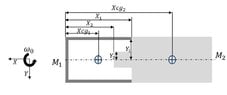
M1 and M2 are rigid bodies that connected. they spin freely around the Z-axis. At a certain time (we will set t=0) when the bodies are in the state described below, the bodies disconnect from each other when each of the bodies is given a speed addition in the direction of the X(V1 and V2 axis respectively). The separation speed is defined as the Vsep=V1-V2 speed difference. What is the minimum separation speed required in order not to cause no harm between the bodies?
 
Physics news on Phys.org
york said:
M1 and M2 are rigid bodies that connected. they spin freely around the Z-axis. At a certain time (we will set t=0) when the bodies are in the state described below, the bodies disconnect from each other when each of the bodies is given a speed addition in the direction of the X(V1 and V2 axis respectively). The separation speed is defined as the Vsep=V1-V2 speed difference. What is the minimum separation speed required in order not to cause no harm between the bodies?
 

Attachments

  • 1.JPG
    1.JPG
    14.6 KB · Views: 158
york said:
M1 and M2 are rigid bodies that connected. they spin freely around the Z-axis. At a certain time (we will set t=0) when the bodies are in the state described below, the bodies disconnect from each other when each of the bodies is given a speed addition in the direction of the X(V1 and V2 axis respectively). The separation speed is defined as the Vsep=V1-V2 speed difference. What is the minimum separation speed required in order not to cause no harm between the bodies?
Welcome to PF.

Sorry, but I'm not able to understand what you mean by "in order not to cause harm between the bodies"? What kind of harm? When the attachment is severed, they fly off in different directions, no? Can you please clarify more? Thanks.
 
berkeman said:
Welcome to PF.

Sorry, but I'm not able to understand what you mean by "in order not to cause harm between the bodies"? What kind of harm? When the attachment is severed, they fly off in different directions, no? Can you please clarify more? Thanks.
i mean that I want the minimum separation speed required which the bodies won't collide, thank you. the bodies severed exactly in the position in the picture
 
What are (S1,Y1) and (X2,Y2)? What is that dark line enclosing the area where M1 is? Can you draw the vectors V1 and V2 at the instant that the masses are released?
 
the dark line enclosing the area in body 1. X1,Y1 you mean the coordinate of c.m?
 
york said:
the dark line enclosing the area in body 1. X1,Y1 you mean the coordinate of c.m?
Sorry, I'm still not understanding the setup at all. I don't understand the function of the dark line around M1, and I don't understand what the coordinates (X1,Y1) and (X2,Y2) represent. And I don't understand the significance of the shaded areas.

My impression so far is that there is a string that hold M1 to the left side of the dark line (is that the origin), and another string that connects M1 and M2. The masses are circulating the origin in a counter-clockwise direction (uniform circular motion). At time t=0 both strings are cut, and M1 flies off with vector velocity V1 and M2 flies off with vector velocity V2.

Is that even close?

1635961341760.png
 
yes, I think you right so far
 
So the 2 mass velocity vectors V1 and V2 are pointing straight up at the moment t=0. So M1 crashes into that dark line enclosure and M2 keeps on going straight up?
 
  • #10
no, first when the bodies severed there c.m each has a velocity only in y axis, the velocity in x-axis is xternal insert.
 
  • #11
york said:
the bodies disconnect from each other when each of the bodies is given a speed addition in the direction of the X(V1 and V2 axis respectively). The separation speed is defined as the Vsep=V1-V2 speed difference. What is the minimum separation speed required in order not to cause no harm between the bodies?
So at the instant t=0, the two masses also are given x-velocities of V1 and V2, and you want to relate those velocities to the initial Y-direction velocities to ensure that the masses don't come together somewhere above and to the right of the origin?

Okay, now that we've gotten that sorted out (whew!), what do your equations look like so far?
 
  • #12
berkeman said:
So at the instant t=0, the two masses also are given x-velocities of V1 and V2, and you want to relate those velocities to the initial Y-direction velocities to ensure that the masses don't come together somewhere above and to the right of the origin?

Okay, now that we've gotten that sorted out (whew!), what do your equations look like so far?
this is where i stuck, i think i understand what happened but i don't know how to write it down
 
  • #13
Just write the equations for the x & y motion of each of the masses based on their initial velocity vectors and position vectors from the origin. Then you should be able to find an equation that gives you the minimum (or maximum?) value of V2-V1 so that the two masses do not come together anywhere...
 
  • #14
berkeman said:
the dark line around M1, and I don't understand what the coordinates (X1,Y1) and (X2,Y2) represent. And I don't understand the significance of the shaded areas.
I believe the thick dark line is M1 and the shaded area is M2. The circles with crosses are the locations of their mass centres. X1, Y1 etc. show the shapes of the masses.

Since the X distances are shown as from the left end of M1 I presume the axis of rotation is the left end of the dashed-dotted line, not where the rotation symbol is shown. But it might not matter which.

To solve it, one will need to consider how the mass centres move after release and how the bodies continue to rotate.
 
  • Like
Likes   Reactions: berkeman
  • #15
haruspex said:
I believe the thick dark line is M1 and the shaded area is M2. The circles with crosses are the locations of their mass centres. X1, Y1 etc. show the shapes of the masses.
Oh my, I didn't see any of that. Thanks @haruspex !
 
  • #16
york said:
i mean that I want the minimum separation speed required which the bodies won't collide, thank you. the bodies severed exactly in the position in the picture
How could the bodies collide?
I believe that the separation trajectory will be radial respect to the center of rotation, which has not been clearly specified yet.
 
  • #17
Lnewqban said:
How could the bodies collide?
I believe that the separation trajectory will be radial respect to the center of rotation, which has not been clearly specified yet.
Think what the trajectory and velocity of each is when no external force acts.
 
  • Like
Likes   Reactions: hmmm27

Similar threads

  • · Replies 20 ·
Replies
20
Views
3K
  • · Replies 6 ·
Replies
6
Views
2K
  • · Replies 1 ·
Replies
1
Views
2K
  • · Replies 10 ·
Replies
10
Views
4K
  • · Replies 5 ·
Replies
5
Views
2K
Replies
6
Views
2K
Replies
3
Views
2K
Replies
2
Views
1K
  • · Replies 10 ·
Replies
10
Views
2K
  • · Replies 12 ·
Replies
12
Views
2K