2 charged conductors form a capacitor

Join the discussion
Ask a follow-up here, or get your own question answered by working scientists, mathematicians and engineers — people, not an autocomplete.
Real named experts · corrections over time · the nuance an AI answer skips
15 replies · 2K views
feynman1
Messages
435
Reaction score
29
2 separate big conductors initially charged Q1 and Q2. Then connect them in a circuit with a battery of emf V. The charges Q1 and Q2 will go to the 4 surfaces (marked red). All the 4 surfaces have an area A. Suppose the 2 conductors form an ideal parallel plate capacitor and the wires in the circuit have no resistance. How to determine the charges on the 4 red surfaces?
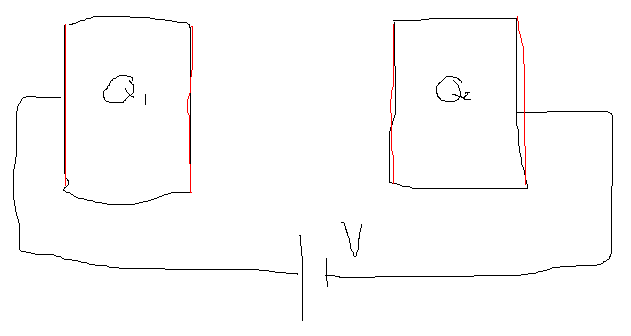
1611832524088.png
 
on Phys.org
feynman1 said:
Faculty looking for tips of designing PhD studentship interviews.
Is this the same user ?

Re this thread: do Q1 and Q2 have opposite signs ?
 
  • Informative
  • Love
Likes   Reactions: berkeman and Vanadium 50
What makes you think that the final charge distribution is any different from what you get if you connect the two plates to the battery when there is no initial charge on them? Remember, the job of the battery is to maintain a constant potential difference V across its terminals. It will do just that in either case by adding/removing charges from the plates as needed.
 
BvU said:
Is this the same user ?

Re this thread: do Q1 and Q2 have opposite signs ?
Q1 and Q2 might have the same or opposite signs
 
There will be a net charge of Q1+Q2 distrbuted on the entire circuit and a charge Q=±VC separated on the capacitor plates where C is the Capacitance of the plates.
The details depend upon the exact geometry. To determine it you solve (or approximately solve) Maxwell's equations. Is there a point to this?
 
hutchphd said:
There will be a net charge of Q1+Q2 distrbuted on the entire circuit and a charge Q=±VC separated on the capacitor plates where C is the Capacitance of the plates.
The details depend upon the exact geometry. To determine it you solve (or approximately solve) Maxwell's equations. Is there a point to this?
The plates are infinitely large. Let's care about the 4 red surfaces only. The geometry is already idealized, so we don't want to solve maxwell.
 
hutchphd said:
If the plates are infinitely large,they will hold an infinite charge at any voltage . I think you need to specify your problem.
Q1 and Q2 are amounts of charge, not density.
 
kuruman said:
What makes you think that the final charge distribution is any different from what you get if you connect the two plates to the battery when there is no initial charge on them? Remember, the job of the battery is to maintain a constant potential difference V across its terminals. It will do just that in either case by adding/removing charges from the plates as needed.
The 2 outward facing sufaces will hold charges? But they should disappear due to the ideal wires (resistance=0)?
 
feynman1 said:
The 2 outward facing sufaces will hold charges? But they should disappear due to the ideal wires (resistance=0)?
I never said or implied that the two outward surfaces hold charges. Furthermore the resistance of the wires has nothing to do with this. Once the battery is connected and the charges are redistributed, the left plate and the wire connected to it all the way to the positive terminal of the battery is an equipotential. Similarly, the right plate and wire is an equipotential.
 
  • Like
Likes   Reactions: hutchphd
hutchphd said:
Are your capacitors infinite??You need to specify the problem.
The plates cannot be mathematically infinite else there will be a potential difference between two points at infinity. They are "physically" infinite in the sense that the measure for their size (radius if circular, sides if rectangular) is much larger than the separation between them. In this limit the electric field between the plates can be considered uniform without fringing at the ends. That's the ideal parallel plate capacitor that OP specified in post #1.
 
And the whole circuit could carry an arbitrary additional charge from say an ungrounded lab tech. It would be distributed all over the place. Of course the capacitor cannot be infinite..but you are correct he did specify "ideal" in the beginning and switched to infinite later.
The ideal air capacitor will carry surface charge densitie$$\sigma =\pm\epsilon_0\frac V {separation}$$ on the opposing faces.

..
 
kuruman said:
I never said or implied that the two outward surfaces hold charges. Furthermore the resistance of the wires has nothing to do with this. Once the battery is connected and the charges are redistributed, the left plate and the wire connected to it all the way to the positive terminal of the battery is an equipotential. Similarly, the right plate and wire is an equipotential.
So the 2 outward surfaces hold no charge? Then the total charge on the 2 inward surfaces=0, total charge isn't conserved any more (initially Q1+Q2)?