2 degree of freedom system modeling

Click For Summary

Homework Help Overview

The discussion revolves around modeling a spring-mass system with multiple degrees of freedom, specifically focusing on the equations of motion for a system with three masses. Participants are exploring the dynamics of the system when one mass is displaced from its equilibrium position and how this affects the other masses in the system.

Discussion Character

  • Exploratory, Assumption checking, Problem interpretation

Approaches and Questions Raised

  • Participants are attempting to understand the forces acting on each mass when one mass is displaced. Questions are raised about the coupling of the masses and the role of springs and dampers in exerting forces. There is also a discussion about the implications of moving one mass while others remain stationary.

Discussion Status

The discussion is active, with participants questioning the assumptions about the forces exerted on the masses and how the motion of one mass influences the others. Some guidance has been offered regarding the nature of the forces and the coupling of the equations of motion, but there is no explicit consensus on the interpretation of the problem.

Contextual Notes

Participants are navigating the complexities of a coupled system and the implications of external forces applied to one mass. There is an acknowledgment that the system's behavior is interconnected, which complicates the analysis.

omka
Poster warned about not having used the homework template
Hello,
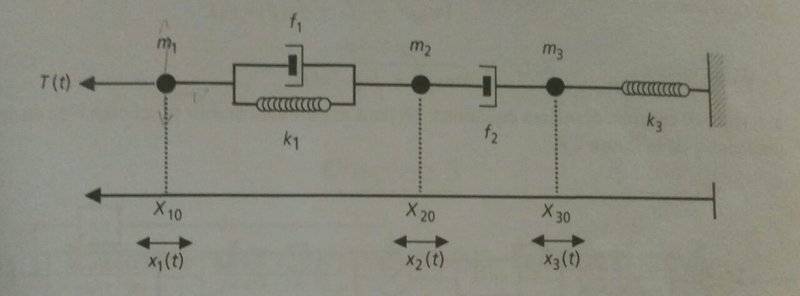
I'm having difficulty finding equation of motion for 3 degree of freedom spring mass system.
IMG-20171020-WA0007.jpg


Homework Statement
the positions of the masses at the equilibre are respectively X10, X20, X30
At t = 0s, the mass m1 is drawn to the left with the force T (t).
Each of the masses is moved from it's equilibrium position by x1 (t), x2 (t) and x3 (t), respectively.
Write the fundamental equation of the dynamics for m1, m2 and m3
K1 stiffness coefficient spring 1
K3 stiffness coefficient spring 2
f1 f2 f3 viscous coefficient

Homework Equations


the fundamental equation of the dynamics

The Attempt at a Solution


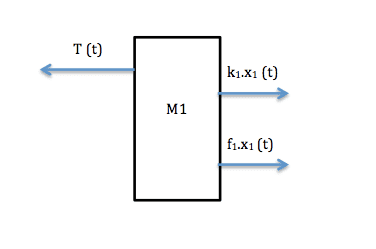
At t= 0s When the mass m1 has moved a distance x1 from it's position (to the left) the spring k1 will be stretched that mean that this spring will be exerting a force on the mass to the right. The viscous force f1 will be exerting also a force on the right because the viscous fiction is always opposite to the direction of motion.
Capture d’écran 2017-10-20 à 15.29.26.png


But the motion of m1 depend also of the motion of mass 2 and so of f2.
Could you please help me to understand what are the forces exerted on the mass 1 and mass 2 from the other masses.
 

Attachments

  • IMG-20171020-WA0007.jpg
    IMG-20171020-WA0007.jpg
    16 KB · Views: 852
  • Capture d’écran 2017-10-20 à 15.29.26.png
    Capture d’écran 2017-10-20 à 15.29.26.png
    2 KB · Views: 695
Last edited by a moderator:
Physics news on Phys.org
omka said:
I'm having difficulty finding equation of motion for 2 degree of freedom spring mass system.
Doesn't the picture show 3 degrees of freedom?

omka said:
When the mass m1 has moved a distance x1 from it's position the spring k1 will be stretched that mean that this spring will be exerting a force on the mass to the right.
From the point of view of particle 1, does it matter if it is being pulled by the spring because particle 1 has moved to the left or because particle 2 has moved to the right?

omka said:
Could you please help me to understand what are the forces exerted on the mass 1 from the other masses.
To be clear: it is not the other masses that exert forces, only springs and dampers.
 
  • Like
Likes   Reactions: omka
DrClaude said:
From the point of view of particle 1, does it matter if it is being pulled by the spring because particle 1 has moved to the left or because particle 2 has moved to the right?

This is my problem.i can't understand how can one mass move while the other is held still. if i apply force T(t)on m1 m2 will move too ?
 
omka said:
This is my problem.i can't understand how can one mass move while the other is held still. if i apply force T(t)on m1 m2 will move too ?
The fact that the motion of the masses will be coupled is taken care of by the fact that you will get a set of coupled equations of motion. From the point of view of a mass, all that is important is the force acting on it.

So, given the position of the masses, what is the force on mass 1 due to k1 and f1?
 

Similar threads

Replies
5
Views
2K
  • · Replies 15 ·
Replies
15
Views
3K
Replies
2
Views
1K
  • · Replies 2 ·
Replies
2
Views
3K
  • · Replies 3 ·
Replies
3
Views
3K
  • · Replies 10 ·
Replies
10
Views
3K
Replies
3
Views
6K
  • · Replies 1 ·
Replies
1
Views
1K
Replies
11
Views
2K
Replies
2
Views
2K