Bobbert
- 16
- 0
So, I know what happens with the first two cases, but what if the dielectrics are on a diagonal?
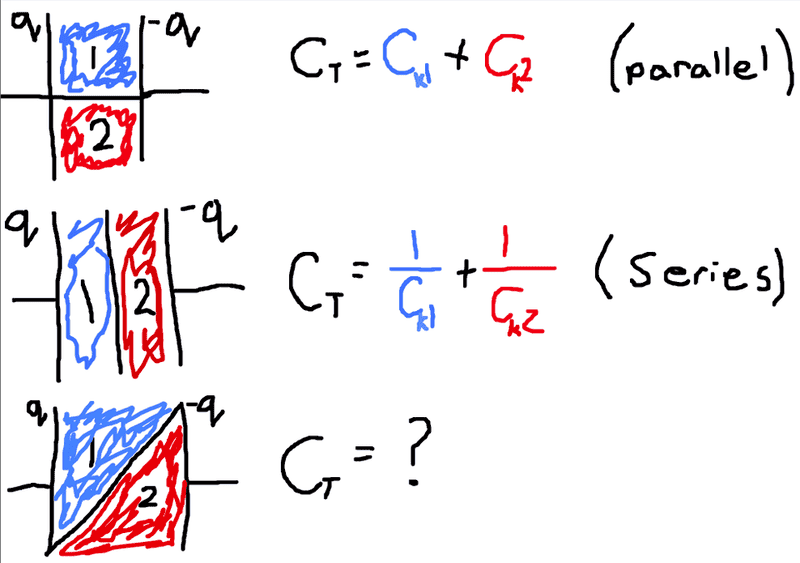
The discussion focuses on calculating the capacitance of a parallel plate capacitor with two dielectrics arranged diagonally. The capacitance can be derived by dividing the capacitor into horizontal strips, applying the formula C = εA/d for each segment, and summing the partial capacitances. The final expression for the overall capacitance is C = (A/d) * (ln(ε2/ε1)) / (1/ε1 - 1/ε2). A challenge arises in defining C1 and C2 when the dielectrics are not aligned, as this configuration can lead to the plates touching and losing their capacitive properties.
PREREQUISITESPhysics students, electrical engineers, and anyone interested in advanced capacitor design and analysis.