2 Dielectrics in a Parallel Plate Capacitor

Click For Summary

Homework Help Overview

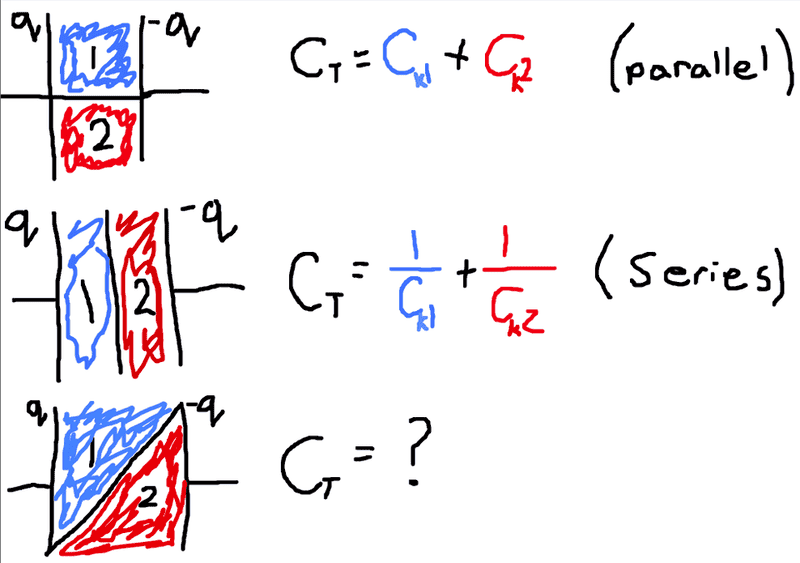
The discussion revolves around the behavior of a parallel plate capacitor with two dielectrics arranged diagonally. Participants explore the implications of this configuration on capacitance calculations and the challenges that arise from it.

Discussion Character

  • Mixed

Approaches and Questions Raised

  • Participants suggest dividing the capacitor into smaller strips to analyze the capacitance of each section separately. There are questions about how to define capacitance in this diagonal arrangement and the implications of the plates touching.

Discussion Status

Some participants have provided insights into the mathematical approach for calculating the overall capacitance by integrating the contributions from each strip. However, there is still uncertainty regarding the definitions of capacitance in this context and the clarity of the proposed formula.

Contextual Notes

There are mentions of specific variables and conditions related to the geometry of the capacitor and the dielectrics, including the need for adjustments in the calculations due to the diagonal arrangement. The discussion also highlights potential confusion regarding the application of standard capacitance formulas in this scenario.

Bobbert
Messages
16
Reaction score
0
So, I know what happens with the first two cases, but what if the dielectrics are on a diagonal?
zkAKl.png
 
Physics news on Phys.org
Nice drawing :)

You could try to split this capacitor into pieces. So you make horizontal cuts and for each strip you cut at the boundaries of dielectrics.
Now you use the equation
[tex]C=\frac{\varepsilon A}{d}[/tex]
for each little piece and add up these partial capacitance according to your equation to yield the overall capacitance.
What you get in the end is
[tex]C=\frac{A}{d}\frac{\ln\frac{\varepsilon_2}{\varepsilon_1}}{\frac{1}{\varepsilon_1}-\frac{1}{\varepsilon_2}}[/tex]
The only problem is that now its ill-defined what C1 and C2 were. I mean in you first two examples you just remove one colour and stick the plates to whatever is left to get C1 and C2. But if you do that for your diagonal case, then the plates touch and thus are not a capacitor anymore.

Is that clear?
 
Gerenuk said:
Nice drawing :)

You could try to split this capacitor into pieces. So you make horizontal cuts and for each strip you cut at the boundaries of dielectrics.
Now you use the equation
[tex]C=\frac{\varepsilon A}{d}[/tex]
for each little piece and add up these partial capacitance according to your equation to yield the overall capacitance.
What you get in the end is
[tex]C=\frac{A}{d}\frac{\ln\frac{\varepsilon_2}{\varepsilon_1}}{\frac{1}{\varepsilon_1}-\frac{1}{\varepsilon_2}}[/tex]
The only problem is that now its ill-defined what C1 and C2 were. I mean in you first two examples you just remove one colour and stick the plates to whatever is left to get C1 and C2. But if you do that for your diagonal case, then the plates touch and thus are not a capacitor anymore.

Is that clear?

Thanks. The logic / ideas make sense but I am having trouble getting your formula. Could you show an extra step or two?
 
One strip has capacitance
[tex]\frac{1}{dC}=\frac{1}{\frac{dx\cdot dy \varepsilon_1}{h}}+\frac{1}{\frac{dx\cdot dy \varepsilon_2}{d-h}}[/tex]
where x is the distance of one strip from the top, y the distance into the plane, so dx dy is an area element, epsilons are the dielectric constants, d the total separation between plates and [itex]h=\alpha x[/itex] (giving a diagonal) the width of one strip from a single dielectric. Also alpha is adjusted to give [itex]d=\alpha x_\text{end}[/itex]. You plug in h and integrate
[tex]C=\int_0^{x_\text{end}}dx\int_0^{y_\text{end}}dy dC[/tex].
 
Btw, it should be
1/C=1/C1+1/C2 ;)
in your second example.
 

Similar threads

  • · Replies 6 ·
Replies
6
Views
2K
Replies
4
Views
2K
Replies
5
Views
1K
  • · Replies 8 ·
Replies
8
Views
2K
Replies
3
Views
2K
Replies
6
Views
1K
Replies
14
Views
3K
  • · Replies 20 ·
Replies
20
Views
4K
Replies
32
Views
5K
  • · Replies 18 ·
Replies
18
Views
3K