Undergrad 2 Questions About the Gyroscope Effect

  • Thread starter Thread starter Johnls
  • Start date Start date
  • Tags Tags
    Gyroscope
Click For Summary
SUMMARY

This discussion focuses on the gyroscopic effect, specifically addressing the relationship between torque and angular momentum. It clarifies that torque can be viewed as a "couple," which consists of equal and opposite forces acting at a distance, and emphasizes that the net torque remains consistent regardless of the reference point chosen. Additionally, it explains that the precession model is valid primarily for rapidly spinning gyroscopes, as low angular momentum leads to increasingly higher precession rates, ultimately resulting in a deviation from the intended axis of rotation.

PREREQUISITES
  • Understanding of angular momentum and its properties
  • Familiarity with the concept of torque and its calculation
  • Basic knowledge of gyroscopic motion and precession
  • Introduction to three-dimensional motion and nutation
NEXT STEPS
  • Study the principles of torque as a "couple" in mechanics
  • Explore the mathematical treatment of angular momentum in three dimensions
  • Investigate the concept of nutation and its effects on gyroscopic motion
  • Learn about the practical applications of gyroscopes in navigation and stabilization
USEFUL FOR

Physics students, mechanical engineers, and anyone interested in the dynamics of rotating bodies and gyroscopic systems.

Johnls
Messages
11
Reaction score
0
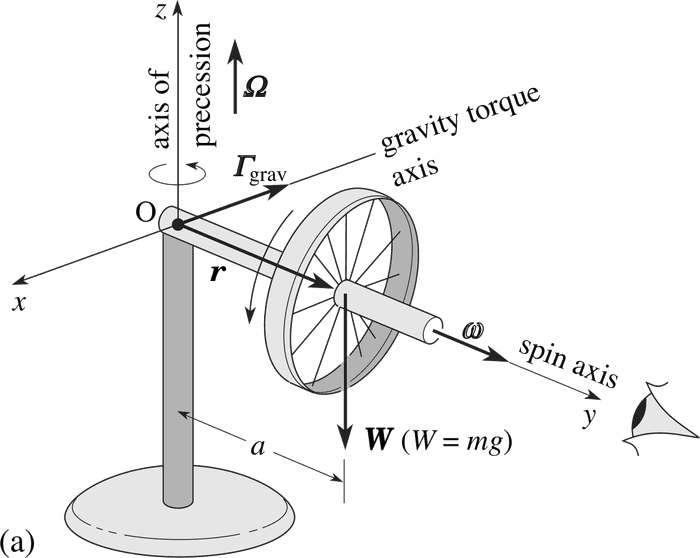
I'm talking here about this situation:
phys2_8f_15a.png

The explanation which is usually given as to why there is a precession, is that the torque is perpendicular to the angular momentum and the angular momentum changes in the direction of the torque.
A few things I don't understand about it:

1. The torque is relative to point O but the angular momentum is relative to the center of the wheel. When you derive that torque is the change in the angular momentum, don't you assume that they are both calculated relative to the same point?

2. Why doesn't it work for low angular momentums?
 
Physics news on Phys.org
Johnls said:
1. The torque is relative to point O but the angular momentum is relative to the center of the wheel. When you derive that torque is the change in the angular momentum, don't you assume that they are both calculated relative to the same point?
Two points...

A torque can be viewed as a "couple" -- a pair of equal and opposite forces separated by a distance that is not parallel to the forces. It does not matter where you choose to place the reference point when calculating the torque from a couple. You always get the same answer.

Point O lies on the axis of rotation anyway.
2. Why doesn't it work for low angular momentums?

The idea that the angular momentum of a gyroscope is purely horizontal, that it does not deflect downward at all under a vertical force and that the motion associated with the precession has no associated angular momentum is an approximation. For a rapidly spinning gyroscope, it is a good approximation. In first year physics courses one is usually exposed to angular momentum primarily as it applies in two dimensions. In that setting, one considers the gyroscope to be rotating in two dimensions and precessing in the third.

The full three dimensional treatment involves the notion of a "nutation" and analysis using tensors.

One simple way of seeing that the precession model cannot work for low angular momentum is to consider what happens as the rotation rate gets lower and lower. The precession rate gets higher and higher. If you get to a point where the precession rate is higher than the rotation rate, it's pretty clear that you're not considering a gyroscope that is spinning on its intended axis. Instead, it is rotating around a different instantaneous axis. And that axis may keep changing over time.

A gyroscope that is not spinning at all does not precess infinitely fast. It just flops down.
 
  • Like
Likes Johnls
jbriggs444 said:
Two points...

A torque can be viewed as a "couple" -- a pair of equal and opposite forces separated by a distance that is not parallel to the forces. It does not matter where you choose to place the reference point when calculating the torque from a couple. You always get the same answer.

Point O lies on the axis of rotation anyway.The idea that the angular momentum of a gyroscope is purely horizontal, that it does not deflect downward at all under a vertical force and that the motion associated with the precession has no associated angular momentum is an approximation. For a rapidly spinning gyroscope, it is a good approximation. In first year physics courses one is usually exposed to angular momentum primarily as it applies in two dimensions. In that setting, one considers the gyroscope to be rotating in two dimensions and precessing in the third.

The full three dimensional treatment involves the notion of a "nutation" and analysis using tensors.

One simple way of seeing that the precession model cannot work for low angular momentum is to consider what happens as the rotation rate gets lower and lower. The precession rate gets higher and higher. If you get to a point where the precession rate is higher than the rotation rate, it's pretty clear that you're not considering a gyroscope that is spinning on its intended axis. Instead, it is rotating around a different instantaneous axis. And that axis may keep changing over time.

A gyroscope that is not spinning at all does not precess infinitely fast. It just flops down.

First of all, thanks for the reply!
Could you please expand a little bit on how torque can be viewed as a "couple"? How can I do this conversion? How does it relate to the Gyro example?
 
Johnls said:
First of all, thanks for the reply!
Could you please expand a little bit on how torque can be viewed as a "couple"? How can I do this conversion? How does it relate to the Gyro example?
For the gyroscope, you have an upward force at point O from the support and a downward force from gravity at the center of gravity (a distance r from point O).

Pick any origin you like and compute the torque from the force at point O plus the torque from the force at the center of gravity. Then pick a different origin and compute it again. The two forces are a "couple" and the net torque they produce will be independent of the origin that you pick.
 
  • Like
Likes Johnls
jbriggs444 said:
For the gyroscope, you have an upward force at point O from the support and a downward force from gravity at the center of gravity (a distance r from point O).

Pick any origin you like and compute the torque from the force at point O plus the torque from the force at the center of gravity. Then pick a different origin and compute it again. The two forces are a "couple" and the net torque they produce will be independent of the origin that you pick.

Oh I see... Thanks!
 

Similar threads

  • · Replies 6 ·
Replies
6
Views
2K
  • · Replies 49 ·
2
Replies
49
Views
4K
  • · Replies 4 ·
Replies
4
Views
2K
  • · Replies 13 ·
Replies
13
Views
3K
  • · Replies 10 ·
Replies
10
Views
4K
Replies
14
Views
6K
  • · Replies 1 ·
Replies
1
Views
2K
Replies
4
Views
2K
  • · Replies 8 ·
Replies
8
Views
2K
  • · Replies 3 ·
Replies
3
Views
2K