Discussion Overview
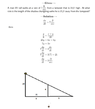
The discussion revolves around the relationship between the heights of a lamppost and a man, and how these heights affect the length of the man's shadow as they walk away from the pole. It includes mathematical reasoning and exploration of related concepts, particularly focusing on rates of change and the implications of height differences.
Discussion Character
- Exploratory
- Mathematical reasoning
- Debate/contested
Main Points Raised
- One participant questions the relevance of the number 35 in the context of the problem, suggesting confusion over its role.
- Another participant generalizes the problem using variables for the heights of the post and the man, deriving a formula that relates the lengths of shadows to these heights.
- There is a discussion about the independence of the rate of change of the shadow's length from the distance between the man and the pole, emphasizing that it depends on the ratio of the heights.
- A participant proposes that if two men of different heights walk at the same speed, the taller man's shadow will change length more quickly, supported by a mathematical derivative.
- Another participant expresses uncertainty about the correctness of a speed value mentioned in the problem, noting inconsistencies in examples they reviewed.
- There is a question posed about the behavior of the shadow's length as the man's height approaches that of the pole, inviting further exploration.
Areas of Agreement / Disagreement
Participants express differing views on the relevance of certain values and the implications of the derived formulas. There is no consensus on the interpretation of the speed value or the examples referenced, indicating ongoing debate and exploration.
Contextual Notes
The discussion includes assumptions about the heights of the individuals involved and the conditions under which the relationships hold. The mathematical steps and implications of the derived formulas are not fully resolved, leaving room for further inquiry.
Who May Find This Useful
Individuals interested in mathematical modeling of physical scenarios, particularly in relation to geometry and rates of change, may find this discussion relevant.