MHB 231.13.3.75 top vertex of a regular tetrahedron

Click For Summary
The discussion centers on determining the center of a unit sphere placed symmetrically atop three unit spheres with specified centers. The coordinates of the center R are derived using the relationship between the height of the tetrahedron formed by the spheres and the side length. The height is calculated as h = (√3/2) * a, with a set to 2, leading to the coordinates R = (2√3/3, √3). The conversation highlights the challenge of finding a comprehensive equation for this geometric configuration. Ultimately, the solution is reached through estimation rather than a formal derivation.
karush
Gold Member
MHB
Messages
3,240
Reaction score
5
$\tiny{231.13.3.75}$
$\textrm{Imagine $3$ unit spheres
(radius equal to 1) with centers at,}\\$
$\textrm{$O(0,0,0)$, $P(\sqrt{3},-1,0)$ and $Q(\sqrt{3},1,0)$.} \\$
$\textrm{Now place another unit sphere symmetrically on top of these spheres with its center at R.} \\$
$\textrm{a Find the center of R.} \\$
 
Last edited:
Physics news on Phys.org
The following post may give you some insight:

http://mathhelpboards.com/challenge-questions-puzzles-28/tetrahedral-stack-spheres-5676.html#post26011
 
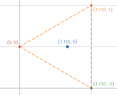
View attachment 7108

ok from this base

$\textrm{so if hieght of $h=\frac{\sqrt{3}}{2} a$ and $a=2$ then:}\\$
\begin{align*}\displaystyle
R&=\left(\sec \left(\frac{\pi }{6}\right),\frac{\sqrt{3}}{2} (2)\right)\\
&=\left( \frac{2\sqrt{3}}{3},\sqrt{3}\right)
\end{align*}

OK couldn't find some comprehensive equation for this so eyeballed it...
 

Attachments

  • s4.13.t.71.PNG
    s4.13.t.71.PNG
    3.8 KB · Views: 127
Last edited:
There are probably loads of proofs of this online, but I do not want to cheat. Here is my attempt: Convexity says that $$f(\lambda a + (1-\lambda)b) \leq \lambda f(a) + (1-\lambda) f(b)$$ $$f(b + \lambda(a-b)) \leq f(b) + \lambda (f(a) - f(b))$$ We know from the intermediate value theorem that there exists a ##c \in (b,a)## such that $$\frac{f(a) - f(b)}{a-b} = f'(c).$$ Hence $$f(b + \lambda(a-b)) \leq f(b) + \lambda (a - b) f'(c))$$ $$\frac{f(b + \lambda(a-b)) - f(b)}{\lambda(a-b)}...

Similar threads

  • · Replies 2 ·
Replies
2
Views
2K
Replies
6
Views
4K
  • · Replies 2 ·
Replies
2
Views
1K
  • · Replies 1 ·
Replies
1
Views
11K
  • · Replies 1 ·
Replies
1
Views
6K
  • · Replies 33 ·
2
Replies
33
Views
3K
  • · Replies 2 ·
Replies
2
Views
2K
  • · Replies 3 ·
Replies
3
Views
4K
Replies
8
Views
10K
  • · Replies 1 ·
Replies
1
Views
17K