Graduate 2D Cartesian Laplace equation with a single point diffusion

Click For Summary
The discussion revolves around solving the 2D Cartesian Laplace equation with a point diffusion source located at (xi, yi). The original poster is unsure how to incorporate this point into the analytical solution, recognizing that it involves a Dirac delta function and potentially Green's functions. Suggestions include writing an eigenvalue equation and using separation of variables to solve the homogeneous part of the equation. The conversation shifts as the poster ultimately decides to abandon the analytical approach due to time constraints and opts for a numerical solution instead. The thread highlights the complexities of incorporating point sources into PDE solutions.
maistral
Messages
235
Reaction score
17
Hi. I have this problem in trying to solve this PDE analytically.

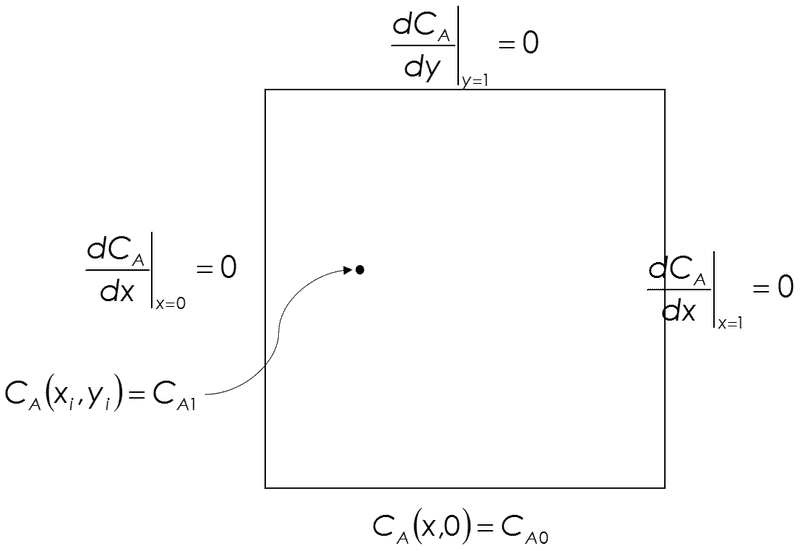
The PDE is represented by this diagram:
2ltsjgw.png


Basically this is solving the Laplace equation with those insulated boundaries except it has that point diffusing its value across the plane. I know how to solve the Laplace equation part. The problem is that I do not know how to solve the Laplace equation WITH a single point in there located at point (xi, yi).

While I have no problem in trying to solve this using numerical analysis, I am totally clueless how to solve this analytically. Where should I start? What should I do?
 
Last edited:
Physics news on Phys.org
It seems you are asking too much. The solution is uniquely determined by the boundary conditions. Once found a solution you can check if it is consistent with the value you have at ##(x_i,y_i)##.
 
What?? How could it be asking too much?

I said it clearly I guess. I don't know where to start at all. If that point CA1 located at point (xi, yi) had not existed then obviously the solution for the PDE is just CA0.

I have no idea how to incorporate that point diffusing its values everywhere on CA0 that's why I'm asking.
 
Apparently this is Laplace equation with a dirac delta function on a certain coordinate. So apparently this involves Green's functions.

Who is this Green? Help?
 
Let's sneak up on it. Suppose that, rather than being in a small finite domain of a square, the system were infinite in extent, and, rather than the concentration being CA1 at a point, it would be CA1 on a small circle of radius a. And suppose that, far from the circle, at infinity, the temperature would be CA0.

Chet
 
I suggest you write the eigenvalue equation$$\Delta\phi+\lambda\phi=f$$where f is the diffusion function. First solve the homogeneous equation$$\Delta\phi + \lambda\phi=0$$by separation of variables and use the boundary conditions to find ##\phi_m\left (k_xx\right )## and ##\phi_n\left (k_yy \right )## and ##\lambda_{mn}=k_x^2+k_y^2##.
Introduce a trial function$$ \phi\left (x,y\right )=\sum_n\sum_m A_{mn}\phi_m\left (k_xx \right )\phi_n\left (k_yy \right )$$
and substitute in the equation$$\Delta\phi+\lambda_{mn}\phi=f$$
Multiply both sides of the equation by ##\phi_m\phi_n## and integrate to solve for ##A_{mn}##.
 
Thanks for the replies. But I gave up trying to get an analytical solution due to time constraints and killed the problem using a numerical attack. Lol
 

Similar threads

Replies
3
Views
3K
  • · Replies 8 ·
Replies
8
Views
4K
  • · Replies 33 ·
2
Replies
33
Views
5K
  • · Replies 10 ·
Replies
10
Views
3K
  • · Replies 7 ·
Replies
7
Views
3K
  • · Replies 4 ·
Replies
4
Views
1K
  • · Replies 5 ·
Replies
5
Views
6K
Replies
4
Views
3K
  • · Replies 3 ·
Replies
3
Views
4K
  • · Replies 5 ·
Replies
5
Views
3K