2d Elastic collision concept and formula

Click For Summary

Discussion Overview

The discussion revolves around the concept of 2D elastic collisions, particularly in a zero-gravity environment. Participants explore the implications of mass, velocity, and angles of impact on the outcomes of such collisions, focusing on the application of conservation laws to determine post-collision velocities and vectors.

Discussion Character

  • Exploratory
  • Technical explanation
  • Debate/contested
  • Mathematical reasoning

Main Points Raised

  • One participant inquires about the expected behavior of two colliding items in a zero-gravity environment, seeking the appropriate formulas for calculating post-collision velocities and vectors.
  • Another participant suggests using conservation of energy and momentum as the basic equations for the collision.
  • A third participant adds that conservation of angular momentum should also be considered and notes that momentum transfer occurs perpendicular to the contact line.
  • One participant proposes simplifying the problem by treating the two lighter balls as a single imaginary ball with double the mass, moving upward at the same speed.
  • There is a discussion about the significance of the angle of impact, with one participant asserting that the 45-degree angle is crucial for determining the direction of movement post-collision.
  • Another participant expresses confusion about the implications of the angle and whether it affects the outcome, leading to further clarification about the role of symmetry in the collision.
  • Concerns are raised about the retention of horizontal velocity after the collision, with some participants arguing that an absolutely elastic collision would not allow for horizontal movement, while others suggest that the finite mass of the wall would result in some horizontal velocity being retained.

Areas of Agreement / Disagreement

Participants do not reach a consensus on the implications of the angle of impact and the retention of horizontal velocity after the collision. Multiple competing views remain regarding the effects of symmetry and the nature of the collision.

Contextual Notes

There are limitations in the discussion regarding assumptions about the collision being perfectly elastic and the specific conditions of the system, which may affect the outcomes and calculations presented.

sl235
Messages
5
Reaction score
0
Would the 2 items displayed in the image below act as I expect in a zero G environment?

Assuming that item A had a mass of 100kg and was stationary, Items B have a mass of 1kg and travel at 10m/s.

what formula would I need to use to calculate the velocities and vectors of the items after the collision?
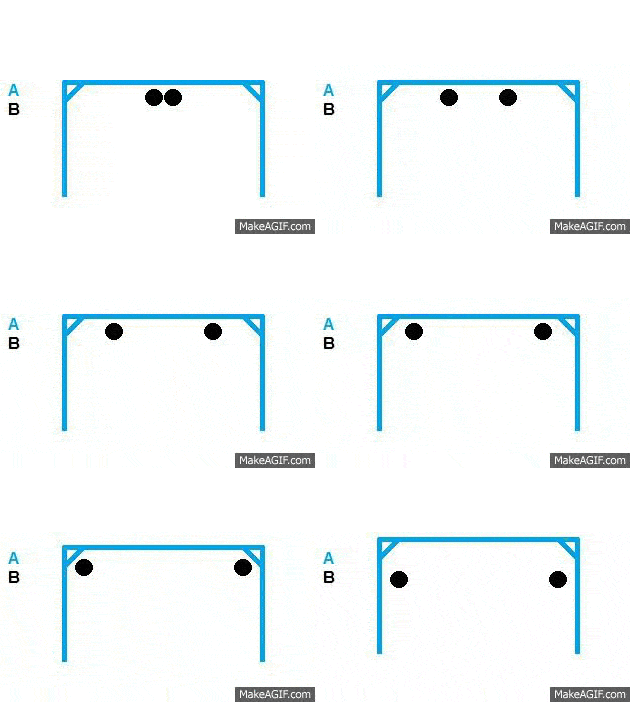

pyw1dC.gif


Thanks
 
Physics news on Phys.org
The basic equations would be conservation of energy and conservation of momentum.
 
+ conservation of angular momentum
+ momentum transfer occurs perpendicular to the contact line.
The B-items will keep a small fraction of their horizontal movement. This is easier to see with a very small mass A: They would just push it away.
 
thanks for the replies. Mfb, would the lighter part A move upward at a 90 degree angle as depicted?
 
Due to symmetry, balls B will move identically after the collision. So you could simplify things by assuming an imaginary ball of mass m = 2kg moving upward at 10 m/s instead of the two balls. Conservation of momentum and energy gives you two equations, and you have two unknowns: velocity of A and velocity of the imaginary ball after the collision.
 
Thanks Voko, again I appologise for my lack of understanding, but from what you are saying I understand that the fact that the 2 balls striking at a 45 degree angle is not significant?
 
The 45 degree angle is very significant: it ensures that the balls will then move downward, which is why they can be replaced with the imaginary ball I mentioned.
 
sl235 said:
Mfb, would the lighter part A move upward at a 90 degree angle as depicted?
It would (for any mass), due to symmetry.

After taking symmetry into account, you have 3 unkown values after the collision:
1) upwards velocity of A
2) downwards velocity of Bs (same value for both B)
3) sidewards velocity of Bs (same magnitude, opposite direction)

Momentum conservation in vertical direction gives you a relation between 1 and 2, energy conservation a relation between all 3. This leaves one degree of freedom, which corresponds to the angle at the impact points: the transferred momentum in vertical and horizontal direction has to be the same, this gives a third equation and allows to solve the system.@voko: I can't see how a ball moving upwards would give any similar system.
 
mfb said:
@voko: I can't see how a ball moving upwards would give any similar system.

And I can't see how the balls could retain any horizontal velocity. The system is modeled to undergo an instantaneous absolutely elastic collision. Which means the normal momentum is reflected, and the tangential momentum is preserved. Which means the angle of reflection = angle of incidence, which in this case means the reflected motion is strictly downward.
 
  • #10
To supplement that. In a less than fully elastic collision, there will be some horizontal velocity. But there is not enough information to model that.
 
  • #11
voko said:
And I can't see how the balls could retain any horizontal velocity. The system is modeled to undergo an instantaneous absolutely elastic collision. Which means the normal momentum is reflected, and the tangential momentum is preserved.
The wall has a finite mass, and will move a bit after the collision. Therefore, the transferred momentum is smaller - the downwards movement will be slower than the initial velocity (should be obvious from momentum conservation) and some horizontal movement remains.
 

Similar threads

  • · Replies 20 ·
Replies
20
Views
2K
  • · Replies 6 ·
Replies
6
Views
3K
  • · Replies 3 ·
Replies
3
Views
1K
  • · Replies 17 ·
Replies
17
Views
2K
  • · Replies 13 ·
Replies
13
Views
3K
  • · Replies 5 ·
Replies
5
Views
2K
  • · Replies 1 ·
Replies
1
Views
2K
  • · Replies 2 ·
Replies
2
Views
2K
  • · Replies 9 ·
Replies
9
Views
4K
  • · Replies 4 ·
Replies
4
Views
2K