Discussion Overview
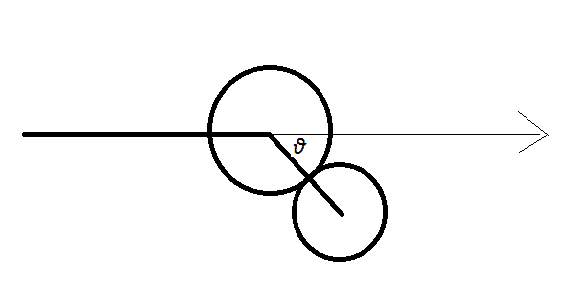
The discussion revolves around the relationship between the angle of collision and the resulting deflection angle in elastic collisions, particularly focusing on a scenario where a large mass collides with a stationary small mass. Participants explore the conditions under which maximum deflection occurs and the implications of mass ratios on the angles involved.
Discussion Character
- Exploratory
- Technical explanation
- Debate/contested
- Mathematical reasoning
Main Points Raised
- One participant suggests that maximum deflection occurs when cos(θ) = m/M, proposing that the small mass stops the incoming momentum component along the line of centers.
- Another participant questions the definition of deflection and the reasoning behind the claim of maximum deflection.
- A participant introduces a diagram showing post-collision trajectories and states that sin(β) = m/M is a proven result for maximum deflection, expressing uncertainty about the validity of their reasoning.
- One participant describes an approach using the center of mass frame (ZMF) to analyze the collision, suggesting that the resultant velocity must be perpendicular to a specific vector for maximum deflection.
- There is a discussion about whether the deflection angle β depends on the collision angle θ, with some participants asserting that it does and others expressing doubt.
- Concerns are raised about the interpretation of momentum transfer along the line of centers, with a participant noting that total momentum transfer may only occur when the masses are equal (M = m).
- Another participant proposes that the relationship might involve cos(2θ) = m/M instead of cos(θ) = m/M, indicating a potential reevaluation of the collision angle's role in maximum deflection.
- A later post introduces a refraction-type formula relating the angles and mass ratios, drawing parallels to wave energy transmission and reflection.
Areas of Agreement / Disagreement
Participants express differing views on the relationship between collision angle and deflection angle, with no consensus reached on the correct interpretation of the conditions for maximum deflection. Some participants agree on certain mathematical relationships, while others challenge the reasoning behind them.
Contextual Notes
There are unresolved mathematical steps and assumptions regarding the definitions of deflection and momentum transfer. The discussion also highlights the dependence on mass ratios and the implications of different collision angles.