3 pulley problem with attached masses

Click For Summary

Homework Help Overview

The discussion revolves around a problem involving three pulleys and two masses, focusing on the dynamics of the system, including tension in the strings, accelerations of the pulleys and masses, and conditions for equilibrium. Participants are analyzing the forces acting on the pulleys and masses, as well as the implications of the pulleys having mass.

Discussion Character

  • Exploratory, Assumption checking, Conceptual clarification

Approaches and Questions Raised

  • Participants discuss the equations of motion for the system, questioning the assumptions about the mass of the pulleys and the direction of forces. There is an exploration of the relationship between the accelerations of the masses and pulleys, as well as the implications of the system being in equilibrium.

Discussion Status

The discussion is active, with participants providing insights and questioning each other's reasoning. Some guidance has been offered regarding the treatment of forces and the relationship between the accelerations, but there is no explicit consensus on the correctness of the original poster's approach.

Contextual Notes

There are mentions of missing information regarding the moment of inertia of the pulleys and the need for assumptions about the system's configuration. Participants are also considering the implications of the string length being constant in their analysis.

patric44
Messages
308
Reaction score
40
Homework Statement
the arrangement in the figure
Relevant Equations
sum(F)=ma
in the opposite problem that has three pulleys and two masses, the book is asking for :
1- the tension on the string.
2- the acceleration of pulley p1.
3- the acceleration of mass m2.
4- what should the mass "m" be such that m1 does not accelerate?
note : pulley p1 has mass m, in the diagram of P1 there should be mg also along with T on pulley 1 , I assume!
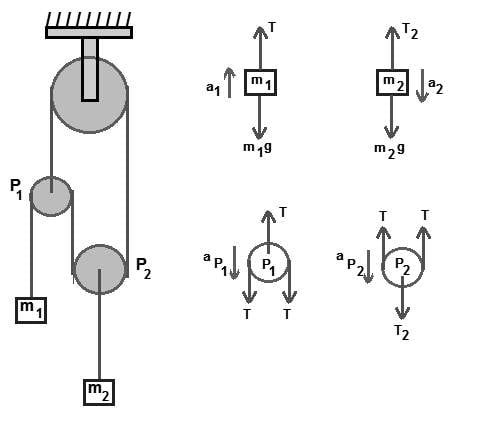
pulle.jpg

the solution
1-
$$
T-m_{1}g=m_{1}a_{1},\quad,\quad T=m_{1}(g+a_{1})
$$
2-
$$
m_{2}g-T_{2}=m_{2}a_{2},\quad,\quad a_{2}=(m_{2}g-T_{2})/m_{2}
$$
3-
$$
2T-T-mg=ma_{p1}\quad,\quad a_{p1}=T/m-g
$$
4- now for a_{1} to equal zero the system will be in equilibrium and
$$
T=m1g\quad, T/m=g\quad, m=m_{1}
$$
I just want to check my answer or if I am missing something, thanks in advance.
 
Physics news on Phys.org
patric44 said:
Homework Statement:: the arrangement in the figure
Relevant Equations:: sum(F)=ma

note : pulley p1 has mass m, in the diagram of P1 there should be mg also along with T on pulley 1 , I assume!
This is not sufficient information about the pulley unless additional assumptions are made about the moment of inertia of that pulley.
 
  • Like
Likes   Reactions: Lnewqban
What “the opposite problem” is?

Are you sure about the pulleys having mass?
 
the problem shown in the figure is exactly similar problem that I found online for the free body diagram only, but my problem states the following :
image.jpg
 
  • Like
Likes   Reactions: Lnewqban
patric44 said:
the problem shown in the figure is exactly similar problem that I found online for the free body diagram only, but my problem states the following :
View attachment 317380
The text of this problem specifies the mass m to be on the axle of the pulley. Effectively givibg it zero moment of inertia. This makes it solvable.
 
Orodruin said:
The text of this problem specifies the mass m to be on the axle of the pulley. Effectively givibg it zero moment of inertia. This makes it solvable.
my bad, I miss wrote that the pulley itself has mass m, so is my approach for the solution correct
 
  • Like
Likes   Reactions: Lnewqban
patric44 said:
my bad, I miss wrote that the pulley itself has mass m, so is my approach for the solution correct
You may want to rethink this:
patric44 said:
3-
$$
2T-T-mg=ma_{p1}\quad,\quad a_{p1}=T/m-g
$$
Which direction are you taking as positive? In which direction do the forces act?
 
should this be, assuming the up is positive
$$
T-2T-mg=ma_{p}\quad,\quad a_{p}=-T/m-g
$$
 
This overlaps previous posts of the last few minutes, but I've already written it and it might help.

Some thoughts…

You have forgotten to include the axle’s weight on the FBD for p1.

When giving each object’s ‘F=ma’ equation, you appear to be using a sign-convention where the positive direction is taken to be the assumed direction of acceleration. I think (not sure) that this will be OK - but it would mean your ‘F=ma’ equation for p1 is wrong.

You haven’t given the ‘F=ma’ equation for p2.

Since the string length is constant, there is a relationship between ##a_1, a_2, a_{p1}## and ##a_{p2}##.

Edit - typo' fixed.
 
  • Like
Likes   Reactions: patric44
  • #10
Steve4Physics said:
This overlaps previous posts of the last few minutes, but I've already written it and it might help.

Some thoughts…

You have forgotten to include the axle’s weight on the FBD for p1.

When giving each object’s ‘F=ma’ equation, you appear to be using a sign-convention where the positive direction is taken to be the assumed direction of acceleration. I think (not sure) that this will be OK - but it would mean your ‘F=ma’ equation for p1 is wrong.

You haven’t given the ‘F=ma’ equation for p2.

Since the string length is constant, there is a relationship between ##a_1, a_2, a_{p1}## and ##a_{p2}##.

Edit - typo' fixed.
yes that's the convention I used, I guess it should be (I am some how confused about the direction of the acceleration) I will assume that both of them will go down ,then for P1
$$
2T+mg-T=ma_{p}\quad, a_{p}=T/m+g
$$
and for the second pulley P2
$$
T_{2}-2T=m_{p2}a_{p2}\quad, T_{2}=2T
$$
 
  • #11
patric44 said:
yes that's the convention I used, I guess it should be (I am some how confused about the direction of the acceleration) I will assume that both of them will go down ,then for P1
$$
2T+mg-T=ma_{p}\quad, a_{p}=T/m+g
$$
and for the second pulley P2
$$
T_{2}-2T=m_{p2}a_{p2}\quad, T_{2}=2T
$$
Looks right so far. What about the kinematic relationship between the accelerations that @Steve4Physics mentioned?
 
  • #12
patric44 said:
$$
2T+mg-T=ma_{p}\quad, a_{p}=T/m+g
$$
This should already tell you something about the possibility of the system being in equilibrium. So this
patric44 said:
now for a_{1} to equal zero the system will be in equilibrium and
cannot be the case. However, you may be able to find a setup such that ##a_1 = 0##, but that will not mean the system is in equilibrium.
 
  • #13
Orodruin said:
This should already tell you something about the possibility of the system being in equilibrium. So this

cannot be the case. However, you may be able to find a setup such that ##a_1 = 0##, but that will not mean the system is in equilibrium.
I assumed that since m1 is not accelerating say downward, it will not lift the other mass m2 at the other side, how could m1 not be accelerating but m2 is ?
 
  • #14
haruspex said:
Looks right so far. What about the kinematic relationship between the accelerations that @Steve4Physics mentioned?
can you give me a little hint on how to use the length in that situation? 🤔
 
  • #15
patric44 said:
can you give me a little hint on how to use the length in that situation? 🤔
Are you familiar with how the string being a fixed length is used in the treatment of the regular Atwood machine?
 
  • #16
patric44 said:
can you give me a little hint on how to use the length in that situation? 🤔
Assign variables to each straight segment of string.
Write equations representing that each whole string is of constant length.
Differentiate as necessary to get accelerations.
 
  • Informative
Likes   Reactions: patric44

Similar threads

Replies
5
Views
1K
  • · Replies 8 ·
Replies
8
Views
2K
  • · Replies 5 ·
Replies
5
Views
1K
Replies
15
Views
2K
  • · Replies 5 ·
Replies
5
Views
2K
  • · Replies 12 ·
Replies
12
Views
1K
  • · Replies 22 ·
Replies
22
Views
2K
Replies
21
Views
1K
  • · Replies 27 ·
Replies
27
Views
1K
  • · Replies 5 ·
Replies
5
Views
2K