3D printed piston for Honda XR75: will 50g vs 79g OEM reduce reciprocating losses
Join the discussion
Registration is free. Start your own thread to ask a follow-up.
41 replies · 6K views
Physics news on Phys.org
novaguy
- 18
- 1
Nothing revolutionary but gave some nice equations of motion to plug into with my engine geometry/mass.
Attached is a PDF copy of the paper:
Hailemariam Nigus. Kinematics and Load Formulation of Engine Crank Mechanism. Mechanics, Materials Science & Engineering Journal, 2015, ff10.13140/RG.2.1.3257.1928ff. ffhal-01305936f
Attached is a PDF copy of the paper:
Hailemariam Nigus. Kinematics and Load Formulation of Engine Crank Mechanism. Mechanics, Materials Science & Engineering Journal, 2015, ff10.13140/RG.2.1.3257.1928ff. ffhal-01305936f
Attachments
Science Advisor
- 3,648
- 10,067
No. If you look carefully, the average torque is zero. Reducing the mass will only reduce the peak values (both positive and negative). Once again, whatever it takes, it gives back; and it takes only one revolution to do so.novaguy said:Can we agree that lower piston mass will reduce the torque due to inertia?
First, your source considers the entire cycle, i.e 2 revolutions, but you consider only half a revolution. Try redoing your math over the entire cycle and calculate the average torque over the cycle. You will see that nothing changed because the average inertial torque is zero.novaguy said:And that the total torque generated (not including resistive torques for simplicity) is the sum of these torques?
Second, these equations assume constant RPM. The model assumes that the torque due to combustion is completely transferred to do work somewhere else. If it wasn't, or the resistive torque would be at least lower than the "torque" coming from the combustion, then this torque difference would accelerate the piston-crank assembly. If it was greater, it would decelerate it.
novaguy
- 18
- 1
Unacceptable references -- User warned that SI chatbots are not acceptable references in the technical forums
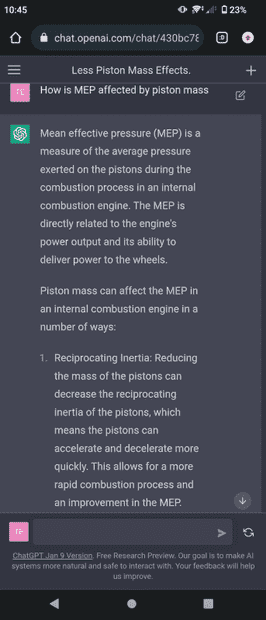
So, I decided to ask ChatGPT what it thought about the subject 
Here is probably the real mechanism behind it, which explains my thinking: lower piston mass can increase the mean effective pressure of the engine.
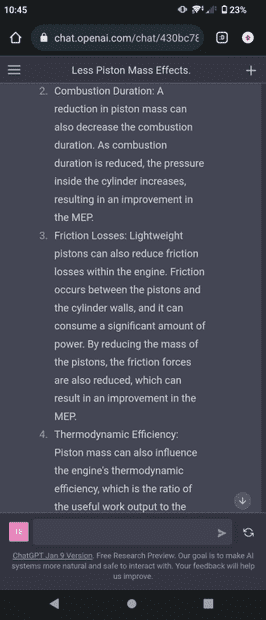
Reciprocating Inertia: Reducing the mass of the pistons can decrease the reciprocating inertia of the pistons, which means the pistons can accelerate and decelerate more quickly. This allows for a more rapid combustion process and an improvement in the MEP.
Combustion Duration: A reduction in piston mass can also decrease the combustion duration. As combustion duration is reduced, the pressure inside the cylinder increases, resulting in an improvement in the MEP.
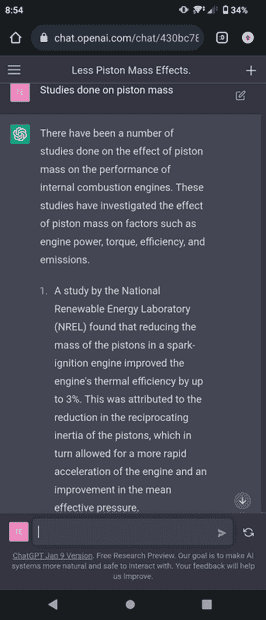
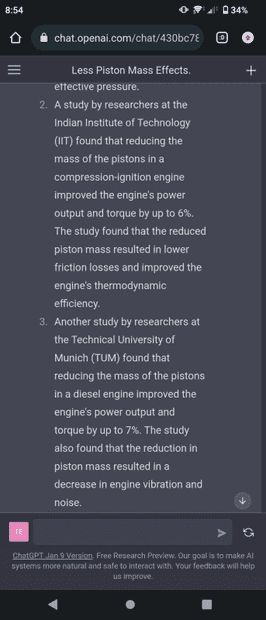
 I also just asked, "studies done on piston mass". Results? INCREASES IN POWER.
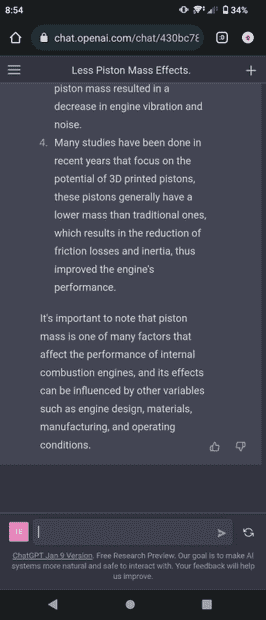
Here is probably the real mechanism behind it, which explains my thinking: lower piston mass can increase the mean effective pressure of the engine.
Reciprocating Inertia: Reducing the mass of the pistons can decrease the reciprocating inertia of the pistons, which means the pistons can accelerate and decelerate more quickly. This allows for a more rapid combustion process and an improvement in the MEP.
Combustion Duration: A reduction in piston mass can also decrease the combustion duration. As combustion duration is reduced, the pressure inside the cylinder increases, resulting in an improvement in the MEP.
Science Advisor
- 3,648
- 10,067
novaguy said:which means the pistons can accelerate and decelerate more quickly. This allows for a more rapid combustion process and an improvement in the MEP.
This is complete nonsense. We already determined that the piston acceleration depends only on the RPM and stroke of the engine; the average over a cycle always being zero (at constant RPM).novaguy said:Combustion Duration: A reduction in piston mass can also decrease the combustion duration. As combustion duration is reduced, the pressure inside the cylinder increases, resulting in an improvement in the MEP.
The only way to reduce the combustion duration (in crank angle) is to reduce the piston speed at TDC. A lower acceleration will achieve that, which only depends on a shorter stroke and/or lower RPM in a traditional engine. The combustion time will remain more or less the same no matter the piston speed. Thus the flame front will have to "chase" the piston at high RPM, getting further away from the ideal constant-volume combustion of the Otto cycle (i.e less efficient). This is the main reason why mean piston speeds higher than 30 m/s are never achieved.
What is said there is about lowering friction force, and vibrations which can all lead to more power. You already mentioned the friction in the OP:novaguy said:I also just asked, "studies done on piston mass". Results? INCREASES IN POWER.
And the energy losses due to vibrations were also already mentioned:novaguy said:and with a much smaller skirt area, less friction too.
Baluncore said:Main bearing friction losses will therefore increase. The unbalanced forces will radiate vibration energy from the main bearings, through the engine mounts, to the vehicle.
ChatGPT is not a valid source of information. Stop looking for things you want to hear and embrace the already-established science. Basically, all you have to do is a Free Body Diagram (FBD) to answer your question:
(The answer should be "no".)novaguy said:will this lighter piston result in a small power increase as less work done by reciprocating the piston?
novaguy
- 18
- 1
You conveniently left out the conclusion by the NREL study showing piston mass to increase MEP.jack action said:What is said there is about lowering friction force, and vibrations which can all lead to more power. You already mentioned the friction in the OP:
"A study by the National Renewable Energy Laboratory (NREL) found that reducing the mass of the pistons in a spark-ignition engine improved the engine's thermal efficiency by up to 3%. This was attributed to the reduction in the reciprocating inertia of the pistons, which in turn allowed for a more rapid acceleration of the engine and an improvement in the mean effective pressure."
The study results make sense if you don't overthink it.
Work done at a faster rate equals more power.
Work can be done faster with lighter reciprocating components.
There aren't some magical parasitic forces that increase to counteract all the increased work that becomes available; some of it goes to engine output.
jack action said:novaguy said:
will this lighter piston result in a small power increase as less work done by reciprocating the piston
There are at least 4 studies that say yes.jack action said:(The answer should be "no".)
Science Advisor
2025 Award
- 17,253
- 10,712
@novaguy
A simple statement, without any specified conditions, may appear to be true in one specific case, but that does not make the simple statement unconditionally true in the general case.
The more you cherry-pick to make your original belief seem correct, the more opposition you will receive from others, who must refuse your unconditional general statements.
A simple statement, without any specified conditions, may appear to be true in one specific case, but that does not make the simple statement unconditionally true in the general case.
The more you cherry-pick to make your original belief seem correct, the more opposition you will receive from others, who must refuse your unconditional general statements.
novaguy
- 18
- 1
I don't think I cherry picked anything. So far, there is mostly conjecture on whether or not reciprocating inertia increases power. Just people stating off the top of their heads what they think.Baluncore said:The more you cherry-pick to make your original belief seem correct, the more opposition you will receive from others, who must refuse your unconditional general statements.
What I've found though various studies and my own data is that lower piston mass does increase power. Whether through reduced friction due to mass, lower bearing loads, and or less reciprocating inertia.
I used basic dynamics equations to compare identical engines with 2 different piston masses, posted earlier. There is a clear increase in the rate that torque is generated due to lower reciprocating inertia. It allows the work to be done faster by the combustion gas expansion. The energy is produced faster and given back to the rotating components faster.
I figured it would be easy for someone to confirm or refute these claims with a few equations. I understand not everyone wants to take their time to explain it
Science Advisor
2025 Award
- 17,253
- 10,712
Where the work is done for only part of the cycle, are you referring to only the part of the cycle where work is being done, the work per full cycle, or the work done over a full working day.
Piston failure must be avoided, because it destroys the investment in the engine. Lighter pistons tend to be more fragile and less durable. It only takes one unusual situation to destroy a poorly designed piston. Before designing and prototyping a piston, you need to examine a collection of failed pistons, then examine your new design in the light of all the failure modes that may be encountered in normal operation.
Piston engines are an old technology.
There are more economic solutions that deserve more urgent attention.
Under what conditions do you believe those general statements to be true?novaguy said:Work done at a faster rate equals more power.
Work can be done faster with lighter reciprocating components.
Piston failure must be avoided, because it destroys the investment in the engine. Lighter pistons tend to be more fragile and less durable. It only takes one unusual situation to destroy a poorly designed piston. Before designing and prototyping a piston, you need to examine a collection of failed pistons, then examine your new design in the light of all the failure modes that may be encountered in normal operation.
Piston engines are an old technology.
There are more economic solutions that deserve more urgent attention.
Science Advisor
- 3,648
- 10,067
You do understand that these words were assembled together by a Chatbot that surely hasn't reviewed a study (if it exists) and then share its conclusions with you?novaguy said:"A study by the National Renewable Energy Laboratory (NREL) found that reducing the mass of the pistons in a spark-ignition engine improved the engine's thermal efficiency by up to 3%. This was attributed to the reduction in the reciprocating inertia of the pistons, which in turn allowed for a more rapid acceleration of the engine and an improvement in the mean effective pressure."
You should find that study because nobody will argue with a Chatbot.
For my part, I think you have enough comments - from so many people - that have answered your question all the same way. On eng-tips.com you do seem to have a friend with SwinnyGG, but in the end, he's saying what I already told you:
jack action said:Reducing mass may reduce the normal forces between the components, leading to fewer friction losses. That is the only way you can explore the higher efficiency of your engine.