4.1.286 AP Calculus Exam .... table of f(t).

Click For Summary
SUMMARY

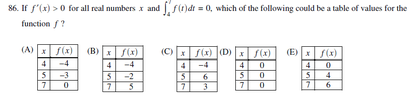
The discussion centers on analyzing the behavior of the function \( f(t) \) in the context of the AP Calculus Exam question regarding the integral \( \int_4^x f(t) \, dt \). Participants conclude that if \( f'(t) > 0 \), the slope is always positive, indicating a potential linear function. They eliminate options (C), (D), and (E) based on the properties of \( f(t) \) within the specified interval, ultimately suggesting that option "D" is the most plausible choice for a possible function.

PREREQUISITES
  • Understanding of calculus concepts such as derivatives and integrals.
  • Familiarity with the properties of functions and their graphs.
  • Knowledge of the Fundamental Theorem of Calculus.
  • Ability to analyze inequalities in the context of functions.
NEXT STEPS
  • Review the Fundamental Theorem of Calculus and its applications.
  • Study the implications of positive and negative derivatives on function behavior.
  • Explore examples of functions that satisfy specific integral conditions.
  • Practice solving AP Calculus problems involving integrals and function properties.
USEFUL FOR

Students preparing for the AP Calculus Exam, educators teaching calculus concepts, and anyone interested in understanding the behavior of functions through derivatives and integrals.

karush
Gold Member
MHB
Messages
3,240
Reaction score
5
View attachment 9426
ok these always baffle me because f(t) is not known. however if $f'(t)>0$ then that means the slope is aways positive which could be just a line. but could not picture this to work in the tables.
Im sure the answer can be found quickly online but I don't learn by copy and paste. d was attractive but where would the slope be?
so any sugest..
 

Attachments

  • Capture.PNG
    Capture.PNG
    3.3 KB · Views: 155
Physics news on Phys.org
check that integral statement ... you sure the upper limit is t and that it's not an inequality?

I'm thinking maybe it should be something like $\displaystyle \int_4^x f(t) \, dt > 0$
 
skeeter said:
check that integral statement ... you sure the upper limit is t and that it's not an inequality?

I'm thinking maybe it should be something like $\displaystyle \int_4^x f(t) \, dt > 0$
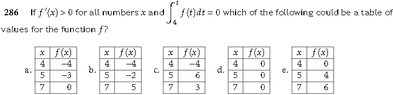
I'm guessing it should be $$\int_4^7 f(t) \, dt = 0$$.
 

Attachments

  • 286.png
    286.png
    8.4 KB · Views: 160
karush said:
here is the original
yeah probably 7 clipped

Well, you can throw out (C) and (D) since $f'(t)$ is not > 0 for all $t$ in the interval

You can throw out (E) since $f(t) \ge 0$ for all $t$ in the interval

You can throw out (A) since $f(t) \le 0$ for all $t$ in the interval
 
Since the problem only asks for a possible function, "D" leaps out immediately!
 

Similar threads

  • · Replies 6 ·
Replies
6
Views
2K
  • · Replies 6 ·
Replies
6
Views
2K
Replies
4
Views
2K
  • · Replies 1 ·
Replies
1
Views
2K
  • · Replies 3 ·
Replies
3
Views
2K
  • · Replies 33 ·
2
Replies
33
Views
3K
  • · Replies 1 ·
Replies
1
Views
2K
  • · Replies 24 ·
Replies
24
Views
6K
  • · Replies 1 ·
Replies
1
Views
2K
  • · Replies 4 ·
Replies
4
Views
11K