SUMMARY
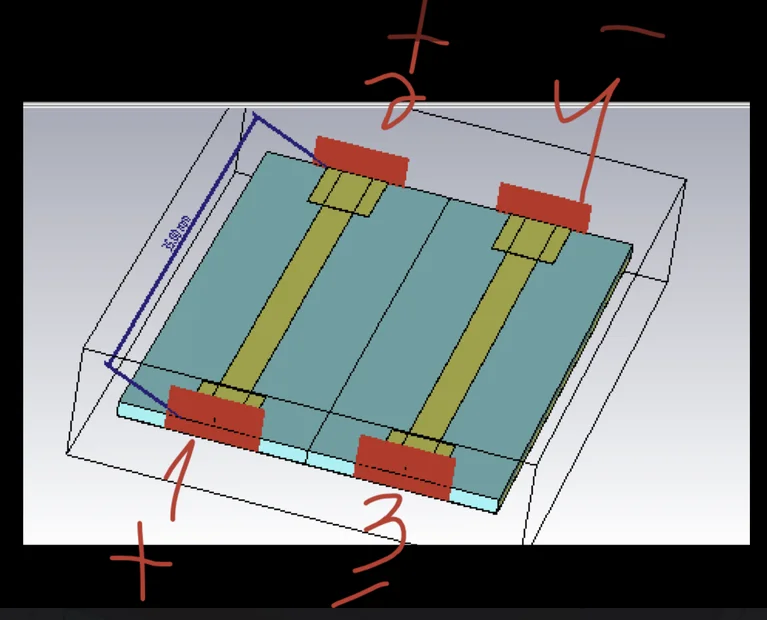
The discussion analyzes the -6dB loss phenomenon in differential pair signaling, specifically focusing on the SDD21 parameter in a 3dB coupler or hybrid with quarter-wave coupled lines. The key conclusion is that a -6dB power loss corresponds to an output voltage at half the input, resulting in one-quarter power output, consistent with a 100Ω to 50Ω balun transmission line transformer impedance ratio. The conversation highlights the importance of correct input port connections (typically ports 1 and 4) for expected signal combining and notes that faults such as a shorted or open coaxial connector can cause λ-dependent reflections affecting measurements. The discussion emphasizes that without detailed device layout, termination, and measurement setup information, precise analysis is impossible.
PREREQUISITES
- Understanding of S-parameters, specifically SDD21 in differential signaling
- Knowledge of 3dB directional couplers and hybrid coupler theory with quarter-wave coupled lines
- Familiarity with balun transmission line transformers and impedance transformation (e.g., 100Ω to 50Ω)
- Experience with Vector Network Analyzer (VNA) measurements and balanced vs. unbalanced port configurations
NEXT STEPS
- Study the design and operation of 3dB coupled line directional couplers and hybrids in microstrip technology
- Learn detailed interpretation of differential S-parameters (SDD21) in presence of faults like open or shorted lines
- Explore balun transformer impedance matching principles and their impact on differential signaling loss
- Investigate VNA measurement techniques for balanced differential ports and proper termination strategies
USEFUL FOR
RF engineers, microwave circuit designers, test engineers working with differential signaling, and anyone involved in designing or troubleshooting directional couplers, baluns, and differential transmission lines using VNAs.