8 Oct 2017, 3 significant Earthquakes

  • Thread starter Thread starter davenn
  • Start date Start date
  • Tags Tags
    2017
Click For Summary
SUMMARY

On October 8, 2017, three significant earthquakes occurred within a 10-hour period: a magnitude 6.1 earthquake 153 km NW of Pangai, Tonga; a magnitude 6.3 in the Balleny Islands region; and a magnitude 6.6 earthquake 60 km E of Buldir Island, Alaska. The largest event, the M6.6, was the deepest at approximately 111 km, resulting in lower surface wave levels. The Indo-Australian tectonic plate is moving at varying speeds, with the eastern part, including Australia, advancing at approximately 5.6 cm/year, contributing to seismic activity in the region.

PREREQUISITES
  • Understanding of tectonic plate movements and their implications.
  • Familiarity with earthquake magnitude scales and seismology.
  • Knowledge of seismic wave propagation and its effects.
  • Basic grasp of statistical models, particularly Poisson distribution in seismic events.
NEXT STEPS
  • Research the Indo-Australian plate dynamics and its impact on seismic activity.
  • Study the relationship between deep earthquakes and surface wave propagation.
  • Explore the concept of remote triggering in seismology and its documented cases.
  • Investigate the statistical modeling of earthquake occurrences using Poisson distribution.
USEFUL FOR

Seismologists, geophysicists, earthquake researchers, and anyone interested in understanding tectonic activity and earthquake prediction methodologies.

davenn
Science Advisor
Gold Member
Messages
9,715
Reaction score
11,717
3 respectable events within 10 hours

M 6.1 - 153km NW of Pangai, Tonga

M 6.3 - Balleny Islands region

M 6.6 - 60km E of Buldir Island, Alaska
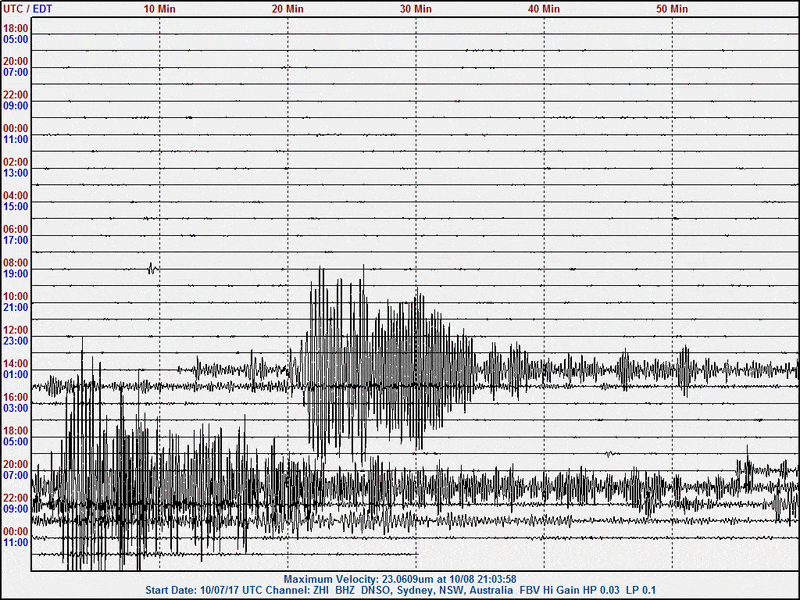
171008 M 6.1 Tonga, 6.3 Balleny Is, 6.6 Aleutians zhi.gif
The first 2 events are on this map. The third event, the M 6.6 in the western Aleutian Islands, is the other end of the pacific from me.
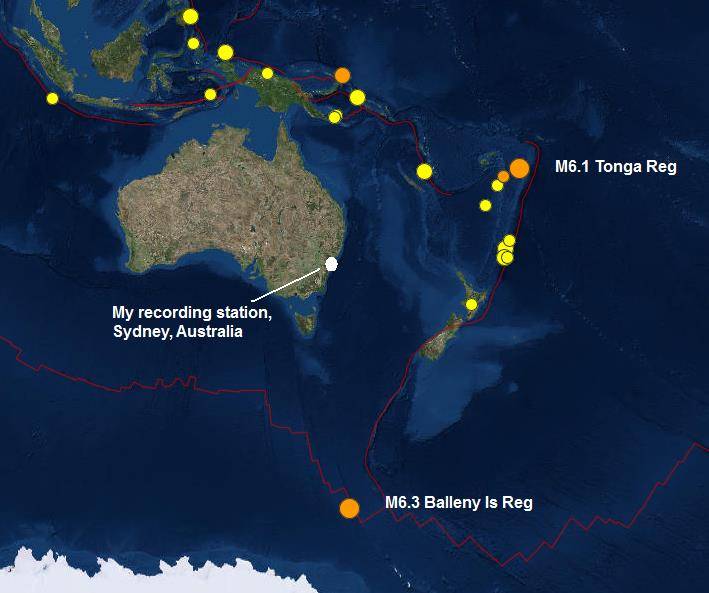
171008  M6.1 Tonga, M6.3 Balleny Is.JPG
The largest event, the M6.6 is the smallest on the seismogram
1) it was the furthest from me and
2) it was reasonably deep, ~ 111 km, so Surface waves were low levelDave
 
  • Like
Likes   Reactions: Stavros Kiri
Earth sciences news on Phys.org
I've heard or read somewhere that you live on the fastest moving ship of all.
 
  • Like
Likes   Reactions: Stavros Kiri
fresh_42 said:
I've heard or read somewhere that you live on the fastest moving ship of all.
ummm please clarify :smile:
 
This is a bit embarrassing because I have no scientific source. It had been said that the Australian plate is the fastest moving one (towards north).
 
  • Like
Likes   Reactions: Stavros Kiri
fresh_42 said:
This is a bit embarrassing because I have no scientific source. It had been said that the Australian plate is the fastest moving one (towards north).

ohhh OK, I was wondering if you were referring to something like that but wasn't sure :smile:

The Indo-Australian plate isn't the fastest moving one but it is still at a reasonable speed, there is a notable difference
between the western part of the plate and the eastern part

from Australian Science ...

The western part of the plate is still pushing against the Himalayas, moving at about 3.7 centimetres per year, but the eastern part, including the entire continent of Australia, is moving at a much faster speed of around 5.6 centimetres per year. This is causing the whole tectonic plate to quite literally buckle, which is the root cause behind all of the quakes in the region over the past decade.
Read more at: www.australianscience.com.au/news/breaking-plates/

For the high speeds look to the Tonga - Kermadec Trench where the Pacific seafloor is diving down under the edge
of the Indo-Australian Plate at up to 7.5 cm / yr
That trench basically covers the region from offshore eastern North Is., NZ up to around the Tonga/Samoa region.
This results in regular large and often very deep earthquakesDave
 
Last edited:
  • Like
Likes   Reactions: Stavros Kiri and fresh_42
In the last few years, I read that earthquakes generate frequencies which allow 'remote triggering' in faults that respond to the same frequency. More properly, the same spectrum of frequencies. If the travel time for the seismic waves is appropriate, could one of these be a case of remote triggering?

More importantly, are sensitivity frequencies are being compiled for the major faults. I can hope that, after a powerful earthquake, the spectrum of frequencies will prompt a warning to the civil authorities where populations are threatens next. Something like the Pacific tidal wave warnings.

Is this spectral information being compiled?
 
  • Like
Likes   Reactions: Stavros Kiri
@MRBlizzard
It helps us enormously when 'I read somewhere' is presented something like I read an article 'XXXX YYYY' in Science Magazine. The reason for this is a lot of what 'I read' may really not be good science, but somebody's speculation or non-standard interpretation. So it leads to:

I'll guess something from a good source: http://www.jstor.org/stable/2881709?seq=1#page_scan_tab_contents

This does not mention harmonics at all. Just large non-linear dyanamic strain. So where do we go from here? I may have guessed wrong. You may have mis-remembered. Nobody knows.

The point is that vague references can lead to awful answers. Please help us here. We need all the help we can get.
Thanks.
 
  • Like
Likes   Reactions: Stavros Kiri
jim mcnamara said:
@MRBlizzard
It helps us enormously when 'I read somewhere' is presented something like I read an article 'XXXX YYYY' in Science Magazine. The reason for this is a lot of what 'I read' may really not be good science, but somebody's speculation or non-standard interpretation. So it leads to:
Thanks Jim :smile:
MRBlizzard said:
I read that earthquakes generate frequencies which allow 'remote triggering' in faults that respond to the same frequency. More properly, the same spectrum of frequencies

I have never heard of that. I don't think fault lines can have specific frequencies, or a spectrum thereof.

As Jim said ... you need to cite references, maybe 1) they are bad info, 2) you misunderstood what was being said ??
MRBlizzard said:
More importantly, are sensitivity frequencies are being compiled for the major faults. I can hope that, after a powerful earthquake, the spectrum of frequencies will prompt a warning to the civil authorities where populations are threatens next. Something like the Pacific tidal wave warnings.

see my above commentsThe only thing I can say is that large events do sometimes trigger events elsewhere but the documented cases are few and far between

The only one that comes to mind is the 1992, M7.3, Landers ( Southern California) that was deemed to have triggered events in Northern California and also possibly the M6.5 Big Bear event in Southern California

https://www.researchgate.net/publication/258565273_Transient_deformation_during_triggered_seismicity_from_the_June_28_1992_M73_Landers_earthquake_at_Long_Valley_Volcanic_Caldera_California

https://broom02.revolvy.com/topic/Landers, California earthquake&item_type=topic
cheers
Dave
 
There are about 160 M6+ earthquakes per year (average of the last 10 years). For a random uniform distribution, the probability that two of them occur within 12 hours of a given other one is 2%. On average we expect this to happen 3 times per year by chance. Roughly every 5 years we expect 4 uncorrelated M6+ earthquakes to happen within 12 hours. This does not include aftershocks, which are clearly correlated.
 
  • Like
Likes   Reactions: jim mcnamara and davenn
  • #10
mfb said:
On average we expect this to happen 3 times per year by chance. Roughly every 5 years we expect 4 uncorrelated M6+ earthquakes to happen within 12 hours.
Please support that
(seems a bit arbitrary)
 
  • #11
For uncorrelated events the number of earthquakes in a 12 hour window follows a Poisson distribution with a mean of 160*12h/(1 year) = 0.219.
Poisson(0.219,2)=0.019, as we have 160 "attempts" per year we expect 160*0.019=3.0 such events per year.
Poisson(0.219,3)=0.0015, we expect this once every 1/(160*0.0015)=4.2 years. As I didn't use a calculator for the last number I made a rough estimate.

Note: The calculation for 3 events neglects the probability for 4 events close together (as it would give two sequences of 3 events), and similar for 4 and 5, but as there is a factor 10 between them that is a good estimate and the error is very small.
 
  • Like
Likes   Reactions: Stavros Kiri
  • #12
mfb said:
For uncorrelated events the number of earthquakes in a 12 hour window follows a Poisson distribution with a mean of 160*12h/(1 year) = 0.219.
Poisson(0.219,2)=0.019, as we have 160 "attempts" per year we expect 160*0.019=3.0 such events per year.
Poisson(0.219,3)=0.0015, we expect this once every 1/(160*0.0015)=4.2 years. As I didn't use a calculator for the last number I made a rough estimate.

Note: The calculation for 3 events neglects the probability for 4 events close together (as it would give two sequences of 3 events), and similar for 4 and 5, but as there is a factor 10 between them that is a good estimate and the error is very small.
Interesting! You have my respect!
 

Similar threads

  • · Replies 8 ·
Replies
8
Views
3K
Replies
1
Views
835
  • · Replies 6 ·
Replies
6
Views
4K
  • · Replies 2 ·
Replies
2
Views
3K