A Charged Particle in a Uniform Electric Field

Click For Summary
SUMMARY

The motion of a charged particle, such as an electron, in a uniform electric field is governed by the equation \( ma = -eE \), where \( E \) is the electric field intensity and \( e \) is the charge. The particle experiences constant acceleration, but radiation losses due to acceleration are negligible unless the electric field strength is extraordinarily high, as established by the Larmor formula and relativistic considerations. The discussion highlights the complexity of solving the resulting differential equations and concludes that first-order approximations can be used to describe the motion effectively under typical conditions.

PREREQUISITES
  • Understanding of Newton's second law of motion
  • Familiarity with the Larmor formula for radiation from accelerated charges
  • Basic knowledge of differential equations
  • Concepts of special relativity and relativistic effects on particle motion
NEXT STEPS
  • Study the Larmor formula and its implications for charged particle motion
  • Learn about solving differential equations in classical mechanics
  • Explore the effects of special relativity on charged particle dynamics
  • Investigate numerical methods for approximating solutions to complex differential equations
USEFUL FOR

Physicists, electrical engineers, and students studying electromagnetism or classical mechanics, particularly those interested in the behavior of charged particles in electric fields.

ThorX89
Messages
13
Reaction score
0
Hi.
I'm curious, how would a charged particle, let's say an electron, move in a simple uniform electric field?
My first guess would be that it would follow Newton's second law of motion and move with a constant acceleration:
$ \dot{x}=\frac{Eq}{m} $
where E is the fields intensity, q the charge, and m it's mass.
However, an accelerated charge should generate electromagnetic waves.
These have energy and so the motion wouldn't accelerate as fast.
I found that the energy radiated by these should be equal to:
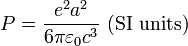
7ee2ee93d0be36072ffd505d4d836d58.png

(Larmor formula) for norelativistic speeds.

So I would assume that the work done by the electric field on the charge in a fraction of time:
$ P_{el} = q\cdot E \cdot \dot{x} $
would be used to a) increase the kinetic energy of the particle b) used for the radiation energy:
\[P_{el}=\frac{d}{dt}(\frac{1}{2}m\dot{x}^2) + P_{rad}\]

That leads to the differential equation:
$ A \cdot \dot{x} = m \cdot \dot{x} \cdot \ddot{x} + B \cdot \ddot{x}^2 $
where
$ A=Eq ; B=\frac{{q^2}}{{6\cdot\pi\eps_0\ c^3}} $
(just to make it look simpler).

I have now idea how to solve this.
Do you think my reasoning is right? If so, can anybody find a solution?
How is the motion of a charged particle in a uniform electric field truly described?

I'd think this is quite a simple question, but I couldn't find any simple answer to it on the Internet.
I appreciate any help.
 
Physics news on Phys.org
It's negligible. The radiated power for linear acceleration, for relativistic effects accounted for, is
P = \frac{2}{3}\frac{e^2}{m^2c^3}\left( \frac{dp}{dt} \right)^2
Now, instead of substituting -qE as our force here, we will note that the rate of change in the momentum is also equal to the change in energy of the particle per unit distance. This obvious from the fact that work is the integral of F*dx. Thus,
P = \frac{2}{3}\frac{e^2}{m^2c^3} \left( \frac{dE}{dx} \right)^2
This allows us to express the power radiated as a function of the external forces that are applied as opposed to the properties of the particle. Now, the ratio of the power radiated to the power supplied by the external source is
\frac{P}{(dE/dt)} = \frac{2}{3}\frac{e^2}{m^2c^3} \frac{1}{v} \frac{dE}{dx}
Where we have made use of the chain rule. In the limit of a relativistic speed,
\lim_{v\rightarrow c} \frac{P}{(dE/dt)} = \frac{2}{3}\frac{(e^2/mc^2)}{mc^2}\frac{dE}{dx}

Thus, the radiation loss is negligible unless the gain in energy is of the order of mc^2 over a distance of e^2/mc^2. In other words, a change in energy on the order of 2e14 MeV/m. Jackson states that typical gains are around 50 MeV/m or less. Obviously, we need an electric field of an inconceivable size.

So, in short, the answer to your question is that we simply use
ma = -eE
because we do not work with electric fields strong enough to bleed enough energy off of the electron as it is linearly accelerated to make a difference.
 
Last edited:
I attempted a solution to the differential equation I proposed
and I got ended up with
this
http://integrals.wolfram.com/index.jsp?expr=2/(-x-Sqrt[x^2%2B4B%2Fx*A]%29&random=false
or
http://integrals.wolfram.com/index.jsp?expr=2/(-x+Sqrt[x^2%2B4B%2Fx*A]%29&random=false
for t, where x actually stands for v=dx/dt.
Ie. no hope of extracting v as v=f(t) so basically a dead end.

So this this is a really nice solution you gave me - when you can't deal with something, just show it's not worth dealing with. :-)
Thanks a lot.
 
ThorX89 said:
I attempted a solution to the differential equation I proposed
and I got ended up with
this
http://integrals.wolfram.com/index.jsp?expr=2/(-x-Sqrt[x^2%2B4B%2Fx*A]%29&random=false
or
http://integrals.wolfram.com/index.jsp?expr=2/(-x+Sqrt[x^2%2B4B%2Fx*A]%29&random=false
for t, where x actually stands for v=dx/dt.
Ie. no hope of extracting v as v=f(t) so basically a dead end.

So this this is a really nice solution you gave me - when you can't deal with something, just show it's not worth dealing with. :-)
Thanks a lot.

Here's a better way you can get to in by two different paths. The differential equation that we have, I have changed to a positron so that all the distances and accelerations should be positive with respect to E, is

m\dot{x}\ddot{x} = eE\dot{x}-\frac{2e^2}{3c^3}\ddot{x}^2

Solving for the acceleration we get

\ddot{x} = \frac{3mc^3\dot{x}}{4e^2} \left[ -1+ m\dot{x} \sqrt{ 1 + \frac{8e^3E}{3m^2c^3\dot{x}}} \right]

Now we take the Taylor's expansion of the square root and get

\ddot{x} \approx \frac{eE}{m} - \frac{2e^4E^2}{3m^3c^3\dot{x}}

In other words,

m\dot{x}\ddot{x} \approx eE\dot{x} - \frac{2e^4E^2}{3m^2c^3}

But this is the same thing as if we did a first order approximation and used eE as the force in the radiated power formula and placed it into the original differential equation. Either way, we come to the same first order approximation. The kinetic energy is thus

\frac{1}{2}m\dot{x}^2 \approx eEx - \frac{2e^4E^2}{3m^2c^3} t

So here is a better starting point to work with. As for solving this, hmmm...

EDIT: Now that I think about it, I don't think the above will work. Because of the small amount of power that is radiated, we would have to use equations that follow special relativity, but currently the above equations of motion allow for unbounded velocities. Oh well, we have at least proven what the first order approximation is and that is derived from a formula that works for relativistic particles. So this approximation should be valid to be substituted into a set of equations of motion that do follow special relativity.
 
Last edited:

Similar threads

  • · Replies 8 ·
Replies
8
Views
2K
  • · Replies 3 ·
Replies
3
Views
3K
  • · Replies 7 ·
Replies
7
Views
2K
  • · Replies 14 ·
Replies
14
Views
2K
  • · Replies 22 ·
Replies
22
Views
2K
  • · Replies 14 ·
Replies
14
Views
2K
  • · Replies 1 ·
Replies
1
Views
2K
  • · Replies 2 ·
Replies
2
Views
2K
  • · Replies 11 ·
Replies
11
Views
2K
  • · Replies 14 ·
Replies
14
Views
3K