zwierz
- 334
- 62
Everybody knows what this is
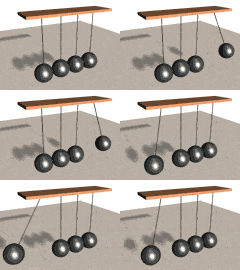
Teachers very like to show it to students as an illustration of conservation laws. But this toy illustrates something less trivial also.
And the questions are
1) should students know such things?
2) are there another explanations besides the one proposed below ?
Assume that our Newton Cradle consists of three same balls each ball has mass 1. Initially the first and the second ball are at rest and those are in contact. The third ball hits the second one with velocity 2. The collision is elastic.
Let ##v_i,\quad i=1,2,3## be the velocities of the balls right after the collision. Write down the laws of energy and impulse conservation:
$$v_1^2+v_2^2+v_3^2=4,\quad v_1+v_2+v_3=2.$$
These are two equations with three unknowns. The solution ##v_1=2,\quad v_3=v_2=0## is usually demonstrated but actually this system has the continuum solutions. For example another one is
$$v_1=\frac{1-\sqrt 5}{2},\quad v_2=1,\quad v_3=\frac{1+\sqrt 5}{2}.$$
So that the model of elastic collision does not provide uniqueness of solution and thus this model is incorrect for the Newton Cradle. The explanation of this effect is as follows. The motion after the collision is very sensitive to initial position of the first and the second ball. They may not be in contact but situated very close to each other and this small distance influences heavily to the behavior of the system right after the collision. Almost the same small initial distances between the first and the second ball can give very different velocities after the collision. The result may also be sensitive to small irregularities of the balls at the contact point.
Teachers very like to show it to students as an illustration of conservation laws. But this toy illustrates something less trivial also.
And the questions are
1) should students know such things?
2) are there another explanations besides the one proposed below ?
Assume that our Newton Cradle consists of three same balls each ball has mass 1. Initially the first and the second ball are at rest and those are in contact. The third ball hits the second one with velocity 2. The collision is elastic.
Let ##v_i,\quad i=1,2,3## be the velocities of the balls right after the collision. Write down the laws of energy and impulse conservation:
$$v_1^2+v_2^2+v_3^2=4,\quad v_1+v_2+v_3=2.$$
These are two equations with three unknowns. The solution ##v_1=2,\quad v_3=v_2=0## is usually demonstrated but actually this system has the continuum solutions. For example another one is
$$v_1=\frac{1-\sqrt 5}{2},\quad v_2=1,\quad v_3=\frac{1+\sqrt 5}{2}.$$
So that the model of elastic collision does not provide uniqueness of solution and thus this model is incorrect for the Newton Cradle. The explanation of this effect is as follows. The motion after the collision is very sensitive to initial position of the first and the second ball. They may not be in contact but situated very close to each other and this small distance influences heavily to the behavior of the system right after the collision. Almost the same small initial distances between the first and the second ball can give very different velocities after the collision. The result may also be sensitive to small irregularities of the balls at the contact point.
Last edited: