A general 2-form - Colley Chapter 8, Section 8.1

  • Context: Graduate 
  • Thread starter Thread starter Math Amateur
  • Start date Start date
  • Tags Tags
    General Section
Click For Summary
SUMMARY

The discussion centers on understanding the formulation of a general 2-form as presented in Susan Colley's "Vector Calculus," specifically in Section 8.1. Participants clarify the ordering of terms in the general 2-form, highlighting that the standard form should maintain strictly increasing indices. The confusion arises from Example 3, where the terms are presented in a non-standard order. It is established that the general 2-form can be expressed in multiple notations, with the coefficients being arbitrary functions, and that reversing the order of wedging results in a sign change.

PREREQUISITES
  • Understanding of differential forms and their properties
  • Familiarity with vector calculus concepts
  • Knowledge of the wedge product and its implications
  • Basic grasp of linear algebra and vector spaces
NEXT STEPS
  • Study the properties of the wedge product in differential geometry
  • Explore the implications of indexing in differential forms
  • Learn about the relationship between forms and linear combinations in vector spaces
  • Review examples of 2-forms in various coordinate systems
USEFUL FOR

Mathematicians, physics students, and anyone studying differential geometry or vector calculus who seeks to deepen their understanding of differential forms and their applications.

Math Amateur
Gold Member
MHB
Messages
3,920
Reaction score
48
I am reading Susan Colley's book: Vector Calculus ... and am currently focussed on Section 8.1: An Introduction to Differential Forms ... ...

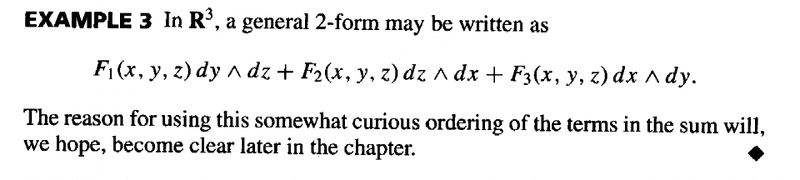
Colley, on page 491 in Example 3 gives a formula for a general 2-form as follows:
?temp_hash=81999305d3b63a031b8f52969f053b61.png
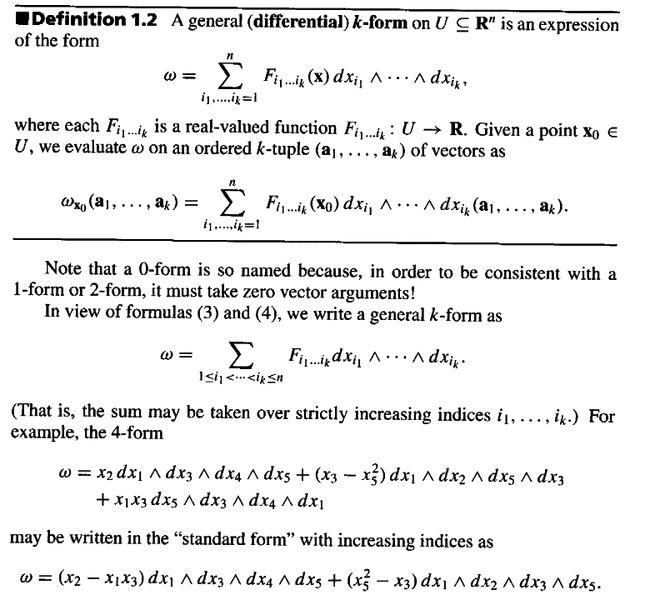
I am trying to understand what Colley describes as 'the somewhat curious ordering of the terms' ... ... with the terms dy \ \wedge \ dz , dz \ \wedge \ dx and dx \ \wedge \ dy occurring in that order ... ... ?... Now when Colley comes to defining a general differential k-form, not two pages further on from Example 3, we find (page 493):
?temp_hash=a20ac2b613eaad2ca9444669eb5946cc.png
So ... from the general k-form above, for a general 2-form we have\omega = \sum_{ 1 \le i_1 \lt i_2 \lt 2 } F_{ i_1 i_2 } dx_{i_1} \ \wedge \ dx_{i_2}\omega = F_{12} \ dx_1 \ \wedge \ dx_2 \ + \ F_{13} \ dx_1 \ \wedge \ dx_3 \ + \ F_{23} \ dx_2 \ \wedge \ dx_3or if we write x_1 as x, x_2 as y, and x_3 as z then we have ... ...

\omega = F_{12} \ dx \ \wedge \ dy \ + \ F_{13} \ dx \ \wedge \ dz \ + \ F_{23} \ dy \ \wedge \ dzHow do we match this general form with that stated two pages earlier in Example 3 ...Hope someone can help ...

Peter
 

Attachments

  • Colley - Example 3 - page 491 - a general 2-form   .png
    Colley - Example 3 - page 491 - a general 2-form .png
    14.2 KB · Views: 688
  • Colley - Page 493 - Defn of a general differential k-form     .png
    Colley - Page 493 - Defn of a general differential k-form .png
    37 KB · Views: 615
Last edited:
Physics news on Phys.org
Hmm, I think I share your confusion.

Example 3: ##F_1(x,y,z)dy\wedge dz+F_2(x,y,z)dz\wedge dx+F_3(x,y,z)dx\wedge dy##
should have been written as ##F_3(x,y,z)dx\wedge dy-F_2(x,y,z)dx\wedge dz+F_1(x,y,z)dy\wedge dz##
to match the standard form with strictly increasing indexes.

EDIT: maybe later in the text they will write 2-forms as ##F_{12}dx \wedge dy+ F_{23}dy \wedge dz +F_{31}dz\wedge dx##, and that's what they are hinting at.
 
Last edited:
  • Like
Likes   Reactions: Math Amateur
Two forms can be added. Addition is commutative so the order of addition does not change the form.

One can multiply forms by arbitrary functions and it doesn't matter what you call them. Indexing is just notation. You can index any way that you want.

In the coordinate system, ##(x,y,z)## on the domain ##U## dx^dy ,dx^dz and ,dy^dz form a basis for all 2 forms. The general 2 form is a linear combination of them with the coefficients being arbitrary functions. Note that at each point of ##U## one just has a linear combination of basis vectors of a vector space.

So one can write the general 2 form in the first notation as

##F_{1}(x,y,z)##dy##∧##dz + ##F_{2}(x,y,z)##dz##∧##dx + ##F_{3}(x,y,z)##dx##∧##dy or as

##F_{12}##dx##∧##dy + ##F_{13}##dx##∧##dz + ##F_{23}##dy##∧## dz in the second notation.

Both are the same provided that the corresponding ##F##'s are equal.

Note also the if one reverses the order of wedging that the form gets multiplied by -1. So dx##∧##dy = -dy##∧##dx
This relation shows that there are only three basis vectors, not 6.
 
  • Like
Likes   Reactions: Math Amateur

Similar threads

  • · Replies 1 ·
Replies
1
Views
3K
  • · Replies 4 ·
Replies
4
Views
3K
  • · Replies 2 ·
Replies
2
Views
1K
  • · Replies 2 ·
Replies
2
Views
4K
  • · Replies 3 ·
Replies
3
Views
3K
  • · Replies 14 ·
Replies
14
Views
5K
Replies
2
Views
1K
  • · Replies 35 ·
2
Replies
35
Views
30K