Differential Forms & Tensor Fiekds .... Browder, Section 13.1

Click For Summary

Discussion Overview

The discussion revolves around the interpretation of differential forms as defined by Andrew Browder in his book and how they relate to an example provided by Steven Weintraub. Participants explore the definitions, notations, and equivalences between the two sources, focusing on the mathematical properties and representations of differential forms.

Discussion Character

  • Exploratory
  • Technical explanation
  • Conceptual clarification

Main Points Raised

  • Peter references Browder's definition of a differential form and seeks clarification on how to interpret Weintraub's example in that context.
  • Some participants explain that the differential of a function is a 1-form and that the products of differentials are interpreted as antisymmetric wedge products, forming 2-forms.
  • There is mention of a complete basis for 1-forms consisting of the differentials of coordinate functions, which are used in the example provided by Weintraub.
  • One participant provides an explicit calculation of a differential 2-form, emphasizing the importance of the antisymmetry in the wedge product, and notes that Weintraub's notation omits explicit wedge symbols.
  • Another participant expresses a desire for clarity on the equivalence between Browder's definition and Weintraub's example, indicating ongoing confusion.

Areas of Agreement / Disagreement

Participants generally agree on the definitions and properties of differential forms but express differing levels of understanding regarding the specific equivalence between Browder's and Weintraub's notations. The discussion remains unresolved as participants continue to seek clarification.

Contextual Notes

There are limitations in the clarity of notation and definitions between the two sources, which may affect the understanding of the relationship between Browder's and Weintraub's presentations of differential forms.

Math Amateur
Gold Member
MHB
Messages
3,920
Reaction score
48
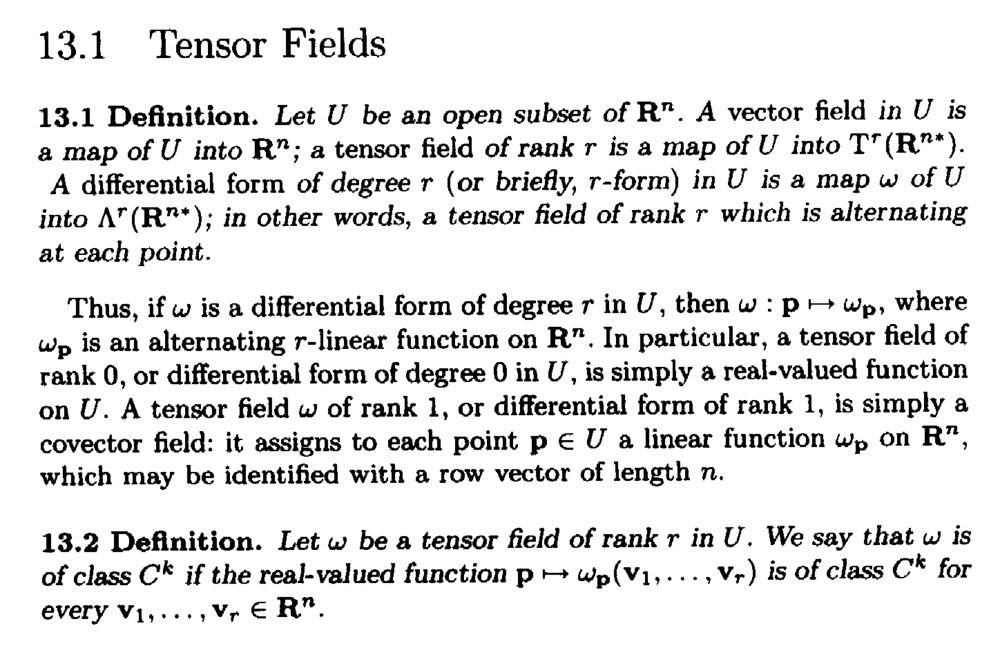
Andrew Browder in his book: "Mathematical Analysis: An Introduction" ... ... defines a differential form in Section 13.1 which reads as follows:
?temp_hash=3f3521b671bccc12ee40577ba0093d88.png


In the above text from Browder we read the following:

" ... ... A differential form of degree ##r## (or briefly an ##r##-form) in ##U## is a map ##\omega## of ##U## into ## { \bigwedge}^r V ( \mathbb{R}^{ n \ast } )## ... ... "In other words if ##\omega## is a differential form of degree ##r## in ##U##, then we have

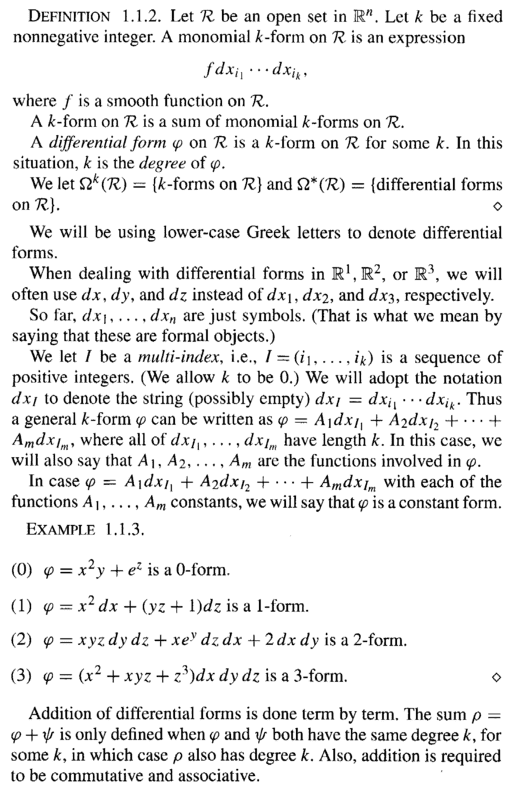
##\omega : p \to \omega_p ( v_1, \cdot \cdot \cdot , v_r )##Browder, unfortunately, gives no example of a differential form ... but I found an introductory example of a ##2##-form on page 6 of Steven Weintraub's book: Differential Forms: Theory and Practice ... the example (Example 1.1.3 (2) ) reads as follows:

" ... ...

##\phi = xyz \text{ dy } \text{ dz } + x e^y \text{ dz } \text{ dx } + 2 \text{ dx } \text{ dy }##
My question is as follows:

How do we interpret Weintraub's example in terms of Browder's definition of a differential form ... and further, how do we translate Weintraub's example into an example in Browder's notation/definition ... ...Help will be much appreciated ... ...

Peter=========================================================================================

So that readers can access Weintraub's definition and notation I am providing the relevant text ... as follows:
?temp_hash=3f3521b671bccc12ee40577ba0093d88.png


Hope that helps,

Peter
 

Attachments

  • Browder - Defn of a differential form .png
    Browder - Defn of a differential form .png
    59.4 KB · Views: 517
  • Weintraub - Differential Forms ,,, Ch. 1, page 6 ... .png
    Weintraub - Differential Forms ,,, Ch. 1, page 6 ... .png
    55.6 KB · Views: 437
  • ?temp_hash=3f3521b671bccc12ee40577ba0093d88.png
    ?temp_hash=3f3521b671bccc12ee40577ba0093d88.png
    59.4 KB · Views: 691
  • ?temp_hash=3f3521b671bccc12ee40577ba0093d88.png
    ?temp_hash=3f3521b671bccc12ee40577ba0093d88.png
    55.6 KB · Views: 552
Last edited:
Physics news on Phys.org
The differential of a function ##f## is the 1-form ##df## such that ##df(v) = df/dt##, where the derivative of ##f## is taken with respect to the curve parameter ##t## such that ##v## is the tangent vector of the curve. A complete basis for 1-forms is given by the differentials of the coordinate functions. These are the ##dx##, ##dy##, and ##dz## in the expression. The products of the differentials is intended as the antisymmetric wedge product, which makes them 2-forms. Since you have three dimensions, there are three [n(n-1)/2] independent such products and the general 2-form is a linear combination of those.
 
Orodruin said:
The differential of a function ##f## is the 1-form ##df## such that ##df(v) = df/dt##, where the derivative of ##f## is taken with respect to the curve parameter ##t## such that ##v## is the tangent vector of the curve. A complete basis for 1-forms is given by the differentials of the coordinate functions. These are the ##dx##, ##dy##, and ##dz## in the expression. The products of the differentials is intended as the antisymmetric wedge product, which makes them 2-forms. Since you have three dimensions, there are three [n(n-1)/2] independent such products and the general 2-form is a linear combination of those.

Thanks Orodruin ... appreciate your help ...

However I am still struggling to understand the explicit link/equivalence between Browder's definition of ##\omega## and Weintraub's example ...

Peter
 
Here is an example with an actual calculation:
https://www.physicsforums.com/threads/why-the-terms-exterior-closed-exact.871875/#post-5474443

Weintraub does not write the wedges and only uses notations up to three, which is a bit confusing, as he does not mention (in what you copied) that differential forms are alternating.

Say we have a differential (alternating) ##2-##form ##\omega = xyz (\text{dy} \wedge \text{dz}) + x e^y (\text{dz}\wedge \text{dx}) + 2 (\text{dx} \wedge \text{dy})##. Then Weintraub writes it as ##\varphi = xyz \text{ dy } \text{ dz } + x e^y \text{ dz } \text{ dx } + 2 \text{ dx } \text{ dy }##, but they are the same thing.

I would quote this section in Wikipedia https://de.wikipedia.org/wiki/Differentialform#Differentialform but I'm too lazy to translate it (and the translator in Chrome needs some additional work - see below). You don't need to understand sections and cuts for now, and they say "smooth" which is ##C^\infty##, which can be substituted by ##C^k##. The English page is less explicit.

upload_2019-3-16_4-22-32.png
 

Attachments

  • upload_2019-3-16_4-22-32.png
    upload_2019-3-16_4-22-32.png
    51.1 KB · Views: 518
  • Like
Likes   Reactions: Math Amateur

Similar threads

  • · Replies 2 ·
Replies
2
Views
2K
Replies
7
Views
2K
Replies
2
Views
2K
  • · Replies 2 ·
Replies
2
Views
2K
  • · Replies 2 ·
Replies
2
Views
2K
  • · Replies 2 ·
Replies
2
Views
2K
Replies
5
Views
2K
  • · Replies 2 ·
Replies
2
Views
1K
Replies
2
Views
2K
  • · Replies 1 ·
Replies
1
Views
2K