'A' Level question on capacitors

  • Thread starter Thread starter jezza10181
  • Start date Start date
  • Tags Tags
    Capacitors
Click For Summary
SUMMARY

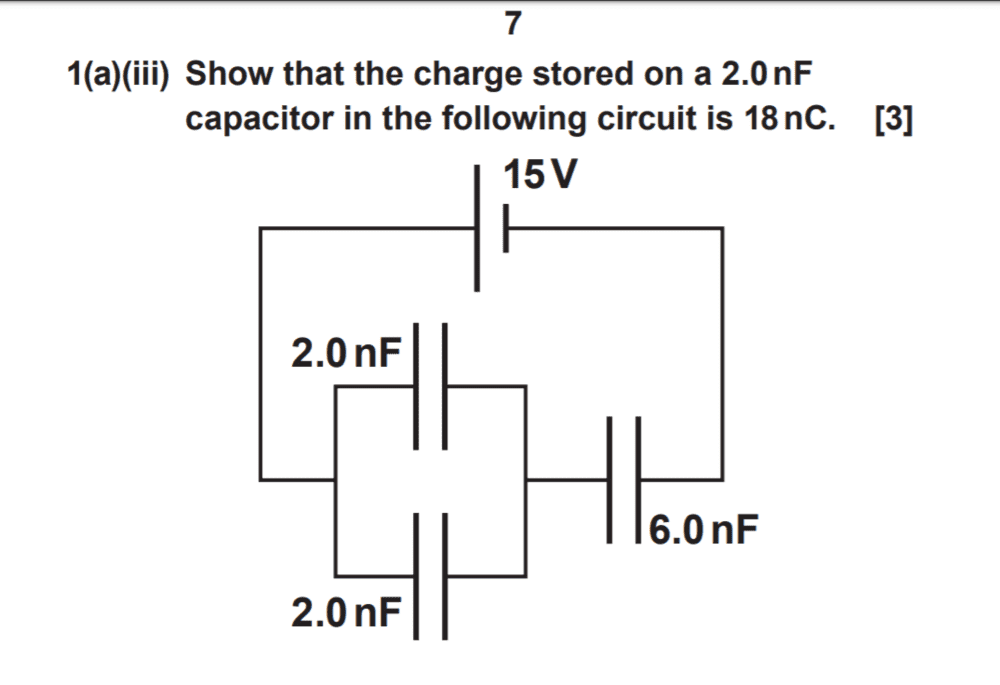
The discussion centers on the calculation of charge distribution in a capacitor system involving two 2.0nF capacitors in series with a 6.0nF capacitor. The user correctly determined the total charge in the system to be 36.0nC and the equivalent capacitance to be 2.4nF using the formula 1/C = 1/C1 + 1/C2. However, confusion arose regarding the charge on each capacitor, with the user concluding that each 2.0nF capacitor should hold 9.0nC instead of the expected 18.0nC. The correct understanding is that the charge on the capacitors in series is equal, leading to 18.0nC on each 2.0nF capacitor and 36.0nC on the 6.0nF capacitor.

PREREQUISITES
  • Understanding of capacitor configurations (series and parallel)
  • Familiarity with capacitance calculations and the formula 1/C = 1/C1 + 1/C2
  • Knowledge of charge distribution in capacitors
  • Basic principles of electrical circuits and charge conservation
NEXT STEPS
  • Study the principles of charge distribution in series and parallel capacitor circuits
  • Learn about the implications of equivalent capacitance in complex circuits
  • Explore practical applications of capacitors in electronic circuits
  • Review advanced topics in capacitor behavior under varying voltage conditions
USEFUL FOR

Students studying electrical engineering, physics enthusiasts, and anyone seeking to deepen their understanding of capacitor behavior in circuits.

jezza10181
Messages
13
Reaction score
1
Homework Statement
Just for a laugh, I decided to try some A level physics questions (I am 50yrs old btw and did my physics A level over 30yrs ago :) ) & ran into this difficulty
Relevant Equations
Q = VC, 1/C = 1/C1 + 1/C2
I have been looking at this question:-
Capacitors.PNG
Now, I have found the charge in the whole system to be 36.0nC. I did this by 'condensing' the two 2.0nF into a single 4.0nF one, that then leaving me with an equivalent system of a 4.0nF capacitor & a 6.0nF one? I then found the equivalent capacitance of that ensemble using the 1/C = ... formula. I found this to be 2.4nF. From that I found the total charge in the system to be 36.0nC.

So, that would mean that each of the capacitors would have to have 18.0nC on them. So, as the 4.0nF 'equivalent' capacitor ,which is composed of the two 2.0nF capacitors, has 18.0nC on it, then that would mean each of the two 2.0nF capacitors has 9.0nC on it & not 18.0nC, as the question states.

What do you think?
 
Physics news on Phys.org
Book answer is correct. Write the charges next to the capacitor plates to see why
 
18.0nC on the one 2nF, 18.0nC on the other, & 18.0nc on the 6.0nF? That is 54nC isn't it? I still don't see it, sorry
 
Over-all C is 2.4 nF, so -36 nC on rightmost plate: continue from there

1581589042170.png
 
  • Like
Likes   Reactions: ehild
Surely, there would only be -36nC on the right most plate, if you were dealing with the equivalent situation of having a single capacitor of 2.4nF there?
 
jezza10181 said:
I have been looking at this question:-View attachment 257036Now, I have found the charge in the whole system to be 36.0nC. I did this by 'condensing' the two 2.0nF into a single 4.0nF one, that then leaving me with an equivalent system of a 4.0nF capacitor & a 6.0nF one? I then found the equivalent capacitance of that ensemble using the 1/C = ... formula. I found this to be 2.4nF. From that I found the total charge in the system to be 36.0nC.
that means, that replacing the whole system by a single capacitor, there is +36 nC charge on one plate and - 36 nC charge on the other plate.
When you connect two capacitors in series to a battery, the plates connected to the terminals of the battery get charge from the battery, but the plates connected to each other can get charge only from each other.
If the first plate of the first capacitor has Q charge,, there is -Q charge on
the opposite plate, and Q charge again on the first plate on the second capacitor, and -Q charge on the second plate on the second capacitor. It is analogous to the current through resistors connected in series.
 
  • Like
Likes   Reactions: BvU and jezza10181
ehild said:
that means, that replacing the whole system by a single capacitor, there is +36 nC charge on one plate and - 36 nC charge on the other plate.
When you connect two capacitors in series to a battery, the plates connected to the terminals of the battery get charge from the battery, but the plates connected to each other can get charge only from each other.
If the first plate of the first capacitor has Q charge,, there is -Q charge on
the opposite plate, and Q charge again on the first plate on the second capacitor, and -Q charge on the second plate on the second capacitor. It is analogous to the current through resistors connected in series.
That's a great explanation, thanks. It's finally sunk in lolll
 

Similar threads

Replies
4
Views
2K
  • · Replies 14 ·
Replies
14
Views
1K
Replies
20
Views
2K
  • · Replies 18 ·
Replies
18
Views
3K
  • · Replies 6 ·
Replies
6
Views
3K
  • · Replies 11 ·
Replies
11
Views
3K
  • · Replies 4 ·
Replies
4
Views
2K
  • · Replies 4 ·
Replies
4
Views
4K
  • · Replies 6 ·
Replies
6
Views
2K
  • · Replies 12 ·
Replies
12
Views
3K