A problem in this photoelectric effect experiment

  • Thread starter Thread starter JACKR
  • Start date Start date
  • Tags Tags
    Modern physics
Click For Summary
SUMMARY

The discussion centers on solving a problem related to the photoelectric effect experiment, specifically calculating the stopping potential (VAC) and the work function (φ) using the equation eV₀=hυ-φ. Participants clarify that the potentiometer is set at R = 3.20 kΩ and address issues regarding the current in the cathode-anode branch, emphasizing the need for accurate values and assumptions in calculations. Typos in the homework statement are also identified, which could lead to confusion in solving the problem.

PREREQUISITES
  • Understanding of the photoelectric effect and its equations
  • Familiarity with Kirchhoff's Voltage Law (KVL)
  • Knowledge of electrical components such as resistors and current sources
  • Ability to manipulate equations involving stopping potential and work function
NEXT STEPS
  • Study the derivation and application of the photoelectric effect equation eV₀=hυ-φ
  • Learn more about Kirchhoff's Voltage Law and its applications in circuit analysis
  • Explore the significance of stopping potential in photoelectric experiments
  • Investigate common errors in circuit analysis and how to avoid them
USEFUL FOR

Students and educators in physics, particularly those focusing on the photoelectric effect, as well as anyone involved in experimental physics and circuit analysis.

JACKR
Messages
13
Reaction score
1
Homework Statement
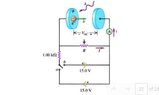
The work function of material examined using apparatus shown schematically in Fig: P38. The ammeter measures the photocurrent. The voltage of the anode relative to the cathode is VAC. The switch is in position while radiation with wavelength 140 nm is incident on the cathode. (a) The potentiometer is set at R = 3.20 kΩ and there is a photocurrent. What is the potential difference VAC? (b) The resistance is slowly adjusted to lower values until the first hint of photocurrent is detected in the ammeter. That happens when R = 334 Ω. What is the value of VAC at that point? (c) What is the work function of the cathode material? (d) The switch is then thrown to position a and the ammeter measures a photocurrent of 3.71 mA. What is the current I in this case? (e) What is the value of VAC? (f) The switch is returned to position a and the wavelength of the light is reduced to 65.0 nm. The photocurrent increases. What is the minimum value of R for which the photocurrent will cease?
Relevant Equations
e|V_AB|=hυ-φ
(a) is easy. No i. Therefore, the 1kΩ resistor and the 3.20kΩ one are connected in series. So 'I' can be easily determined and so is VAC

(b) is the same as (a)

(c) The work function should be solved for via the equation eV₀=hυ-φ, where V₀ is the absolute value for VAC from part (b)

(d) I am stuck at this. The current in the cathode-anode branch is constant regardless of the battery voltage. So, it occurred to me that I should place a current source in the top branch giving 3.71 mA. The |voltage difference| between the cathode and the anode equals to IR. I thought about applying KVL in the upper loop, but when I carried this out, I didn't reach to anything.


(e) Is easy to figure out once 'I' from (d) is known

(f) given the wavelength and the figured work function, I can calculate V₀, then through applying KVL to the down loop, I will be able to determine the value of 'I' therefore, the value of R.


. . ..
 

Attachments

  • IMG_20240528_082734.jpg
    IMG_20240528_082734.jpg
    15.6 KB · Views: 58
Physics news on Phys.org
Hi. Welcome to PF! A few comments...

JACKR said:
Homework Statement: ..... The voltage of the anode relative to the cathode is VAC. The switch is in position while radiation with wavelength 140 nm is incident on the cathode.
But the value of 'position' is missing! Presumably position b?

JACKR said:
(a) The potentiometer is set at R = 3.20 kΩ and there is a photocurrent.
But your anwer to part (a) says the photocurrent is zero - which conflicts with the information in the question.

You give the equation "e|V_AB|=hυ-φ". I would use ##V_S## (stopping potential) in the equation. And the modulus (absolute value) symbol suggests the polarity of the voltage does not matter - but it does. A more conventional form of the the equation is therefore ##eV_S = h\nu - \phi##.

You could improve the readability of the Homework Statement a lot by starting each question in a new paragraph. Much easier on our eyes – so you’re more likely to get replies!
 
  • Like
Likes   Reactions: JACKR and nasu
But to actually answer your question...

JACKR said:
(d) I am stuck at this. The current in the cathode-anode branch is constant regardless of the battery voltage. So, it occurred to me that I should place a current source in the top branch giving 3.71 mA. The |voltage difference| between the cathode and the anode equals to IR. I thought about applying KVL in the upper loop, but when I carried this out, I didn't reach to anything.
I is the current through the variable resistor (presumably still set at 334 Ω).
What is the current through the battery in terms of I and i?
What is the current through the fixed resistor in terms of I an i?

Then consider the loop containing only the battery and two resistors.
 
  • Like
Likes   Reactions: JACKR
But why would you assume that it's still set at 334 Ω?
 
JACKR said:
But why would you assume that it's still set at 334 Ω?
Because 334 Ω is the last value given for R (in part (b)) and the question tells you when R is changed. And, as far as I can see, you need the value of R to answer question-parts (d) and (e).

Any comments on what I said in Post #2 by the way?
 
Regarding part (b), you can think of it as the moment just before the one moment when current flows. Indeed, this is only way to solve the problem. Also, the value calculated there is the value of the stoping potential. About the equation, I think you're right. I shouldn't have put a modulus around VAC. Thank you for your help.
 
(a) The potentiometer is set at R = 3.20 kΩ and there is a NO photocurrent. What is the potential difference VAC?
It's a a typo in the statement of the question.
 
JACKR said:
(a) The potentiometer is set at R = 3.20 kΩ and there is a NO photocurrent. What is the potential difference VAC?
It's a a typo in the statement of the question.
Yes. The other typo's I can spot are also important:
________________________

"The switch is in position while radiation with wavelength 140 nm is incident ..."
should be
"The switch is in position b while radiation with wavelength 140 nm is incident ..."
________________________

"(f) The switch is returned to position a ..."
should be
"(f) The switch is returned to position b ..."
________________________

Hope you managed parts (e) and (f). Post again if you still need help.

Edited.
 
  • Like
Likes   Reactions: JACKR
Steve4Physics said:
Yes. The other typo's I can spot are also important:
________________________

"The switch is in position while radiation with wavelength 140 nm is incident ..."
should be
"The switch is in position b while radiation with wavelength 140 nm is incident ..."
________________________

"(f) The switch is returned to position a ..."
should be
"(f) The switch is returned to position b ..."
________________________

Hope you managed parts (e) and (f). Post again if you still need help.

Edited.
Thanks for pointing them out. Yeah, I managed parts (e) and (f); thank you!
 
  • Like
Likes   Reactions: Steve4Physics

Similar threads

Replies
7
Views
1K
Replies
1
Views
2K
  • · Replies 25 ·
Replies
25
Views
4K
  • · Replies 11 ·
Replies
11
Views
2K
  • · Replies 3 ·
Replies
3
Views
5K
  • · Replies 2 ·
Replies
2
Views
2K
  • · Replies 11 ·
Replies
11
Views
2K
  • · Replies 6 ·
Replies
6
Views
3K
Replies
4
Views
2K
  • · Replies 4 ·
Replies
4
Views
5K