A quarterback throws a football to a stationary receiver

  • Thread starter Thread starter Etheryte
  • Start date Start date
  • Tags Tags
    Receiver
Click For Summary
SUMMARY

A quarterback must throw a football at an initial speed of approximately 24.5 m/s at a 40° angle to reach a stationary receiver 31.5 meters away. The highest point of the football's flight occurs at half the horizontal distance, which is 15.75 meters, and can be calculated using projectile motion equations. The discussion emphasizes the need to separate the horizontal and vertical motion equations to solve for time and initial velocity effectively.

PREREQUISITES
  • Understanding of projectile motion principles
  • Familiarity with kinematic equations
  • Knowledge of trigonometric functions for angle calculations
  • Ability to manipulate algebraic equations
NEXT STEPS
  • Study the derivation of projectile motion equations
  • Learn how to apply kinematic equations in two dimensions
  • Explore the concept of maximum height in projectile motion
  • Practice solving problems involving initial velocity and angle of projection
USEFUL FOR

Students studying physics, educators teaching projectile motion, and anyone interested in understanding the dynamics of sports physics.

Etheryte
Messages
3
Reaction score
0
1. Homework Statement
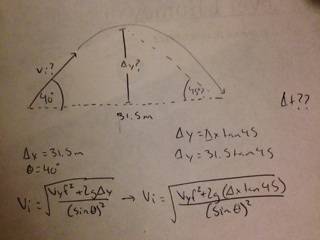
A quarterback throws a football to a stationary receiver 31.5m away from him. If the football is thrown at an initial angle of 40° to the ground, at what initial speed must the quarterback throw the ball for it to reach the receiver? What's the balls highest point during flight?

2. Homework Equations
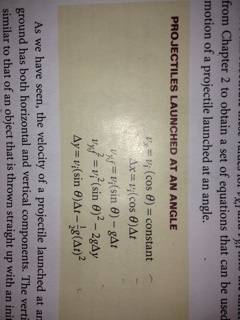
ImageUploadedByPhysics Forums1429555553.253050.jpg


3. The Attempt at a Solution
ImageUploadedByPhysics Forums1429555747.953364.jpg


I know this is only one small attempt at rearranging the formula, but trust me if you checked my trash you'd find crumpled up pieces of paper with many more attempts.

I always go through the same procedure;
1. I make my goal to find the initial velocity.
2. To find initial velocity, I need time.
3. To find time, I need /\y.
4. To find /\y, I need the initial velocity.

Please help.
 
Physics news on Phys.org
The motion has two dimensions: vertical and horizontal. Write the equations of motion w.r.t. time for both motions. The time that the football takes to reach its destination must be the same for both horizontal and vertical motions...
 
I'm sorry, but could you please explain more in depth? I know there's two dimensions but set what two motions with which equations?
 
Etheryte said:
I'm sorry, but could you please explain more in depth? I know there's two dimensions but set what two motions with which equations?
The horizontal motion and the vertical motion. What are the equations for each?
 
Oh, the /\y and /\x equations? I thought you referred to the x and y components of the velocity..

Well, after trying to set them equal to each other — it gets to a point where the /\t can't be really set equal to the rest of the /\y equation and you have a quadratic of a sort:
ImageUploadedByPhysics Forums1429560546.830396.jpg
 
The x and y components of the trajectory are independent equations in terms of time. Write them separately to begin with. (And it would be better if you would type them in rather than attaching image. Use icons in the editing window's top bar to make subscripts or superscripts: x2, x2. Other symbols and special characters can be found using the Sigma icon).

You should then have a pair of equations that describe the motion with respect to time. The only unknowns will be the initial velocity and time. Two equations in two unknowns.
 

Similar threads

  • · Replies 9 ·
Replies
9
Views
4K
  • · Replies 3 ·
Replies
3
Views
4K
  • · Replies 3 ·
Replies
3
Views
5K
Replies
4
Views
6K
  • · Replies 6 ·
Replies
6
Views
5K
Replies
23
Views
4K
  • · Replies 1 ·
Replies
1
Views
3K
Replies
3
Views
2K
Replies
2
Views
2K
  • · Replies 3 ·
Replies
3
Views
4K