A question about special relativity? Car reference vs Earth reference?

Click For Summary

Homework Help Overview

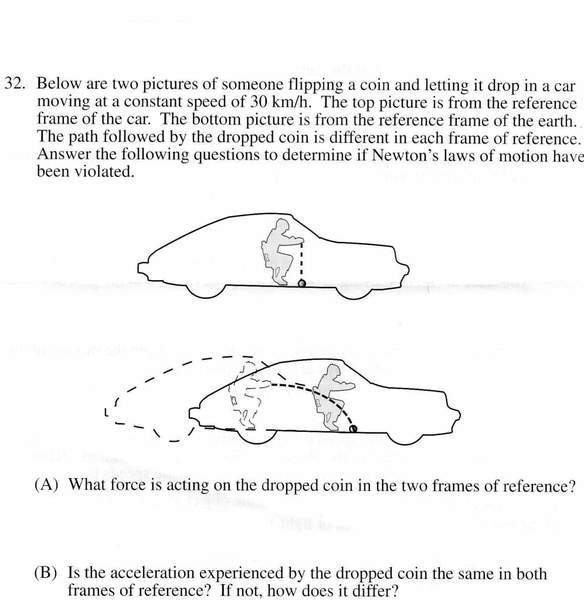
The discussion revolves around concepts of special relativity, particularly focusing on the reference frames of a car moving at a constant speed and an observer on Earth. The original poster presents a scenario involving a coin dropped from a moving car and poses several questions regarding forces, acceleration, initial speed, and the implications for Newton's laws and special relativity.

Discussion Character

  • Exploratory, Conceptual clarification, Assumption checking

Approaches and Questions Raised

  • The original poster attempts to understand the forces acting on the coin in different frames of reference and questions whether acceleration and initial speed are perceived differently from the car and Earth perspectives. Participants engage with these questions, prompting further exploration of the concepts of speed and acceleration.

Discussion Status

Participants are actively discussing the implications of the original poster's questions, with some providing guidance on how to think about the problems. There is a recognition of the need for clarity on the differences in observations from each frame of reference, and some questions remain unanswered, indicating ongoing exploration.

Contextual Notes

The original poster expresses confusion about the effects of Earth's motion and the implications for the initial speed of the coin. There is a mention of homework rules requiring participants to show their work, which influences the nature of the discussion.

graphicer89
Messages
55
Reaction score
0
A question about special relativity? Car reference vs Earth reference??

Hi I am prepping for a upcoming exam and I am trying to understand some concepts of physics and special relativity...which my exam will be on and i need to understand these problems so that i can know how to do the rest being that i was left in the dark without anything to guide my self by and i looked up information but i just don't understand it...and if you could help me out i would really appreciate it a lot...I gave my 2 cents...which i hope can clear any doubts that i have...thanks again...

Lets say there are 2 pictures of someone flipping a coin and letting it drop in a car moving at a constant speed of 30 km/h. One picture is from the reference frame of the car and the other is from the reference frame of the earth.The path followed by the dropped coin is different in each frame of reference.

A) What force is acting on the dropped coin in the 2 frames of reference?

My guess that Gravity is the force that acts on both cause ..both are still on earth(obvious?)

B) Is the acceleration expererienced by the dropped coin the same in both frames of reference?If not how does it differ?

I think that in both cases it is the same speed because though the references are different they both in up in the same spot...just like a rock...if you throw a rock down it falls and it takes time...throw a rock and it falls but takes the same amount of time...

C) Is the initial speed of the coin the same in both frames of reference? (That is,is the initial speed of the coin compared to the car the same as the initial speed of the coin compared to objects outside the car?) If not how does it differ?

I think the initial speed of both coins are different mostly because of Earth's speed ...(thats where I am confused ...earth moves 30 km/h right? so wouldn't both initial speeds be the same??)...

D) According to Newton's Law, what path should the dropped coin follow in the frame of the reference of the car?

According to Newtons law ,the path of the coin should move in a straight line ...

E) According to Newtons's Law what path should the dropped coin follow in the frame of reference of the earth?

F) Does the example of the 2 references support or contradict the first postulate of special relativity? Why or Why not?

Yes because according to the first postulate we can't conduct an experiment that tells us where our frame of reference or another frame of reference is at rest or moving at constant velocity...(my gut isn't agreeing with me)

G) If you were inside the car, from the motion of the coin could you tell if you were at rest or moving at a constant speed relative to the ground?

I think i could tell that I am moving at a constant speed relative to the ground..(obvious?)

H) If you were standing as an observer outside the car, from the motion of the coin could you tell which was at rest, you or the car?

My guess is that i am at rest being that the coin travels faster as I am observer...

img035.jpg
 
Last edited:
Physics news on Phys.org


Hello again graphicer89!

According to the rules in the homework forums, you need to show us you work - either an attempt at solving the problems yourself or, at the very least, you should detail your thoughts on the problem.


Thank you for taking the time to detail your thoughts. Let's take a look
graphicer89 said:
A) What force is acting on the dropped coin in the 2 frames of reference?

My guess that Gravity is the force that acts on both cause ..both are still on earth(obvious?)
Absolutely correct, once the coin has been dropped the only force acting upon it (neglecting drag) is of course it's weight.
graphicer89 said:
B) Is the acceleration expererienced by the dropped coin the same in both frames of reference?If not how does it differ?

I think that in both cases it is the same speed because though the references are different they both in up in the same spot...just like a rock...if you throw a rock down it falls and it takes time...throw a rock and it falls but takes the same amount of time...
I think that your on the right lines, but why are you talking about speed when the question asks about acceleration?

graphicer89 said:
C) Is the initial speed of the coin the same in both frames of reference? (That is,is the initial speed of the coin compared to the car the same as the initial speed of the coin compared to objects outside the car?) If not how does it differ?

I think the initial speed of both coins are different mostly because of Earth's speed ...(thats where I am confused ...earth moves 30 km/h right? so wouldn't both initial speeds be the same??)...
Put yourself in the shoes of the two observers. If you are sat in the car, what do you see the coin do? Now, if you are stood watching the car go past, what do you see the coin do?
graphicer89 said:
D) According to Newton's Law, what path should the dropped coin follow in the frame of the reference of the car?

According to Newtons law ,the path of the coin should move in a straight line ...
You are indeed correct.
graphicer89 said:
E) According to Newtons's Law what path should the dropped coin follow in the frame of reference of the earth?
You don't seem to have answered this question.
graphicer89 said:
F) Does the example of the 2 references support or contradict the first postulate of special relativity? Why or Why not?
I think its best if we leave discussion of this question until you have answered all the previous parts correctly.
graphicer89 said:
G) If you were inside the car, from the motion of the coin could you tell if you were at rest or moving at a constant speed relative to the ground?

I think i could tell that I am moving at a constant speed relative to the ground..(obvious?)
Could you? How would your observations differ if the car were at rest?
graphicer89 said:
H) If you were standing as an observer outside the car, from the motion of the coin could you tell which was at rest, you or the car?

My guess is that i am at rest being that the coin travels faster as I am observer...
That wasn't the question was it? :wink:


Originally Posted by graphicer89
B) Is the acceleration expererienced by the dropped coin the same in both frames of reference?If not how does it differ?

I think that in both cases it is the same speed because though the references are different they both in up in the same spot...just like a rock...if you throw a rock down it falls and it takes time...throw a rock and it falls but takes the same amount of time...

I think that your on the right lines, but why are you talking about speed when the question asks about acceleration?

...So the acceleration on both coins are the same mostly because both end up at the same place? ...Hm can i get a little bit of more insight??

Originally Posted by graphicer89
C) Is the initial speed of the coin the same in both frames of reference? (That is,is the initial speed of the coin compared to the car the same as the initial speed of the coin compared to objects outside the car?) If not how does it differ?

I think the initial speed of both coins are different mostly because of Earth's speed ...(thats where I am confused ...earth moves 30 km/h right? so wouldn't both initial speeds be the same??)...

Put yourself in the shoes of the two observers. If you are sat in the car, what do you see the coin do? Now, if you are stood watching the car go past, what do you see the coin do?

...If i was inside the car i would see the coin go down and maybe hit the floor of the car at normal speed...(my guess that comes to mind)... Now if i saw the car pass by then i would see the coin take a lot more time to come down...in other words it would look slow (my little light bulb just lit up )


E) According to Newtons's Law what path should the dropped coin follow in the frame of reference of the earth?

You don't seem to have answered this question.

...Well it follows a curved path but the path should be a straight path?

G) If you were inside the car, from the motion of the coin could you tell if you were at rest or moving at a constant speed relative to the ground?

I think i could tell that I am moving at a constant speed relative to the ground..(obvious?)

Could you? How would your observations differ if the car were at rest?

...Hmm you made me think about the question again...So basically i wouldn't be able to tell that i am moving? ..if i was inside the car and I am looking out and see a car moving back wards its because the car I am in is moving forward...


H) If you were standing as an observer outside the car, from the motion of the coin could you tell which was at rest, you or the car?

My guess is that i am at rest being that the coin travels faster as I am observer...

That wasn't the question was it?

...This one really had to make me think ...hmm but i think its the car...i don't know why but an example...in a high speed jetliner if we flip a coin and catch it just like it was at rest...


I can attach a picture of what i am working with so that you can take a look at it...


graphicer89 said:
...So the acceleration on both coins are the same mostly because both end up at the same place? ...Hm can i get a little bit of more insight??
Try using Newton's second law :wink:
graphicer89 said:
...If i was inside the car i would see the coin go down and maybe hit the floor of the car at normal speed...(my guess that comes to mind)... Now if i saw the car pass by then i would see the coin take a lot more time to come down...in other words it would look slow (my little light bulb just lit up )
No, you were correct the first time: the coin would hit the floor at time same time in both reference frames - but that doesn't mean that the initial speeds were the same in both reference frames.
graphicer89 said:
...Well it follows a curved path but the path should be a straight path?
It does indeed follow a parabolic path, but why do you think it should follow a straight path. (Once you answer the previous question correctly, you should be able to do this one).

graphicer89 said:
...Hmm you made me think about the question again...So basically i wouldn't be able to tell that i am moving? ..if i was inside the car and I am looking out and see a car moving back wards its because the car I am in is moving forward...
Correct, the only way you could tell you were moving would be to look outside.
graphicer89 said:
H) If you were standing as an observer outside the car, from the motion of the coin could you tell which was at rest, you or the car?

My guess is that i am at rest being that the coin travels faster as I am observer...

That wasn't the question was it?

...This one really had to make me think ...hmm but i think its the car...i don't know why but an example...in a high speed jetliner if we flip a coin and catch it just like it was at rest...
What would happen if instead of standing on the earth, you were also in a car. How could you tell which car was moving?

P.S. Could you please try and use quotes in your posts (using the [ quote ] tags), otherwise, this is going to get rather confusing rather quickly.
 

Similar threads

  • · Replies 126 ·
5
Replies
126
Views
11K
  • · Replies 13 ·
Replies
13
Views
1K
Replies
36
Views
4K
  • · Replies 11 ·
Replies
11
Views
2K
  • · Replies 6 ·
Replies
6
Views
2K
  • · Replies 22 ·
Replies
22
Views
1K
  • · Replies 6 ·
Replies
6
Views
1K
  • · Replies 4 ·
Replies
4
Views
3K
  • · Replies 1 ·
Replies
1
Views
1K
Replies
11
Views
2K