SunshineR12
- 2
- 0
Hello all, as a meteorologist I have recently been trying to put together an advanced report on why the standard model of homes are very dangerous during a period of advance snowfall, winds, downburst, or tornado.
My theory is somewhat simple, but at the same time, very complicated.
Given the normal structure of a home being similar to a cube with a triangular top, I imagine the sides would experience a great amount of force being blasted by even a weak tornado, which can reach wind speeds of around 60-150MPH.
The low end wind speeds can be quite normal in a severe thunderstorm, 60MPH-75MPH winds in a thunderstorm are actually quite common in many areas.
Downbursts are particularly dangerous due to the fact that these come with little to no warning, downbursts frequently reach wind speeds of 100mph or greater.
Here's a diagram of what happens during a downburst.

As you can see, the area that would experience the most severe damage would be the initial impact of the downward wind, I'd imagine the pressure put onto a roof would be quite considerable due to the shape, I'm not sure how to explain it, but there is little to no room for the wind to roll off the roof so to say.
The flat surface also comes to play in the dangers of snow, large snowfall amounts can put tremendous weight onto a roof, and ultimately, lead to the collapse.
During a tornado, the period that causes the most damage would be the wind extending from the center of the funnel, which is where the standard cube shaped homes are flawed.
I'd imagine that the winds place a severe amount of pressure on the outside walls, which could lead to the collapse of the walls, or the winds filtering into the house through a weak-spot such as a window or previous crack, and basically exploding the house like an over-inflated balloon.
Here is a chart showing the pressure drop within a strong tornado.
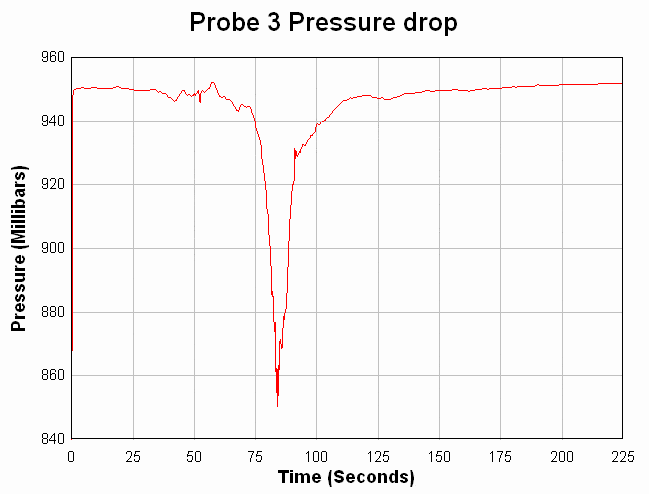
Anyways, onto my question, I've tried using the formula provided in a previous thread, but it's a bit confusing, so I was wondering, given a model house of 50 feet long, and 20 feet high, (forgive me if I'm totally off on the size of average homes, I'm just guessing on search results from Google), what would the PSI be on the outside walls given a wind gust of 120MPH?
My theory is somewhat simple, but at the same time, very complicated.
Given the normal structure of a home being similar to a cube with a triangular top, I imagine the sides would experience a great amount of force being blasted by even a weak tornado, which can reach wind speeds of around 60-150MPH.
The low end wind speeds can be quite normal in a severe thunderstorm, 60MPH-75MPH winds in a thunderstorm are actually quite common in many areas.
Downbursts are particularly dangerous due to the fact that these come with little to no warning, downbursts frequently reach wind speeds of 100mph or greater.
Here's a diagram of what happens during a downburst.
As you can see, the area that would experience the most severe damage would be the initial impact of the downward wind, I'd imagine the pressure put onto a roof would be quite considerable due to the shape, I'm not sure how to explain it, but there is little to no room for the wind to roll off the roof so to say.
The flat surface also comes to play in the dangers of snow, large snowfall amounts can put tremendous weight onto a roof, and ultimately, lead to the collapse.
During a tornado, the period that causes the most damage would be the wind extending from the center of the funnel, which is where the standard cube shaped homes are flawed.
I'd imagine that the winds place a severe amount of pressure on the outside walls, which could lead to the collapse of the walls, or the winds filtering into the house through a weak-spot such as a window or previous crack, and basically exploding the house like an over-inflated balloon.
Here is a chart showing the pressure drop within a strong tornado.
Anyways, onto my question, I've tried using the formula provided in a previous thread, but it's a bit confusing, so I was wondering, given a model house of 50 feet long, and 20 feet high, (forgive me if I'm totally off on the size of average homes, I'm just guessing on search results from Google), what would the PSI be on the outside walls given a wind gust of 120MPH?