"A sentient being can't be aware of being in a superposition"

  • Context: Undergrad 
  • Thread starter Thread starter Swamp Thing
  • Start date Start date
  • Tags Tags
    Superposition
Click For Summary
SUMMARY

The discussion centers on the concept that a sentient being cannot be aware of being in a superposition, as articulated by Sean Carroll. The scenario involves a photon source and two mirrors, M1 and M2, where M1 can be set to absent, 50%, or 100% reflective. The key argument presented is that for a creature to encode an experience of seeing a flash of light, it must have an active neuron corresponding to that specific state. The assertion is made that it is impossible to design a creature whose neurons activate solely in response to a superposition state, highlighting the complexity of brain function in relation to quantum mechanics.

PREREQUISITES
  • Understanding of quantum mechanics, specifically superposition.
  • Basic knowledge of neurobiology and cognitive science.
  • Familiarity with the concept of neurons and their role in experience encoding.
  • Awareness of photon behavior and interference patterns.
NEXT STEPS
  • Research the principles of quantum superposition in detail.
  • Study the neurobiological mechanisms of experience encoding in the brain.
  • Explore the relationship between quantum mechanics and cognitive science.
  • Investigate the design and function of interferometers in quantum experiments.
USEFUL FOR

This discussion is beneficial for physicists, cognitive scientists, and neurobiologists interested in the intersection of quantum mechanics and consciousness, as well as anyone exploring the implications of superposition in sentient experience.

Swamp Thing
Insights Author
Messages
1,047
Reaction score
798
TL;DR
In the linked video, Sean Caroll explains why, under the Many Worlds interpretation, we can't have the experience of seeing things like Schroedinger's cat in a superposition.

I'm trying to propose a simpler reason for this, but I need help.
Sean Carroll on why we don't see things in a superposition [30:44] ---
www.youtube.com/watch?v=5hVmeOCJjOU&feature=youtu.be&t=1843

Here's my attempt at a simpler reason (but I need some help).
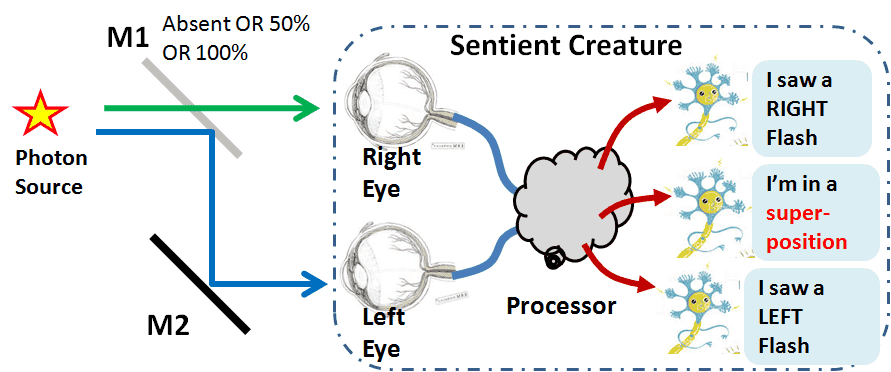
In the figure, we have a photon source and two mirrors M1 and M2. M2 is 100% reflective, but M1 can be switched between absent, 50% and 100%.
  • If M1 is absent, the primitive sentient creature on the right sees a flash of light in its right eye.
  • If M1 is 100% reflective, the creature sees a flash in its left eye.
  • If M1 is 50% reflective, the creature is in a superposition of having seen a flash in the right and left eye.
After the stimulus is applied, signals go through a processor (the cloud in the center) and then activate one of three neurons.
Now here's a reasonable assumption:
(a) In order to be able to encode (and hence to experience) one of the above states, the creature must have at least one neuron (or other such element) that is active only in that state.

For example, the top neuron encodes the experience of "I saw a flash in my right eye"

And now here's a strong intuition that I have, for which I am unable to articulate a proof:
(b) It is impossible to design a creature such that one of its neurons will be activated only when the stimulus corresponds to a superposition.

===========
Firstly, I'd appreciate some feedback as to whether the above makes some sense.
Secondly, how can one prove (or disprove) the statement (b) above?
sentient.png
 
Physics news on Phys.org
If each eye redirects the photons by mirrors and attempts to create an interference pattern, (in essence, completing the interferometer), then a photon reaching a dark band in the interference pattern would indicate that there the mirror was not at the 50% setting. But such a set-up would prevent the brain from ever knowing which eye saw the photon.

Otherwise:
Of course, we are assuming that the brain is in a super-position - and that perceiving super-positioned photons can put it into that state.

Since the mirror seems to be in full view of the creature, the creature could observe that it is half-silvered and therefore deduce that the photons are super-positioned and therefore, so is it (or he or she).

Or, if such brain super-positioning is so easily achieved, then it could keep the "I'm in a super-position" neuron firing at all times.

After all, what do we know about your "Photon Source". Are there variations in the photons emitted from it? Are those variations real or just super-positions of many possible variations?
 
Last edited:
Swamp Thing said:
here's a reasonable assumption

No, it's not a reasonable assumption at all. If it were true, every time you had a neuron die (which happens all the time), you would lose the ability to have an experience. However your brain encodes experiences, it has to be more complicated than this.

Note, also, that this whole question of how the brain encodes experiences is not a question of physics, it's a question of neurobiology and cognitive science. Very few physicists have any familiarity with those fields, so you should not expect their speculations about how the brain works to be very informed.
 
  • Like
Likes   Reactions: Demystifier

Similar threads

  • · Replies 15 ·
Replies
15
Views
3K
  • · Replies 2 ·
Replies
2
Views
2K
Replies
6
Views
3K
  • · Replies 3 ·
Replies
3
Views
2K
  • · Replies 33 ·
2
Replies
33
Views
4K
  • · Replies 25 ·
Replies
25
Views
6K
  • · Replies 1 ·
Replies
1
Views
2K
Replies
5
Views
3K
  • · Replies 2 ·
Replies
2
Views
2K
  • · Replies 15 ·
Replies
15
Views
6K