Special Relativity: Comparing Lengths in Parallel Motion

Click For Summary
SUMMARY

This discussion focuses on the implications of special relativity when comparing lengths of two horizontal rods moving parallel to each other along the x-x' axis. It highlights that simultaneous measurements of the rods' ends are crucial for accurate length determination. When measured from different frames, both rods experience length contraction, leading to a scenario where lab assistants marking the ends of the rods only succeed in marking the origins, illustrating the relativity of simultaneity. This phenomenon is essential for understanding the consistency of special relativity, as demonstrated through the thought experiment and the pole-barn paradox.

PREREQUISITES
  • Understanding of special relativity concepts
  • Familiarity with the pole-barn paradox
  • Knowledge of relativity of simultaneity
  • Basic grasp of thought experiments in physics
NEXT STEPS
  • Research the "pole-barn paradox" for deeper insights into length contraction
  • Study Einstein's train thought experiment to grasp simultaneity
  • Explore mathematical formulations of length contraction in special relativity
  • Investigate the implications of simultaneity in different inertial frames
USEFUL FOR

Students of physics, educators teaching special relativity, and anyone interested in the nuances of length measurement in relativistic contexts.

RohanJ
Messages
18
Reaction score
2
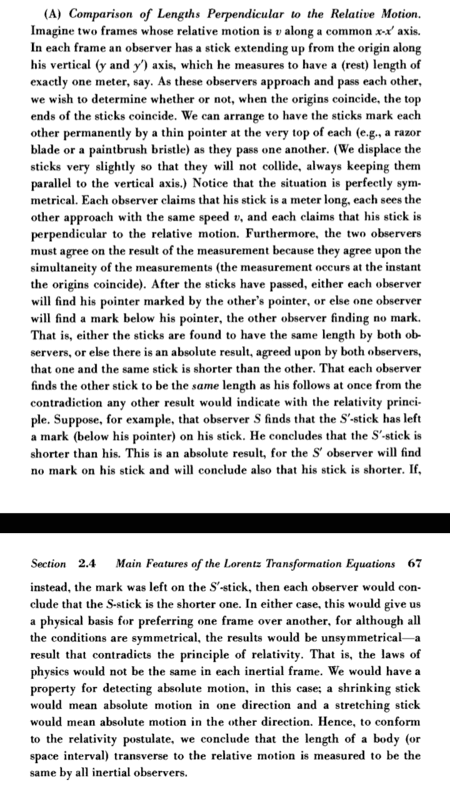
In Introduction to special relativity by Resnick,there is a thought experiment to compare lengths perpendicular to relative motion as given in the below image.
What if we try to perform such an experiment to compare lengths parallel to relative motion?
Suppose there are two horizontal rods moving relative to each other along x -x' axis. If both the rods have a marker at each end,then what will happen when they pass each other?
Screenshot_2019-11-11-22-21-53-665_com.google.android.apps.docs.png
 
Physics news on Phys.org
A measurement of length requires simultaneous measurements of the position of both ends. When the rods are vertical, all four ends of the rods are at the same ##x## coordinate at the same time in both frames.

If the rods are horizontal, then the two ends are spatially separated along the direction of motion. And this makes all the difference. In this case, both rods will be contracted when measured in the other frame.
 
RohanJ said:
Suppose there are two horizontal rods moving relative to each other along x -x' axis. If both the rods have a marker at each end
If you google for "pole-barn paradox" you will find many good explanations of what's going on here.

So we have lab assistants, one stationed at each end of the two rods (that's four total) and holding loaded paintbrushes. They have been all been instructed to swipe out with their brushes to mark whatever is passing at the moment that the two origins coincide.
then what will happen when they pass each other?
Both rods will have one mark, at the origin, made by the lab assistant stationed at the origin end of the other rod. The two lab assistants at the non-origin ends of the two rods will find that at the moment that the origins coincide they are facing just empty space so they don't make any mark. This result is consistent with the moving rod being length-contracted no matter which rod we choose to consider to be at rest.

There is no contradiction because of the relativity of simultaneity. The events "origins coincide" and "lab assistant at end of rod A swipes their brush" happen at the same time in the frame in which rod A is at rest, but not the frame in which rod B is at rest, and vice versa. If you are not already comfortable with relativity of simultaneity, you'll want to learn about it (google for "Einstein train simultaneity") because it is essential to understanding how special relativity is consistent.
 
Last edited:

Similar threads

  • · Replies 15 ·
Replies
15
Views
2K
  • · Replies 21 ·
Replies
21
Views
2K
  • · Replies 84 ·
3
Replies
84
Views
7K
  • · Replies 37 ·
2
Replies
37
Views
3K
  • · Replies 8 ·
Replies
8
Views
1K
  • · Replies 50 ·
2
Replies
50
Views
5K
  • · Replies 20 ·
Replies
20
Views
2K
  • · Replies 26 ·
Replies
26
Views
3K
  • · Replies 4 ·
Replies
4
Views
1K
  • · Replies 4 ·
Replies
4
Views
1K