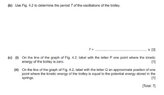
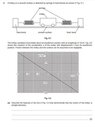
A Trolley oscillates horizonally between two springs....
- Thread starter Mr Smailes
- Start date
-
- Tags
- Springs
Click For Summary
Homework Help Overview
The discussion revolves around a trolley oscillating between two springs, focusing on the relationship between kinetic energy (K.E) and potential energy (P.E) at various positions. Participants explore how these energies compare, particularly at the equilibrium position and maximum amplitude.
Discussion Character
- Exploratory, Conceptual clarification, Assumption checking
Approaches and Questions Raised
- Participants question how to determine the position where K.E equals P.E and how P.E varies with displacement. They discuss the implications of having two springs and the potential energy dynamics at the equilibrium position.
Discussion Status
The conversation is ongoing, with participants providing insights and questioning assumptions about energy relationships. Some guidance has been offered regarding the nature of potential energy in relation to kinetic energy, but no consensus has been reached on specific positions or values.
Contextual Notes
There is a focus on understanding the energy dynamics in a system with two springs, including assumptions about their states at equilibrium and the implications for potential and kinetic energy. Participants express confusion about how to relate these energies and their maxima.
- 42,886
- 10,521
How does the PE vary with displacement?
- 16,219
- 4,934
Hello mr @Mr Smailes ,Mr Smailes said:Homework Statement:: Help needed with part 4c.ii of the attached paper.
Relevant Equations:: K.E. = 1/2mv^2 P.E = 1/2kx^2
How do I know the position where the K.E is equal to the P.E?
 ##\qquad##!
Our guidelines require a bit more effort from you in tackling this exercise...
[edit]Ah, I see @haruspex already asked the relevant question

- 16
- 0
I'm confused due to there being two springs so would the PE for one not be maximum when it is minimum for the other?haruspex said:When they are equal, how does the PE compare with the maximum PE?
How does the PE vary with displacement?
- 14,822
- 4,809
I think you are supposed to assume that, when the trolley is in the middle at the equilibrium position, then the springs are neither stretched nor compressed. So, at that position, neither spring has any potential energy.Mr Smailes said:I'm confused due to there being two springs so would the PE for one not be maximum when it is minimum for the other?
As you stretch a spring, the potential energy of the spring increases. What happens to the potential energy of the spring as you compress it?
- 42,886
- 10,521
Probably, but you could also consider that the PE of the spring system means only the available energy. At the equilibrium position, none is available.TSny said:I think you are supposed to assume that, when the trolley is in the middle at the equilibrium position, then the springs are neither stretched nor compressed.
- 13,433
- 8,105
Indeed, that is likely so. But in spite of this, is the sum of the two potentials constant?Mr Smailes said:I'm confused due to there being two springs so would the PE for one not be maximum when it is minimum for the other?
Also, remember that only differences in potential energy are physically meaningful. If you find yourself trying to equate potential energy with kinetic energy, you are likely doing something wrong. If you find yourself trying to relate the change in potential energy with the change in kinetic energy then you are more likely to be correct.
- 14,822
- 4,809
Yes. Maybe I am not correctly interpreting @Mr Smailes remark:haruspex said:Probably, but you could also consider that the PE of the spring system means only the available energy. At the equilibrium position, none is available.
He seems to be thinking that as one spring increases its PE, the other spring decreases its PE. Now that would actually be possible if, say, both springs are highly compressed when the trolley is at the equilibrium position. But, if we assume the springs have their natural length at the equilibrium position, then both springs increase their PE as the trolley moves away from equilibrium. This is what I hoped he would realize.Mr Smailes said:I'm confused due to there being two springs so would the PE for one not be maximum when it is minimum for the other?
- 42,886
- 10,521
Yes, there are two issues here:TSny said:Yes. Maybe I am not correctly interpreting @Mr Smailes remark:
He seems to be thinking that as one spring increases its PE, the other spring decreases its PE. Now that would actually be possible if, say, both springs are highly compressed when the trolley is at the equilibrium position. But, if we assume the springs have their natural length at the equilibrium position, then both springs increase their PE as the trolley moves away from equilibrium. This is what I hoped he would realize.
- the possible misconception that, even if they are relaxed at equilibrium, adding PE to one reduces it for the other
- if they are not relaxed at equilibrium and we interpret their overall PE as the sum of their individual PEs then a) that might always exceed the KE; and b) there would be phases in which one loses PE as the other gains it.
- 14,822
- 4,809
Yes.haruspex said:Yes, there are two issues here:
- the possible misconception that, even if they are relaxed at equilibrium, adding PE to one reduces it for the other
- if they are not relaxed at equilibrium and we interpret their overall PE as the sum of their individual PEs then a) that might always exceed the KE; and b) there would be phases in which one loses PE as the other gains it.
- 16
- 0
- 13,433
- 8,105
If you change the reference zero point for your measurement of potential energy, potential energy changes. But nothing physical is any different. If you are trying to compare potential energy with kinetic energy, you are doing something wrong.
- 42,886
- 10,521
As I wrote in post #6, I think it is reasonable to consider the PE here as only that which is available (for conversion to KE).jbriggs444 said:By itself, potential energy is meaningless. Only differences are meaningful.
If you change the reference zero point for your measurement of potential energy, potential energy changes. But nothing physical is any different. If you are trying to compare potential energy with kinetic energy, you are doing something wrong.
- 42,886
- 10,521
Have you tried answering my questions in post #2?Mr Smailes said:So they will be equal at some point between the equilibrium position and the max amplitude but how do I know where?
- 16
- 0
haruspex said:Have you tried answering my questions in post #2?
- 42,886
- 10,521
No, I askedMr Smailes said:The PE increases with displacement but I am still unsure of your first question in how does PE compare with max PE?
I.e. when PE and KE are equal.haruspex said:When they are equal, how does the PE compare with the maximum PE?
Perhaps I should start with a more basic question: what is the relationship between max PE and max KE (assuming we are defining PE as that which is available for conversion to KE)?
- 16
- 0
Max P.E is equal to minimum K.E and vice versaharuspex said:No, I asked
I.e. when PE and KE are equal.
Perhaps I should start with a more basic question: what is the relationship between max PE and max KE (assuming we are defining PE as that which is available for conversion to KE)?
- 42,886
- 10,521
Max PE > min PE = max KE > min KE = max PE? That makes no sense.Mr Smailes said:Max P.E is equal to minimum K.E and vice versa
- 16
- 0
Maximum potential energy is at either end where K.E is zero. In the middle would the K.E not be maximum and the potential energy be 0?haruspex said:Max PE > min PE = max KE > min KE = max PE? That makes no sense.
- 42,886
- 10,521
Right. But what is the relationship between max PE and max KE?Mr Smailes said:Maximum potential energy is at either end where K.E is zero. In the middle would the K.E not be maximum and the potential energy be 0?
- 16
- 0
The maximum kinetic energy must be equal to the maximum potential energy presuming all of the potential energy is converted to kineticharuspex said:Right. But what is the relationship between max PE and max KE?
- 42,886
- 10,521
Ok, so when the PE and KE are equal, how do they compare to their maxima?Mr Smailes said:The maximum kinetic energy must be equal to the maximum potential energy presuming all of the potential energy is converted to kinetic
- 16
- 0
They will be lower then the maxima when they are equal, it will be at some point between the max amplitude and the equilibrium positionharuspex said:Ok, so when the PE and KE are equal, how do they compare to their maxima?
- 42,886
- 10,521
Don't worry about amplitude for now, concentrate on energy.Mr Smailes said:They will be lower then the maxima when they are equal, it will be at some point between the max amplitude and the equilibrium position
Suppose the block is moving away from the equilibrium position. As it moves some particular distance, say it gains an amount ##\Delta E## of PE. How much KE does it lose in the process?
- 16
- 0
The same amount?haruspex said:Don't worry about amplitude for now, concentrate on energy.
Suppose the block is moving away from the equilibrium position. As it moves some particular distance, say it gains an amount ##\Delta E## of PE. How much KE does it lose in the process?
- 42,886
- 10,521
Right. It is an example of conservation of work.Mr Smailes said:The same amount?
So I ask again, if ##max KE=max PE=E##, then what are the KE and PE equal to when they equal each other?
- 16
- 0
- 42,886
- 10,521
At the moment, we're just discussing energy. Please try to answer my question in post #26.Mr Smailes said:So at the halfway point?
- 16
- 0
- 42,886
- 10,521
Right, so each will be E/2.Mr Smailes said:KE and PE will add together to equal the total energy
The next step is to answer my second question in post #2. If the displacement is x and the effective spring constant is k, what is the PE?
Similar threads
- Replies
- 3
- Views
- 2K
- Replies
- 5
- Views
- 2K
- Replies
- 15
- Views
- 2K
- Replies
- 2
- Views
- 5K
- Replies
- 1
- Views
- 947
- · Replies 12 ·
- Replies
- 12
- Views
- 3K
- Replies
- 8
- Views
- 2K
- Replies
- 20
- Views
- 3K
- · Replies 5 ·
- Replies
- 5
- Views
- 1K
- · Replies 1 ·
- Replies
- 1
- Views
- 2K