No reason to feel confused ! Understanding will break through soon enough

.
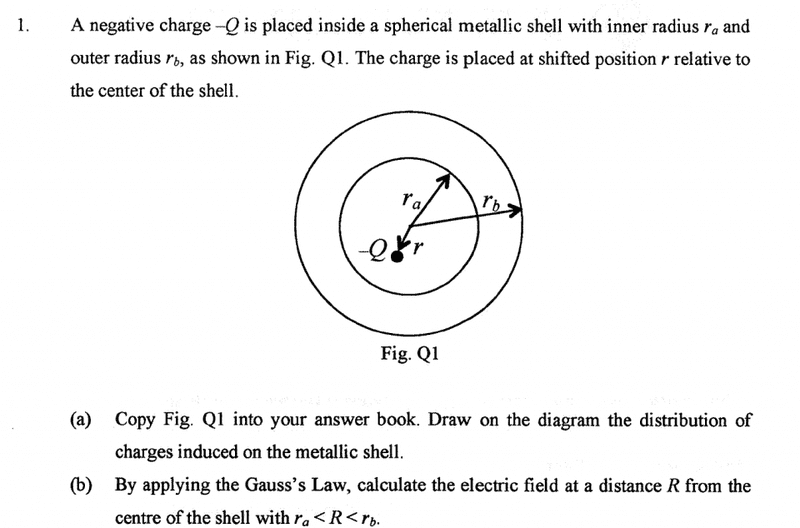
The -Q charge at r 'pulls' positive charge towards the inner surface of the metallic conducting shell. That positive charge will be distributed in such a way that the electric field lines inside the shell all are perpendicular to the surface. Why ? Well, if the field lines were not, the component of the electric field along the surface would cause motion of the charges until that component no longer is present.
The shell was uncharged and remains uncharged. The negative charges are repelled from the inner surface and don't hang about in the metal: they sit on the outer surface because there they have the most room (they repel each other!).
Inside a (ideal) conductor you have no electric field (reason as above: charge can move freely until there is no driving force qE left over).
And you can check this: any sphere with radius ##r_a<R<r_b## has zero charge inside, so no field !
So parts a and b of this exercise are more or less a giveaway !