About groups and continuous curves

Join the discussion
Ask a follow-up here, or get your own question answered by working scientists, mathematicians and engineers — people, not an autocomplete.
Real named experts · corrections over time · the nuance an AI answer skips
2 replies · 2K views
LCSphysicist
Messages
644
Reaction score
163
TL;DR
Lorentz transformations
Homomorphism
Determinant
Continuous curve
Define $$\phi(A)$$ a transformation which, acting on a vector x, returns $$AxA^{*}$$, in such way that if A belongs to the group $$SL(2,C)$$, $$||\phi(A)x||^2 = ||x||^2$$, so it conserves the metric and so is a Lorentz transformation. $$\phi(AB)x = (AB)x(AB)^{*} = ABxB^{*}A^{*} = A(BxB^{*})A^{*} = \phi(A)\phi(B)x$$ so we have homomorphism too. Now:
1603188206340.png

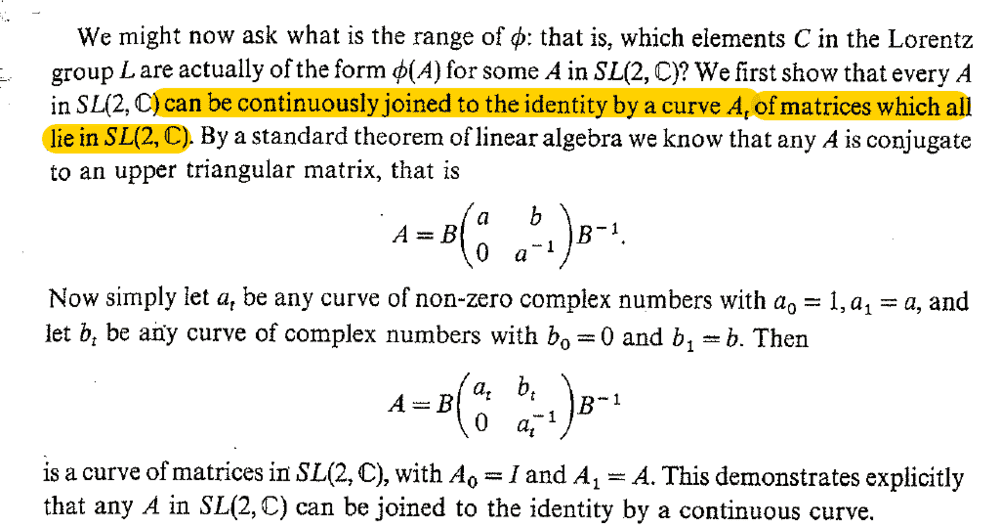
What does it means by "be continuously joined to the identity by a curve A of matrices"? It is a geometric interpretation of what? What is the meaning of curve here? I don't get this proof
 
Physics news on Phys.org
There is a natural topology on [itex]SL(2, \mathbb{C})[/itex]: regard a 2x2 matrix with complex entries as a vector in [itex]\mathbb{C}^{4}[/itex] and use the toplogy induced by the standard inner product (which is equivalent to the topology induced by any norm on [itex]\mathbb{C}^4[/itex]). A continuous curve from [itex]A[/itex] to [itex]B[/itex] in [itex]SL(2,\mathbb{C})[/itex] is then a function [itex]f: [0,1] \to SL(2,\mathbb{C})[/itex] with [itex]f(0) = A[/itex] and [itex]f(1) = B[/itex] which is continuous with respect to this topology.
 
  • Like
Likes   Reactions: LCSphysicist
LCSphysicist said:
What is the meaning of curve here?
You could think of a curve in the space of 2x2 matrices with complex entries as function that maps a real valued parameter ##t## to a matrix of the form:
## C(t) = \begin{pmatrix} c_{1,1}(t)&c_{2,2}(t) \\ c_{2,1}(t)&c_{2,2}(t) \end{pmatrix}##

where each ##c_{i,j}## is a continuous function (using the definition of "continuous function" that is appropriate for complex valued functions).

A curve in the space ##SL(2,\mathbb{C})## must also satisfy the condition that ## C(t) \in SL(2,\mathbb{C}) ## for each value of the parameter ##t##.

What does it means by "be continuously joined to the identity by a curve A of matrices"?

It means for each matrix ##M \in SL(2,\mathbb{C})## we can find a curve ##C(t)## in ##SL(2,\mathbb{C})## such that ##C(0) = I## and ##C(1) = M##

I don't get this proof

I don't like the notation it uses. A clearer way to denote things is that we can express ##M## as ##B \begin{pmatrix} c&d\\0&1/c\end{pmatrix} B^{-1}##.

We assert we can find continuous complex valued functions ##a(t), b(t)## such that
##a(0) = 1, a(t) =c,\ b(0) = 0, b(1) = d##
and such that for ## 0 \le t \le 1## the matrix
##C(t) = B \begin{pmatrix} a(t) & b(t) \\ 0 & 1/a(t) \end{pmatrix} B^{=1} ##
is in ##SL(2,\mathbb{C})##. (For example, we can let ##a(t)## ever be zero.)

This constructs a curve ##C(t)## in ##SL(2,\mathbb{C})## such that ##C(0) = B^{-1}IB = I## and ##C(1) = M##.
It is a geometric interpretation of what?
I don't have a good grasp of geometry in the space of complex valued 4-tuples! To me, geometry in higher dimensional spaces is only understandable in terms of algebra - as a generalization of the algebraic forms of things used to describe geometry in lower dimensional spaces.